

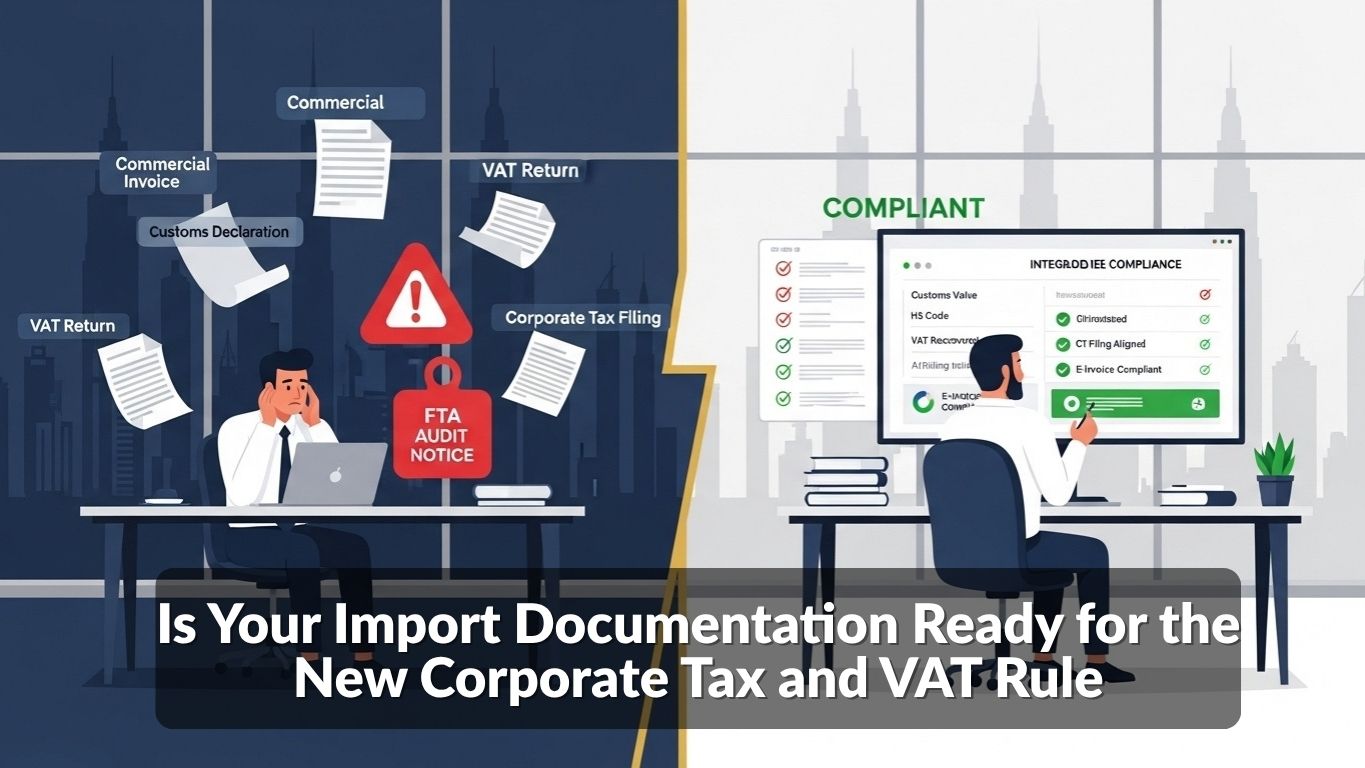
If you are an importer in the UAE and you still think of customs clearance as a box-ticking exercise that ends when your cargo is released from Jebel Ali, 2026 is the year to fundamentally revise that view.
The UAE’s tax compliance landscape has undergone the most significant structural transformation in its history over the past twelve months. Three landmark pieces of legislation took effect on January 1, 2026. A fourth changed the penalty framework in ways that every importer needs to understand, effective April 14, 2026. A fifth, the e-invoicing mandate, begins its pilot phase in July 2026 and will fundamentally change how every VAT-registered business documents its transactions. And throughout all of this, the Federal Tax Authority conducted 93,000 inspection visits in 2024 alone, a 135% increase from the prior year, powered by digital tools and risk-based selection algorithms that were specifically designed to find the intersection between customs declarations, VAT returns, and corporate tax filings.
The message embedded in that statistic is simple: the FTA is no longer waiting for importers to self-report discrepancies. It is finding them, using data. And the data it is working from includes your customs declarations, your VAT returns, and now your corporate tax filings, as three components of a single, cross-referenced compliance picture.
This guide breaks down every significant 2026 regulatory change that affects Dubai importers and exporters, explains exactly how customs documentation now connects to your corporate tax position, identifies the specific documentation gaps that trigger FTA audits, and tells you what you need to do before the April 14, 2026 penalty framework change and the July 2026 e-invoicing pilot create compliance events that cannot be unwound after the fact.
1. The Three Laws That Changed Everything on January 1, 2026
Understanding the 2026 compliance environment begins with understanding which specific legislative changes took effect at the start of the year and what each one means for importers in practical terms.
Federal Decree-Law No. 16 of 2025: The VAT Amendments
This law amends the UAE’s original Federal Decree-Law No. 8 of 2017 on Value Added Tax and introduces three changes with direct operational significance for importers:
Change 1: Reverse Charge Mechanism documentation requirement eliminated. Before January 1, 2026, businesses importing goods or services into the UAE were required to issue themselves a self-invoice documenting the VAT due under the Reverse Charge Mechanism (RCM). From January 1, 2026, this self-invoicing requirement is eliminated. Taxpayers are no longer required to issue a tax invoice to themselves for imports under the RCM. Instead, the original supporting document, which is the customs declaration or the supplier’s invoice, must be retained as the documentary basis for the VAT entry. This simplification sounds administrative, but it has an important practical implication: if your customs declaration or supplier invoice is incomplete, incorrectly valued, or missing from your records, you have no RCM documentation at all under the new rules. The customs declaration is now the primary document, not a supporting document. Its accuracy and availability are more critical than ever before.
Change 2: Anti-evasion supplier due diligence requirement. Under the updated VAT rules, input VAT recovery may now be denied if a supplier is involved in tax evasion and the purchaser failed to exercise reasonable due diligence. This marks a clear shift in VAT compliance philosophy: accuracy alone is no longer sufficient. Businesses must now demonstrate that they took appropriate steps to assess counterparties, contractual arrangements, and payment flows. For importers who purchase goods from international suppliers and claim input VAT on those purchases, this requirement introduces a supplier verification obligation that did not previously exist under UAE law. If the FTA determines that your supplier was part of a fraudulent supply chain and you cannot demonstrate that you verified their legitimacy, your input VAT claim can be denied regardless of whether you personally were involved in any wrongdoing.
Change 3: Five-year VAT credit recovery deadline with December 31, 2026 transitional date. Under the new rules, businesses can now claim excess input VAT refunds only within five years from the end of the relevant tax period. Unclaimed balances beyond that period will expire and become non-refundable. Crucially, for credits from before 2021, there is a transitional grace period ending December 31, 2026. After that date, any pre-2021 input VAT credit that has not been claimed is permanently forfeited. For importers who have accumulated VAT credit balances from previous periods, including import VAT paid on goods where the input tax was never formally claimed, December 31, 2026 is a hard deadline that requires a deliberate audit of your VAT position before it passes.
Federal Decree-Law No. 17 of 2025: Corporate Tax Amendments
This law amends the UAE Corporate Tax Law (Federal Decree-Law No. 28 of 2022) and takes effect from January 1, 2026. The headline rates remain unchanged (0% on taxable profits up to AED 375,000, 9% above that threshold), but the mechanics of how corporate tax is calculated, applied, and audited have been materially updated. The 2026 amendments focus on mechanics, predictability, and alignment with international best practices.
The most operationally significant change for importers is the introduction of clear sequencing for tax credits and incentives. Businesses must now apply withholding tax credits, foreign tax credits, and approved incentives in a defined order before settling any remaining corporate tax liability. For businesses that import from countries with which the UAE has double-tax treaties (India, China, France, Germany, the UK, and many others), this sequencing change affects how treaty-related tax credits are applied against the UAE corporate tax bill.
The corporate tax change most relevant to customs compliance is the strengthened alignment between the FTA’s VAT audit framework and its emerging corporate tax audit framework. Because VAT and corporate tax share the same Tax Procedures Law, the FTA’s established practice of cross-referencing VAT returns, customs declarations, and business records now extends to corporate tax filings as a third data layer. A customs declaration that declares goods at one value, a VAT return that reports a different purchase figure for the same goods, and a corporate tax filing that shows yet another cost-of-goods number for the same transaction is precisely the pattern that the FTA’s risk-based audit selection system is calibrated to find.
Federal Decree-Law No. 17 of 2025: Tax Procedures Law Amendment
This amendment to the UAE Tax Procedures Law is the one that most significantly changes the enforcement risk landscape for importers. Under the amended framework, tax audit and assessment periods may now extend up to 15 years in cases involving tax evasion, failure to register, or serious non-compliance. The standard five-year assessment window is preserved for ordinary compliance matters, but the 15-year extension for cases involving evasion or serious non-compliance means that the FTA can effectively audit any transaction from 2011 onwards if it has grounds to suspect misconduct.
The practical significance for importers is direct: import documentation that was filed inaccurately, whether intentionally or through administrative error, in any year from 2011 onwards, could be the subject of an FTA assessment in 2026 and beyond, if the FTA’s cross-referencing systems surface a discrepancy. This is not hypothetical. It is the stated rationale for the extension.
2. The New Penalty Framework: What Changes on April 14, 2026
Cabinet Decision No. 129 of 2025 introduces a new administrative penalty framework for violations of UAE tax laws, effective April 14, 2026. This framework represents a genuine restructuring of the penalty system, not merely an update to existing fine levels, and it has direct implications for importers who discover compliance gaps in their documentation.
What Changes and Why It Matters
The new framework replaces the previous compounding penalty system with a non-compounding structure. The key word is “non-compounding”: under the old system, penalties accrued on top of each other in a way that could generate disproportionate total liabilities for businesses that were slow to resolve compliance issues. The new system caps the accumulation mechanism, making penalties more predictable and proportionate.
However, the headline change that every importer must understand is the incentive to use voluntary disclosure before April 14, 2026. The new framework introduces a defined voluntary disclosure (VD) mechanism that provides materially reduced penalties for businesses that proactively disclose and correct tax errors before an audit is initiated. After April 14, 2026, the VD penalty calculation changes in ways that may make voluntary disclosure more expensive for some categories of error. For importers who are aware of documentation inconsistencies between their customs declarations and their VAT or corporate tax filings, the window before April 14, 2026 is the optimal moment to engage the voluntary disclosure process.
The penalty calculation example provided in the legislation is instructive. For AED 100,000 of unpaid corporate tax, a voluntary disclosure submitted six months after the original due date generates an Understatement Penalty of AED 6,000 (1% multiplied by six months). The same underpayment discovered in an FTA-initiated audit carries a substantially higher penalty. The difference between self-disclosure and audit discovery is a multiplier on the same underlying liability.
It is the effective date of the new penalty framework. For any importer who has identified a potential discrepancy between their customs declarations, VAT filings, or corporate tax submissions, the period between now and April 14, 2026 is the most cost-effective window in UAE tax history to address those discrepancies voluntarily. After that date, the calculation changes. Every day of delay after April 14 that ends in an FTA audit discovery rather than a voluntary disclosure is a day on which the financial consequence of the same underlying error increases.
3. How Customs Documentation Now Connects to Your Corporate Tax Filing
This is the dimension of the 2026 compliance environment that most importers have not yet fully internalised: customs clearance is no longer merely a port procedure. It is the first link in a documentation chain that runs through your VAT return and terminates in your corporate tax filing, and the FTA now has the tools and the legal mandate to verify that the values, descriptions, and parties declared at each link in that chain are consistent with each other.
Here is how the connection works in practice:
The Value Chain from Customs Declaration to Tax Filing
When your goods arrive at Jebel Ali and your customs agent submits the import declaration through Mirsal 2, several data points are recorded in the UAE customs system:
- The declared CIF value of the goods
- The 12-digit HS code assigned to the goods
- The country of origin
- The importer of record
- The customs duty assessed and paid
- The import VAT assessed on the CIF value plus duty
Those data points do not disappear when your cargo is released from port. They are held in the FTA’s integrated tax system, which also holds your VAT returns and, from the 2023/24 fiscal year onwards, your corporate tax returns. The FTA’s audit selection algorithms compare three things simultaneously:
First, the total value of goods imported as declared in your customs declarations. Second, the total cost of goods purchased as reported in your VAT input tax claims. Third, the cost of goods sold or cost of inventories as reported in your corporate tax filing’s profit and loss account.
If those three numbers are broadly consistent, your risk score is low. If there is a material discrepancy between any two of the three, your risk score increases. If there is a pattern of discrepancies across multiple tax periods, your profile is escalated for audit. This is not speculation. It is the documented logic of the FTA’s risk-based audit selection framework, confirmed by the Alvarez and Marsal analysis of the FTA’s February 2025 update.
The Specific Discrepancy Patterns That Trigger Audits
Based on established FTA audit patterns and the extension of that framework to corporate tax, the following documentation inconsistencies carry the highest audit trigger risk for importers in 2026:
- Customs declared value significantly below the equivalent purchase price in the VAT return: This pattern suggests either customs undervaluation (to reduce duty and import VAT payable) or inflated purchase price in VAT filings (to increase input tax claims). Either way, it flags a potential compliance issue.
- Import volume in customs declarations inconsistent with cost of goods in corporate tax filing: An importer who declares AED 5 million of goods through customs but shows AED 8 million in cost of goods sold in their corporate tax return, without a clear explanation (beginning inventory, local purchases, inventory write-downs), presents a pattern that the FTA’s systems are specifically calibrated to surface.
- VAT claimed on import but import not appearing in customs records: This was a common pattern under the old system where the RCM self-invoice requirement allowed VAT to be claimed without a corresponding customs event. The elimination of self-invoicing under the new rules means the customs declaration is now the mandatory evidential basis for RCM VAT claims. Any VAT claimed on imports without a matching customs declaration record is now directly visible to the FTA’s cross-referencing system.
- Inconsistent supplier details across customs declarations, VAT returns, and corporate tax filings: A supplier identified one way on the commercial invoice, a slightly different way on the customs declaration, and yet another way in the VAT return for the same transaction creates the type of data inconsistency that the FTA’s automated matching systems flag for review.
- Unexplained fluctuations in gross profit margin relative to sector peers: The FTA benchmarks corporate tax filers’ gross margin ratios against sector averages. An importer whose gross margin drops sharply in the year their import costs increase significantly, without a corresponding change in declared customs values, presents an anomaly that may indicate undisclosed additional costs, related-party pricing issues, or inconsistent valuation across tax filings.
4. The FTA Audit Powers You Need to Understand in 2026
The amended Tax Procedures Law does not merely extend the audit window to 15 years. It also expands and clarifies the FTA’s operational audit powers in ways that change the risk profile for importers with documentation gaps. Here is what the law now authorises:
On-Site and Remote Audits
The FTA may conduct audits at its own headquarters, at your business premises, or at any location where your records or inventory are stored. Crucially, audits may be conducted both on-site and remotely, meaning the FTA can initiate a comprehensive review of your import documentation, VAT records, and corporate tax filings without physically visiting your premises. In the age of Mirsal 2, the Dubai Trade Portal, and the FTA’s EMARATAX platform, the FTA’s access to your transaction data is as comprehensive remotely as on-site.
No-Notice Audits for Suspected Evasion
The law now explicitly permits no-notice audits for up to 72 hours with prior written consent from the FTA’s Director-General in cases of suspected tax evasion. For an importer where automated risk-scoring has flagged a pattern consistent with systematic undervaluation or documentation inconsistency, a no-notice audit is now a legally established enforcement tool.
Examination and Seizure of Records
The FTA may examine or seize accounting books, invoices, and other documents during an audit. This includes your customs declarations, your commercial invoices from suppliers, your Bills of Lading, your VAT records, and your corporate tax workings. For importers whose physical and digital record-keeping is inconsistent, or who cannot produce the original supporting documentation for import transactions from prior years, this power is particularly significant given the 15-year window for evasion-related assessments.
The 93,000 Visits Statistic in Context
The FTA conducted 93,000 inspection visits in 2024, a 135% increase from the prior year. This number is not primarily explained by a 135% growth in the number of registered businesses. It is explained by a 135% increase in the FTA’s enforcement capacity, driven by digital tools that identify audit targets algorithmically. The same digital tools that drove 93,000 visits in 2024 now have three years of corporate tax filing data to work with in addition to seven years of VAT data. The audit selection pool available to those tools is larger, the data quality is higher, and the cross-referencing capability between customs, VAT, and corporate tax is now fully operational.
5. The E-Invoicing Mandate: What July 2026 Means for Importers
The UAE e-invoicing mandate is the final piece of the 2026 compliance architecture, and it is the development that will most permanently change the relationship between import documentation and tax compliance for every VAT-registered business in the UAE.
The pilot phase begins July 1, 2026, with a phased mandatory rollout from 2027 onwards. The UAE is adopting the Peppol PINT standard, a decentralised model that differs from Saudi Arabia’s centralised FATOORA system but achieves the same fundamental outcome: every B2B and B2G transaction is documented electronically in a structured, machine-readable format that is transmitted to or verifiable by the FTA in near real-time.
What This Means for Importers Specifically
For businesses importing goods into the UAE and then selling them to UAE business customers, the e-invoicing mandate creates a complete, automated, digital audit trail from the customs declaration at Jebel Ali to the VAT invoice issued to the end customer. The FTA will, in the mandatory phase, be able to trace the entire value chain of imported goods without requiring a manual audit. Discrepancies between import cost and sale price that do not align with normal commercial margins will be visible algorithmically before any human auditor is ever involved.
For importers supplying goods to government entities or large corporates who will be among the earliest mandatory e-invoicing adopters, the practical requirement to issue compliant e-invoices may arrive before the general mandatory rollout for smaller suppliers. Businesses that supply to both government and private sector customers should assess their e-invoicing readiness based on their customer base, not just the general rollout timeline.
The System Readiness Question
A non-compliant e-invoice may not be accepted for VAT credit claims. If your invoice is rejected by the e-invoicing system or not properly transmitted, your customer cannot recover input VAT, a situation that could strain business relationships and cash flow. For importers who act as the wholesale supplier in a distribution chain, the failure of your e-invoicing compliance affects not just your own VAT position but that of every business downstream that buys from you. This creates commercial pressure to achieve compliance well before the mandatory deadline rather than waiting for enforcement.
July 1, 2026: Pilot phase begins. Larger businesses and early-adopter sectors begin voluntary or mandated participation.
2027 onwards: Phased mandatory rollout by business size and sector, following the Saudi Arabia ZATCA model.
Full mandatory coverage: All VAT-registered businesses, including SMEs, service providers, and trading companies.
Businesses that delay preparation risk invoice rejections, payment delays, disputes with customers, and penalties for non-compliance once enforcement begins. (Source: Alaan / UAE MoF FTA Guidelines, August 2025)
6. The Documentation Standards That Customs Declarations Must Now Meet
Given the expanded cross-referencing between customs declarations, VAT returns, and corporate tax filings, the quality standards required for import documentation in 2026 are materially higher than they were in 2023 or 2024. Here is the practical documentation standard that every import transaction should meet:
Commercial Invoice Requirements
The commercial invoice is now the foundational document for three separate tax events: the customs duty calculation, the import VAT determination, and the cost-of-goods entry in the corporate tax profit and loss account. All three must be consistent. A commercial invoice that shows a value materially different from the transfer pricing policy applied in your corporate tax filing (for related-party transactions), or a value that is suspiciously low relative to market benchmarks (for independent transactions), will generate the cross-filing inconsistency pattern that triggers FTA scrutiny.
Specific invoice requirements include the full legal names and addresses of both seller and buyer matching their registered entity details in the FTA system, a complete and specific description of the goods that enables HS code assignment and product categorisation for both customs and tax purposes, the declared value at the agreed Incoterms price (CIF for customs purposes), the transaction currency and the AED equivalent at the rate prevailing on the invoice date, and explicit reference to the purchase order or contract that the invoice relates to.
HS Code Accuracy Under the 12-Digit Requirement
The 2025 to 2026 transition to 12-digit HS codes under the GCC Integrated Customs Tariff is directly relevant to the tax compliance picture. An incorrectly classified HS code affects not only the customs duty rate applied but also the product categorisation used in risk-based VAT sector benchmarking. A product consistently classified under an HS code that does not accurately reflect its nature will create inconsistencies between the customs-declared product and the corporate tax filing’s revenue and cost categorisation, particularly for businesses where the product category affects the applicable VAT rate or the eligibility for specific corporate tax exemptions.
Transfer Pricing for Related-Party Imports
For multinational groups importing from related entities (parent companies, subsidiaries, or affiliates), the declared customs value and the transfer price used for corporate tax purposes must be consistent. The UAE’s transfer pricing framework, aligned with OECD guidelines, requires that related-party transactions be conducted at arm’s length prices. A customs declaration that declares goods at a price below the arm’s length transfer price to minimise customs duty, while a corporate tax filing records the higher arm’s length price as cost of goods, is precisely the type of related-party inconsistency that the FTA’s cross-referencing tools are built to identify.
Our customs clearance team works with clients’ tax advisors to ensure that declared customs values are consistent with transfer pricing policies before each shipment is filed, preventing the documentation gap from being created in the first place rather than having to explain it during an audit.
7. Free Zone Importers: The Specific 2026 Compliance Changes You Must Understand
Businesses operating from UAE free zones, including JAFZA, DAFZA, DMCC, DIFC, and Dubai South, face a specific set of 2026 compliance changes that differ from mainland importer requirements.
The Qualifying Free Zone Person Corporate Tax Status
Free zone businesses that qualify as Qualifying Free Zone Persons (QFZPs) under the UAE Corporate Tax Law benefit from a 0% corporate tax rate on qualifying income. The 2026 corporate tax amendments clarify the mechanics of applying this benefit and introduce more specific rules around what constitutes qualifying income versus non-qualifying income for a QFZP.
The critical compliance point for free zone importers is that the customs clearance treatment of goods determines whether income from the sale of those goods qualifies for the QFZP 0% rate. Goods that are imported into a free zone and re-exported without entering the UAE mainland market are more clearly within the QFZP qualifying income definition. Goods that are imported into a free zone and then transferred to the UAE mainland market (triggering a separate customs import event) must be correctly documented as generating UAE mainland-sourced income for corporate tax purposes, not free zone qualifying income.
Free zone companies that mix their revenue between free zone re-export income and UAE mainland sales without clearly delineating the two streams in their corporate tax filing, supported by consistent customs documentation showing which goods went where, are in a high-risk audit position under the 2026 framework.
The De Minimis Rule for QFZPs
Under the UAE Corporate Tax Law, a QFZP that generates non-qualifying income above a de minimis threshold loses its QFZP status for the entire tax period, not just on the non-qualifying portion. This means that a free zone business which generates even a small amount of mainland UAE revenue without proper documentation and corporate tax treatment could find its entire income subject to 9% corporate tax rather than 0%. The customs documentation trail for goods moved from a free zone to the mainland is therefore not merely a customs compliance matter. It is a corporate tax status determination document.
8. The Practical Compliance Gap Assessment: Four Questions Every UAE Importer Must Answer
Given the regulatory changes described above, here is a framework for assessing your current compliance exposure before the April 14, 2026 penalty framework change and the July 2026 e-invoicing pilot begin creating new compliance events:
Question 1: Are your customs declared values consistent with your VAT return input tax claims and your corporate tax cost-of-goods figures for the same transactions?
Run a reconciliation across your last three financial years. Take your total customs duty and import VAT paid in each year (available from your Mirsal 2 records) and compare the implied total goods value with the cost of goods declared in your VAT returns and corporate tax filings. Material unexplained differences between any two of these three data points are the first indicator of a documentation gap that warrants voluntary disclosure consideration.
Question 2: Do you have original supporting documentation for every import transaction that supports both your customs declaration and your VAT input tax claim?
Under the new RCM rules, the customs declaration or supplier invoice is the mandatory supporting document for import VAT claims. If you cannot produce the original import customs declaration for transactions from the last five years (or earlier if a 15-year window applies), your VAT input tax recovery position for those transactions is potentially at risk. Conduct a document retrieval exercise and identify any gaps before they become audit vulnerabilities.
Question 3: Have you claimed all input VAT credits from before 2021 that you are entitled to?
The December 31, 2026 transitional deadline for pre-2021 VAT credits is a use-it-or-lose-it event. Review your VAT records for any unclaimed credits from transactions before 2021, including import VAT that was paid but not formally recovered, and ensure those credits are claimed in your VAT return before year-end 2026.
Question 4: Is your e-invoicing infrastructure being planned now, or are you waiting until the mandatory rollout forces action?
Businesses that supply to government entities, large corporates, or multinational companies should assume that their customers will require e-invoice compliance before the general mandatory rollout. Starting the systems assessment and service provider evaluation now, rather than in late 2026, is the only way to avoid the last-minute integration scrambles, invoice rejections, and relationship strains that will characterise the transition for underprepared businesses.
9. How U.N. Cargo and Logistics Keeps Your Import Chain Compliant in 2026
The regulatory changes described in this guide create a compliance challenge that spans customs clearance, VAT management, and corporate tax documentation simultaneously. No single provider can manage all three without specialist knowledge in each area. But the logistics component, the accuracy and consistency of the customs declaration that is now the primary document for import VAT claims under the RCM, is the foundation that every other element of the compliance chain depends on.
At U.N. Cargo and Logistics, our customs clearance team applies the following standards to every import we manage that are directly aligned with the 2026 compliance requirements:
- 12-digit HS code verification: Every product line in every shipment is verified against the current GCC Integrated Customs Tariff before the declaration is filed. Incorrect HS codes that generate duty, VAT, or corporate tax category inconsistencies are identified and corrected before submission, not discovered in an audit.
- Customs value alignment with commercial documentation: Our team reviews the commercial invoice, purchase order, and transfer pricing guidance (where provided by the client’s tax advisor) to ensure that the declared customs value is consistent with the values that will appear in the client’s VAT return and corporate tax filing for the same transaction.
- Complete document archiving: Every customs declaration we file is archived with its full supporting document set, including the commercial invoice, packing list, Bill of Lading, Certificate of Origin, and any regulatory permits. This archive is maintained in a format that supports easy retrieval for FTA audit requests, whether those requests arrive one year or five years after the original transaction.
- Pre-shipment permit identification: Our team identifies regulatory permit requirements for controlled product categories before goods are shipped, eliminating the compliance event of goods arriving without required approvals and requiring ad hoc post-arrival arrangements that generate documentation gaps.
- Supplier verification support: Under the new anti-evasion due diligence requirement, businesses must demonstrate appropriate supplier verification. We provide guidance on the documentation that constitutes adequate supplier verification for import transactions, supporting our clients’ compliance position if their input VAT claims are ever challenged on anti-evasion grounds.
For clients who also import through sea freight or air freight, our integrated logistics and customs service ensures that the documentation chain from the Bill of Lading through the customs declaration to the delivery receipt is consistent and complete at every step, with no gaps between the freight component and the clearance component that create the type of documentation inconsistencies described throughout this guide.
Your 2026 UAE Customs Compliance Checklist
- ✅ Run a three-year customs-VAT-corporate tax reconciliation: Compare total import values from customs records against VAT input claims and corporate tax cost-of-goods figures for FY2022, FY2023, and FY2024. Identify any material unexplained differences
- ✅ Review pre-2021 VAT credit balances before December 31, 2026: Any unclaimed input VAT credits from transactions before 2021 expire permanently on December 31, 2026. This deadline is non-extendable
- ✅ Evaluate voluntary disclosure before April 14, 2026: For any identified documentation inconsistency or under-declared tax liability, the voluntary disclosure process before April 14 generates substantially lower penalties than post-audit assessment under the new Cabinet Decision No. 129 framework
- ✅ Verify 12-digit HS codes for all active import product lines: Check every product you regularly import against the current GCC Integrated Customs Tariff. Codes updated under the January 2026 revision that were not reflected in your declarations may have generated incorrect duty or VAT calculations
- ✅ Review your RCM documentation practice: Confirm that for every import VAT claim in your 2026 VAT returns, you hold the original customs declaration or supplier invoice as the supporting document, not a self-invoice that no longer has legal standing under the new rules
- ✅ Implement supplier due diligence documentation: For your top suppliers by value, document the verification steps you have taken to confirm their legitimacy, TRN registration, and absence from any known fraud registers. This documentation protects your input VAT recovery position under the new anti-evasion provisions
- ✅ Audit free zone vs. mainland goods flows: If you operate from a free zone and sell to both free zone clients and UAE mainland customers, ensure your customs documentation clearly identifies which goods moved to the mainland and that your corporate tax filing treats the resulting income correctly
- ✅ Begin e-invoicing system assessment now: Identify your ERP or accounting system’s current e-invoicing capability, evaluate Authorised Service Provider options, and plan system integration ahead of the July 2026 pilot phase
- ✅ Ensure document retention covers the full 15-year audit window: For any transaction period where the 15-year evasion-related assessment window could theoretically apply, retain all customs declarations, commercial invoices, and supporting documentation in an accessible archive
- ✅ Engage a customs clearance specialist who understands the VAT and CT interface: The quality of your customs declarations is now your first line of compliance defence for three separate tax obligations simultaneously
Compliance in 2026 Is Not About the Box. It Is About the Chain.
Dubai’s customs infrastructure is among the most digitally advanced in the world. The FTA’s audit capability is growing at 135% per year. The legislative changes that took effect on January 1, 2026, and those effective from April 14 and July, have closed the documentation gaps that allowed inconsistencies between customs declarations, VAT returns, and corporate tax filings to exist without automated detection.
The importers who navigate 2026 successfully are those who treat every customs declaration as a tax document, not just a port procedure. Who maintain document archives that can support a VAT or corporate tax query ten years after the original transaction. Who use voluntary disclosure proactively when gaps exist, before April 14 changes the calculation. And who work with a customs clearance partner who understands not just the port, but the entire compliance chain that the port feeds.
U.N. Cargo and Logistics manages customs clearance in Dubai with the precision that the 2026 regulatory environment demands. Our team stays current with every FTA and UAE Customs Authority update so that the declarations we file for our clients are not just port-compliant. They are tax-compliant.
Speak to Our Customs Compliance Team Today → |
Sea Freight with Integrated Clearance → |
Air Freight with Integrated Clearance →
References
- My Business Consulting DMCC: Corporate Tax and VAT Compliance in the UAE 2026, What Business Owners Need to Know (January 2026): https://mybusinessconsulting.ae/corporate-tax-vat-compliance-in-the-uae-2026-what-business-owners-need-to-know/
- Alvarez and Marsal Middle East Tax Alert: From VAT to Corporate Tax, How FTA Risk-Based Audits Will Shape Compliance in 2026 (December 2025): https://www.alvarezandmarsal.com/thought-leadership/middle-east-tax-alert-uae-from-vat-to-corporate-tax-how-fta-s-risk-based-audits-will-shape-compliance-in-2026
- DLA Piper Gulf Tax Insights: UAE Announces Amendments to VAT Law Effective 1 January 2026 (December 2025): https://www.dlapiper.com/en/insights/publications/gulf-tax-insights/2025/gulf-tax-insights-december-2025/uae-announces-amendments-to-vat-law-effective-1-january-2026
- ClearTax UAE: New VAT Rules in UAE 2026, Amendments, Reverse Charge and Deadlines (December 2025): https://www.cleartax.com/ae/new-vat-rules-uae-2026
- PwC Middle East: UAE Revised Administrative Penalty Framework for Violation of Tax Laws, Cabinet Decision No. 129 of 2025 (November 2025): https://www.pwc.com/m1/en/services/tax/middle-east-tax-news-alerts/2025/use-revised-administrative-penalty-framework-for-violation-of-tax-laws.html
- Middle East Briefing: How to Handle FTA and ZATCA Audits in the UAE and Saudi Arabia (October 2025): https://www.middleeastbriefing.com/news/how-to-handle-fta-and-zatca-audits-in-the-uae-and-saudi-arabia/
- Alaan: UAE E-Invoicing Regulatory Framework 2025 to 2026 Guide (October 2025): https://www.alaan.com/blog/uae-e-invoicing-compliance-preparation
- Radiant Biz: UAE E-Invoicing Mandate, Is Your Business Ready for the Digital Tax Era? (2025): https://www.radiantbiz.com/blog/uae-e-invoicing-compliance-guide
- AA Consultancy: UAE Import Tax 2026, Complete Guide to Customs Duty, VAT, Exemptions and Business Compliance (December 2025): https://www.aaconsultancy.ae/uae-import-tax/
- PwC Middle East: Saudi Arabia Approved Amendments to VAT Implementing Regulations (April 2025): https://www.pwc.com/m1/en/services/tax/middle-east-tax-news-alerts/2025/approved-amendments-to-the-vat-implementing-regulations.html
- Federal Tax Authority UAE: Tax Procedures Law and Executive Regulation: https://tax.gov.ae/en/legislation/tax.procedures.law.aspx
- Federal Tax Authority UAE: Corporate Tax Overview: https://tax.gov.ae/en/taxes/corporate.tax.aspx