

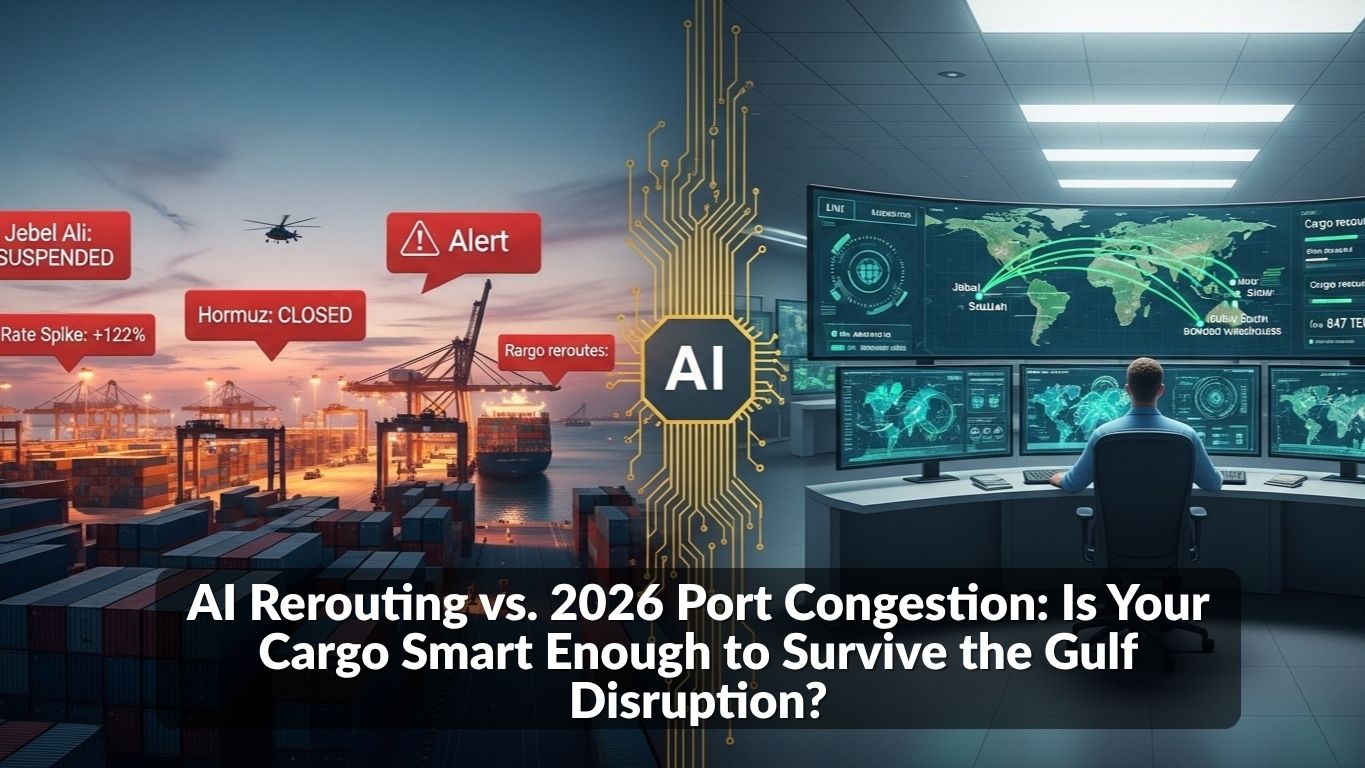
On March 1, 2026, a projectile struck a container ship approximately 35 nautical miles north of Jebel Ali. A fire broke out on board. DP World, operator of the world’s ninth busiest container port and the backbone of Dubai’s trade economy, suspended operations as a precautionary measure. Within hours, MSC, the world’s largest container shipping line, halted all cargo bookings for the Middle East. Maersk and Hapag-Lloyd suspended all vessel crossings through the Strait of Hormuz. CMA CGM instructed every vessel in or outbound for the Gulf to shelter and suspended Suez Canal passage simultaneously. Freightos reported the Shanghai to Jebel Ali spot rate spiking from approximately USD 1,800 per FEU to over USD 4,000 within days. (Source: Bloomberg / Scan Global Logistics / GetTransport / Freightos, March 2026)
This is not a hypothetical scenario from a supply chain risk textbook. It happened three weeks ago. And the businesses that absorbed the least damage were not the ones with the best freight rates or the most established carrier relationships. They were the ones with the most intelligent, most flexible, and most proactively managed logistics operations.
The era of static shipping is over. Static shipping means booking a container to Jebel Ali, assuming the vessel will arrive on schedule, and discovering the problem when your operations team calls to ask where the cargo is. In 2026, with Jebel Ali facing its most severe supply chain crisis since COVID-19 and the Strait of Hormuz closed for the first time to commercial container traffic, static shipping does not merely create delays. It creates weeks of cargo paralysis, demurrage accumulation, rate spikes absorbed at the worst moment, and customer relationship damage that cannot be recovered with an apology email.
This guide explains what intelligent, AI-assisted logistics management actually means in the operational context of Dubai in March 2026, how predictive rerouting works before the disruption hits rather than after, how bonded warehouse storage in Dubai functions as the buffer that converts port crises into manageable diversions, and what every importer and exporter operating out of the Gulf needs to put in place today for the disruptions that, based on the current geopolitical trajectory, are not finished arriving.
1. What Just Happened at Jebel Ali: The Real-Time Disruption Map
Understanding the scale of the current disruption is the starting point for understanding why AI-driven logistics management is not a technology investment. It is a survival strategy.
Jebel Ali was not just a large port before the March 2026 crisis. It was the most connected container port in the Middle East, with a Liner Shipping Connectivity Index (LSCI) that rose from 735 to a peak of 834 in early 2025, as carriers concentrated connectivity there while the Red Sea crisis made alternative regional routing more complex. The port was becoming more central to Middle East shipping precisely because disruption elsewhere was funnelling services toward it. The Hormuz closure now eliminates the very node that carriers had been building their contingency networks around. (Source: Container Management / Alphaliner, March 2026)
The cascading consequence of Jebel Ali’s operational suspension was felt at every level of the regional logistics network:
- 791 points of connectivity went offline simultaneously. Jebel Ali serves as the primary transshipment point connecting Gulf feeder services to mainline Asia-Europe and Asia-Americas rotations. Those feeder networks were designed around Jebel Ali’s schedule. When the hub went offline, feeders lost their trunk connection. A terminal operator in Kuwait whose feeder vessel was still running had no mainline ship to transfer cargo onto.
- Khalifa Port in Abu Dhabi (LSCI 416) and Port of Hamad in Qatar (LSCI 217) were locked behind the same chokepoint. The diversification strategy that carriers had built to spread risk between UAE ports assumed both were accessible. The Strait of Hormuz closure made both simultaneously unavailable.
- Alternative ports reached capacity within days. Aqaba Port in Jordan was handling 312% more diverted container volume than forecast for Q1 2026 and exhausted its 14,000-TEU peak yard capacity within the first week, forcing rotational berthing windows. Salalah Port in Oman and Sohar Port absorbed significant diverted traffic, with DP World activating overland corridors from Jebel Ali to Sohar (approximately 350 kilometres) as an emergency bypass. (Source: Supply Chain Intelligence / yrules.com, March 2026)
- Emergency surcharges appeared immediately. Carriers applied emergency surcharges for Gulf-destined containers to offset security and rerouting costs. Maersk paused new reefer bookings into the entire region. Bookings from India to the Gulf were curtailed due to compressed lead times. These moves created immediate chokepoints in origin yards and cascading congestion into India and Far East transshipment hubs. (Source: GetTransport, March 2026)
2. Why Static Shipping Cannot Survive the 2026 Disruption Environment
Static shipping is the model in which a logistics decision is made once, at the time of booking, and then left unchanged unless something obviously catastrophic forces a revision. It is the model in which a shipper books a container to Jebel Ali because that is where they always book, uses the same carrier because that is the carrier their broker defaulted to, and receives a vessel ETA notification without checking whether the vessel has deviated, been delayed, or been diverted to an alternative port.
Static shipping was a viable model in a world where port disruptions were rare, geopolitical volatility was low, and the gap between booking and delivery could be estimated within a three to five day window with reasonable accuracy. None of those conditions exist in the Gulf in March 2026.
The core challenge is not the diversion itself. It is knowing what is happening early enough to respond. (Source: Kpler, March 2026) Container shipping networks are complex, and two containers on different carriers can follow completely different routes to the same destination port. Cargo destined for the same port may arrive days or weeks apart. Transshipment risks multiply across the network. Inland planning, including trucking, rail, and warehouse operations, becomes harder when ETAs cannot be relied upon.
For companies moving large container volumes, these disruptions ripple into inventory planning, production schedules, and delivery commitments. For the thousands of Dubai importers whose businesses depend on predictable stock replenishment, the gap between static and smart logistics is the gap between a supply chain that bends under pressure and one that breaks.
The answer is not simply to book contingency space on three different carriers for every shipment. That is expensive, operationally complex, and does not address the underlying problem: knowing what is happening to a specific shipment in real time, having the intelligence to identify when a disruption is building before it materialises, and having the operational flexibility to redirect cargo to an alternative path before the original one closes.
3. How AI-Driven Predictive Rerouting Actually Works
The term “AI logistics” is applied to everything from basic shipment tracking to genuinely predictive supply chain intelligence. Understanding the distinction is important for evaluating any claim that a logistics provider uses AI to manage routing decisions. Here is what real predictive rerouting capability looks like in the 2026 operational environment:
Layer 1: Real-Time AIS Vessel Intelligence
The foundation of any AI rerouting system is live Automatic Identification System (AIS) data from vessels at sea. AIS tracking provides real-time vessel position, speed, and heading for every vessel in the global fleet. By combining AIS signals with historical route patterns and schedule data, it becomes possible to forecast future port calls for container ships weeks in advance. (Source: Kpler, March 2026)
The specific intelligence value of AIS in the current Gulf disruption is precise. When a vessel that was scheduled to call at Jebel Ali alters its heading toward Salalah or Sohar, that heading change is visible in AIS data within minutes. An AI system that monitors AIS data against expected route patterns can identify a vessel deviation from its scheduled route hours or days before the carrier issues a formal advisory. That advance warning is the window in which a proactive rerouting decision can be made at standard costs rather than emergency costs.
Kpler’s Container Intelligence platform, for example, combines AIS vessel tracking, historical port call data, and predictive models to reconstruct where container ships are likely to go next. This makes it possible to detect a service that omits Jebel Ali, see multiple vessels redirect toward Salalah, and identify congestion building at alternative terminals as these shifts happen, not after they have cascaded through the network. (Source: Kpler / Hellenic Shipping News, March 2026)
Layer 2: Port Congestion Prediction
Identifying that a vessel is diverting is necessary but not sufficient. The next question is: diverting to where, and how congested is that alternative? When diverted ships begin arriving at alternative hubs, terminals can quickly become bottlenecks. Most disruption analysis focuses on ports. In practice, delays occur at the terminal level, where vessels berth, load, and discharge containers. (Source: Kpler, March 2026)
AI congestion prediction models use historical terminal performance data, current yard occupancy estimates, vessel arrival schedules, and labour data to forecast terminal performance at alternative ports days in advance. PSA International’s Singapore terminals deploy digital twin simulations to model congestion propagation across 312 potential disruption scenarios, from drone swarm incidents to port worker strikes, allowing proactive resource reallocation. (Source: Supply Chain Intelligence, March 2026)
For the Dubai operator, this means knowing not just that Salalah is an alternative to Jebel Ali, but knowing how many diverted vessels are already en route to Salalah, what the current yard occupancy is, what the expected berth wait time will be when those vessels arrive, and whether the inland transport capacity from Salalah to Dubai can absorb the diverted volume. The difference between “divert to Salalah” and “divert to Salalah but expect 3-day berth wait and book inland transport now” is the difference between a managed diversion and a second delay event that compounds the first.
Layer 3: Automated Document Triage and Customs Pre-Clearance
DP World’s new SecureFlow protocol at Jebel Ali is one of the most significant operational AI deployments in Middle East port logistics in 2026. SecureFlow introduces AI-powered document triage, reducing customs processing time from 11.2 hours to 2.4 hours by cross-referencing shipment data against 27 international sanction databases in real time. (Source: Supply Chain Intelligence, March 2026)
The direct implication for shippers is that for cargo that reaches Jebel Ali when the port is operational, the customs clearance step that previously consumed 11 hours now takes 2.4 hours. Combined with Dubai Customs’ five-minute automated X-ray scan capability at the Jebel Ali-DWC bonded corridor, the total time from vessel discharge to cargo release has been compressed dramatically for shipments with correctly prepared documentation. The AI document triage works fastest when the commercial invoice, packing list, Bill of Lading, and HS codes are consistent, accurate, and pre-submitted to the Mirsal 2 system before vessel arrival. Our customs clearance team submits pre-arrival declarations as a standard practice for every import we manage, ensuring that our clients’ cargo captures the full benefit of the AI-accelerated customs processing.
Layer 4: Rate Monitoring and Booking Trigger Management
The final AI layer in a predictive rerouting system is rate intelligence. Freight rates during port disruptions move faster than any human monitoring process can track manually. The Shanghai to Jebel Ali rate moved from USD 1,800 to USD 4,000 in days. Rates on alternative routes, particularly Jebel Ali to Salalah feeders and direct long-haul services to Indian Ocean transshipment points, respond to the same events on shorter notice.
An AI rate monitoring system with pre-set booking triggers can identify when a rate on a specific alternative lane crosses a threshold relative to the standard route rate and automatically generate a booking instruction for the lower-cost alternative, subject to human confirmation. This removes the response lag that occurs when a logistics coordinator is manually reviewing rates from multiple carrier portals while simultaneously handling a dozen other disruption-related queries. The booking decision happens at the optimal moment rather than the convenient moment.
4. The Bonded Warehouse: The Most Underutilised Tool in the Dubai Logistics Arsenal
No routing algorithm, however sophisticated, can guarantee continuous vessel access to any Gulf port in March 2026. The Strait of Hormuz situation has demonstrated that the disruption can be total, not merely inconvenient. In a total disruption scenario, the difference between a business that continues to serve its customers and one that enters supply chain paralysis is not the quality of its carrier relationships. It is the depth of its pre-positioned inventory buffer.
This is the strategic role of bonded warehouse storage in Dubai. And it is a role that most importers have chronically underinvested in.
What Bonded Warehousing Actually Provides
A bonded warehouse is a customs-controlled storage facility in which imported goods are held under customs supervision without payment of import duties or VAT until the goods are formally released into the UAE market. Goods can remain in bonded storage indefinitely (subject to periodic review), can be re-exported without ever attracting UAE duty, and can be transferred between bonded facilities without triggering a customs clearance event.
In the context of port disruption, bonded warehousing provides four distinct strategic advantages:
Advantage 1: Buffer stock that is immune to port closures. Goods already in a bonded facility in JAFZA or Dubai South are completely unaffected by vessel access restrictions at Jebel Ali or Sohar. They are on the ground in Dubai, available for same-day release into the market when duties are paid. A business that holds 30 to 45 days of demand coverage in bonded storage can absorb a three to four week port closure without any impact on its customers. A business that holds zero buffer stock is out of stock within days of its in-transit shipments being delayed.
Advantage 2: Duty-free holding for re-export cargo. For Dubai-based distributors who export to GCC markets, bonded warehousing allows goods to be held and dispatched to regional markets without paying UAE import duty. This is a significant cost advantage for any business whose distribution model includes both UAE domestic sales and GCC re-export, because the duty liability only arises for the goods that actually enter the UAE market.
Advantage 3: Flexibility for diversion routing. When a vessel bound for Jebel Ali is diverted to Salalah, the cargo can be unloaded at Salalah and stored in a bonded facility there while land transport to Dubai is arranged, without attracting Oman customs duty. DP World’s emergency land corridor from Jebel Ali to Sohar (350 kilometres) specifically leverages this principle: cargo moves under bond from Sohar to Dubai without double customs events. (Source: DP World / Digital Dubai, March 2026)
Advantage 4: Inventory positioning ahead of disruption. The most valuable use of bonded storage in a predictive logistics model is pre-positioning. When AI vessel intelligence identifies that a disruption is building, a logistics provider with access to bonded storage capacity can recommend pulling forward the next two restocking orders to build buffer inventory before the disruption materialises, rather than placing emergency orders at surge prices after it does.
Dubai’s Bonded Storage Capacity in 2026: The Occupancy Problem
There is a constraint that must be addressed honestly: bonded and general warehousing near the DWC-Jebel Ali corridor is now operating at 98% occupancy. This occupancy level reflects both the growth of the Dubai e-commerce and logistics market and the structural demand driven by businesses that began building inventory buffers after the Red Sea crisis of 2024. (Source: Place Overseas, March 2026)
For businesses that do not currently hold bonded storage agreements in Dubai, the moment of maximum disruption is the worst possible time to seek new capacity. Storage space that was available at standard rates in January 2026 is now being allocated at premium rates with waiting lists for some facility types.
This is a proactive infrastructure investment that pays its dividend precisely when markets are in crisis, and it is most affordable precisely when markets are calm. Our storage in Dubai solutions include bonded warehouse capacity within the Dubai South logistics corridor and the JAFZA ecosystem, with agreements that are structured to provide guaranteed space rather than spot market availability.
5. The Alternative Port Network: Where Dubai Cargo Is Actually Moving Right Now
In the absence of full Jebel Ali access, the cargo that is continuing to flow into and out of Dubai’s commercial ecosystem is moving through a network of alternative ports and overland corridors. Understanding this network in detail is the operational knowledge that separates businesses managing the crisis proactively from those responding reactively.
Sohar Port, Oman (Approximately 350 Kilometres from Jebel Ali)
The shortest alternative to Jebel Ali for UAE-bound cargo. Sohar is located south of the Strait of Hormuz on the Gulf of Oman, outside the current security exclusion zone. DP World operates APM Terminals at Sohar and has activated the Jebel Ali to Sohar land corridor as a primary emergency route. Transit from Sohar to Dubai by road is approximately four to five hours. The challenge is capacity: Sohar was designed as a complementary regional hub, not as a replacement for Jebel Ali’s 14 million TEU annual throughput. Yard congestion is building as diverted vessels arrive.
Salalah Port, Oman (Approximately 1,100 Kilometres from Jebel Ali)
A major international transshipment hub operated by APM Terminals, located in southern Oman on the Arabian Sea. Salalah is well outside the Strait of Hormuz risk zone and has established mainline carrier calls from Asia-Europe services. Cargo arrives at Salalah on mainline vessels and is transshipped to smaller feeder vessels for onward movement, or moved by road via the Oman highway network. Road transit from Salalah to Dubai is approximately 14 to 18 hours. Salalah’s handling capacity is significantly larger than Sohar’s, making it a more reliable pressure valve for large-volume diversions.
Dammam King Abdulaziz Port, Saudi Arabia (Approximately 1,200 Kilometres from Jebel Ali)
Saudi Arabia’s primary eastern port, with established carrier calls and strong road connectivity to Dubai via the Abu Samra or Al Ghuwaifat border crossings. DP World has activated the Jebel Ali to Dammam land corridor for cargo that would otherwise be stuck at Jebel Ali. The approximately 1,200 kilometre truck journey adds transit time but provides a workable alternative for non-urgent cargo. Our land freight team operates across the UAE-Saudi Arabia corridor, providing the border documentation, truck capacity, and transit coordination required for this route.
King Abdullah Port, Saudi Arabia
The world’s largest container shipping line has reduced Gulf calls and is rerouting cargo through King Abdullah Port as one of the primary alternatives. Located north of Jeddah on the Red Sea coast, King Abdullah Port is positioned outside the Persian Gulf risk zone entirely and serves as an alternative entry for cargo bound for Saudi Arabia and, via overland routing, for the broader Gulf region. (Source: Digital Dubai, March 2026)
The Al Rawdah Crossing (UAE-Oman, Al Buraimi)
A newly opened border crossing connecting the UAE to Oman via Al Buraimi, providing an additional corridor for UAE-Oman freight movements. Border crossings are functioning, with the Al Rawdah crossing providing a useful relief valve for specific routes subject to security controls and border processing. (Source: Scan Global Logistics, March 2026)
6. The U.N. Cargo Smart Rerouting Framework: How We Manage Your Cargo During Active Disruption
Describing AI logistics and predictive rerouting as a concept is one thing. Explaining how it translates into specific operational decisions for your cargo is another. Here is the framework that U.N. Cargo and Logistics applies to active shipment management during the current Jebel Ali and Gulf disruption:
Stage 1: Shipment Classification by Disruption Sensitivity
Not all cargo in transit is equally affected by a Jebel Ali closure. Cargo already discharged and in bonded storage is unaffected. Cargo on a vessel more than 14 days from arrival has maximum flexibility for routing changes. Cargo on a vessel less than five days from arrival has minimal rerouting options and must be managed for the best available alternative port. Cargo at the origin port awaiting loading has full routing flexibility.
At the moment of a disruption advisory, our operations team classifies every active shipment in this framework and applies a different response protocol to each category. This classification happens before we contact clients, so that every call we make is a specific, actionable briefing rather than a general delay notification.
Stage 2: Alternative Route Assessment
For each affected shipment, we assess the available alternative routes based on cargo type, container type, destination address, urgency level, and current capacity at each alternative port. The assessment uses live carrier advisory data, AIS vessel tracking data from our intelligence partners, and current occupancy data from alternative port agents in Sohar, Salalah, Dammam, and Aqaba. The output is a ranked set of routing options with cost, transit time, and congestion risk estimates for each.
Stage 3: Client Recommendation and Authorisation
We present the ranked routing options to our client with a clear recommendation and a cost comparison. The recommendation includes the premium above the original booked route (if any), the transit time impact, and the risk assessment for each option. For pre-authorised clients with standing rerouting instructions (for example, “route to Sohar if Jebel Ali is inaccessible, at up to 15% cost premium without prior approval”), we execute the rerouting immediately and notify afterwards. For clients without standing instructions, we seek authorisation before making changes, with a clearly communicated response deadline.
Stage 4: Bonded Storage Activation
For shipments that cannot be rerouted to an alternative sea port without unacceptable cost or delay, we activate bonded storage arrangements at the point of rerouting. If cargo is diverted to Sohar, it enters our partner bonded facility there while inland transport to Dubai is arranged. If cargo was pre-positioned in Dubai South bonded storage ahead of the disruption, we activate the release protocol for the market-ready inventory while managing the in-transit stock separately.
Stage 5: Inland Transport Coordination
Every alternative port routing terminates in an inland transport leg to Dubai. Our land freight team pre-books truck capacity on all active alternative corridors, including Sohar to Dubai, Salalah to Dubai, and Dammam to Dubai, during active disruption periods. During the first wave of the March 2026 disruption, truck capacity on the Sohar to Dubai corridor was fully booked by the second day. Clients whose freight forwarders had not pre-booked truck capacity before the disruption materialised faced a further two to three day delay at Sohar waiting for available truck slots.
Stage 6: Air Freight Escalation for Critical Cargo
For cargo whose commercial value to the client justifies the air freight premium, we can escalate from sea freight to air freight when sea freight routes are severely compromised. Al Maktoum International Airport (DWC) and Dubai International Airport (DXB) are both currently operational, providing air freight access to and from Dubai that is entirely independent of the sea freight situation. Emirates SkyCargo, which had temporarily suspended flights on March 1 due to airspace restrictions, resumed operations by March 2, confirming that air freight access to Dubai is the most resilient logistics option available during active maritime disruption.
7. What Port Disruption Actually Costs: The Numbers Every Importer Must Know
The most powerful argument for proactive AI logistics management is financial. Here is the cost structure of the current Jebel Ali disruption for a business that manages it reactively versus one that manages it proactively:
| Cost Element | Reactive Management (Static Shipping) | Proactive Management (AI Rerouting) |
|---|---|---|
| Ocean freight surcharge | Emergency rebooking at USD 4,000 per FEU | Pre-disruption booking at USD 2,200 per FEU |
| Port storage at Jebel Ali | 5 to 14 days demurrage at USD 25 to USD 60 per day per container | Zero (cargo diverted before arrival) |
| Alternative port inland transport | Emergency truck booking at 35 to 50% premium | Pre-booked truck at standard rate |
| Lost sales from stockout | 2 to 4 weeks of lost revenue during port closure | Near zero (bonded buffer stock covers the gap) |
| War risk insurance premium | Emergency premium applied to in-transit cargo | Pre-booked coverage at lower anticipatory rate |
| Customer penalty clauses | Potentially triggered by delivery failure | Avoided through advance customer communication |
The total cost differential on a single disruption event for a business managing ten to twenty container movements per month is measured in hundreds of thousands of dirhams over the period of the disruption. For larger importers managing fifty or more movements per month, the differential can reach seven figures. These are not abstract figures. They are the real cost of the gap between static and smart logistics that the March 2026 Jebel Ali crisis has made impossible to ignore.
8. Building a Disruption-Proof Supply Chain: The 2026 Framework
Beyond the immediate response to the current crisis, the March 2026 events validate a supply chain architecture that the most sophisticated logistics operators have been building toward for three years. Here is the structural framework:
Principle 1: 30 to 45 Days of Buffer in Bonded Storage
The minimum buffer to ride through a major port closure without customer impact. Goods in bonded storage are on the ground in Dubai, importable into the market within hours of duty payment authorisation. Buffer stock at this level requires an investment in storage costs, but those costs are marginal compared to a single disruption event’s total cost impact for businesses that held zero buffer.
Principle 2: Carrier Diversity Across Alliance Networks
The current disruption has shown that carriers make independent routing decisions, and a single-carrier dependency eliminates the routing optionality that multi-carrier relationships provide. Space secured across MSC, Maersk, CMA CGM, and Evergreen for the same trade lane means that when one carrier suspends Gulf bookings, the others provide alternative access at non-emergency rates.
Principle 3: Active AIS Intelligence, Not Passive Vessel Tracking
Passive vessel tracking shows you where a container is. Active AIS intelligence shows you where the vessel carrying it is deviating from its expected route, six to eighteen hours before that deviation is confirmed by the carrier in an official advisory. Those hours are the rerouting window that determines whether your response is proactive or reactive.
Principle 4: Pre-Authorised Rerouting Protocols
The response lag between a disruption advisory and a rerouting authorisation costs money at the exact moment that every hour of delay is most expensive. Pre-authorised rerouting protocols, agreed with your freight forwarder in advance, allow routing changes to be executed within the AIS detection window rather than the human authorisation window. The parameters are simple: define your maximum acceptable cost premium and your maximum acceptable transit time extension for each cargo category, and authorise your forwarder to act within those parameters without individual approval for each decision.
Principle 5: Multimodal Land Freight Pre-Booked Capacity
In every disruption event of the past three years, inland truck capacity on alternative corridors filled to saturation within 24 to 72 hours. Pre-booking truck capacity on the Sohar, Salalah, and Dammam to Dubai corridors during calm periods, even if that capacity is not ultimately used, is a relatively low-cost insurance policy against the emergency booking premium that always materialises during active disruptions.
Your Smart Logistics Action Plan for March 2026
- ✅ Activate your bonded storage now: If you do not currently hold bonded warehouse space in Dubai South or JAFZA, engage a freight partner immediately to secure capacity before the ongoing disruption drives occupancy to 100% across the board
- ✅ Classify every active shipment by disruption stage: Identify which of your in-transit containers are on vessels more than 14 days out (full flexibility), five to fourteen days out (limited flexibility), or less than five days out (alternative port management required)
- ✅ Brief your freight forwarder on pre-authorised rerouting parameters: Set the cost premium and transit time extension within which they can reroute without waiting for your individual approval on each decision
- ✅ Pre-book truck capacity on Sohar, Salalah, and Dammam to Dubai corridors: Truck capacity fills within 48 to 72 hours of a disruption event. Pre-booking costs little. Not pre-booking costs significantly during the crisis
- ✅ Review your war risk insurance terms: Confirm that your marine cargo insurance policy covers the current Gulf threat environment and that the coverage terms have been updated since the March 2026 escalation. War risk premiums have surged and some policies contain geographic exclusions that are now operationally relevant
- ✅ Communicate delivery expectation changes to your customers now: The businesses that maintain customer relationships through port crises are those that communicate proactively, not those that wait until delivery misses to explain the situation
- ✅ Consider air freight escalation for critical stock: For cargo whose commercial urgency or stockout cost justifies the premium, air freight from origins outside the Gulf provides full access to DWC and DXB while sea freight routes are disrupted
- ✅ Evaluate your supplier diversification: Apple’s 2026 supplier summit mandated that all Tier-1 suppliers demonstrate minimum 35% routing diversity across three non-contiguous geopolitical blocs. If your entire supply base ships through a single routing corridor, your supply chain resilience is structurally constrained regardless of how well you manage individual disruption events. (Source: Supply Chain Intelligence, March 2026)
Static Is Not a Shipping Strategy. It Is a Liability.
The March 2026 Gulf disruption has not created a new category of logistics risk. It has revealed, with unusual clarity, the risk that was always present in a static approach to shipping management. The geopolitical forces driving current disruptions are not temporary. The Strait of Hormuz will not be permanently at peace. Jebel Ali will not be permanently insulated from the conflicts that surround it geographically.
The supply chain that survives 2026 intact is not the one that was lucky enough to have all its cargo in transit during a calm week. It is the one that built the intelligence, the buffer, and the operational flexibility to adapt to disruption in hours rather than days. It is the one that treats port congestion not as an act of God to be absorbed with an apology to customers, but as a manageable operational variable that a smart logistics partner can navigate around before it becomes a crisis.
U.N. Cargo and Logistics provides the active shipment monitoring, alternative port network, bonded storage access, land freight corridor relationships, and integrated sea freight and air freight optionality that converts the 2026 Gulf disruption from an emergency into a manageable operational challenge. Your cargo can be smart enough. The question is whether your logistics partner is.
Review Your Gulf Freight Strategy with U.N. Cargo → |
Secure Bonded Warehouse Storage in Dubai → |
Air Freight: The Disruption-Proof Alternative → |
GCC Land Freight Corridors → |
Customs Clearance at Alternative Ports →
References
- Bloomberg: DP World Suspends Operations at Jebel Ali Port in Dubai (March 1, 2026): https://www.bloomberg.com/news/articles/2026-03-01/dp-world-suspends-operations-at-jebel-ali-port-in-dubai
- Digital Dubai AI: Jebel Ali Port Supply Chain Crisis 2026, DP World Update and Land Corridors (March 2026): https://digitaldubai.ai/dubai-updates/dubai-jebel-ali-port-supply-chain-dp-world-land-corridors-march-2026
- Supply Chain Intelligence (yrules.com): Strategic Fracture — How the Iran War Is Rewiring Global Ocean Container Supply Chains (March 2026): https://news.yrules.com/en/archives/8263
- Container Management: 791 Points of Connectivity Just Went Offline — What Jebel Ali’s Closure Means for Global Liner Networks (March 2026): https://container-mag.com/2026/03/03/jebel-ali-strait-of-hormuz-closure-global-liner-networks/
- Kpler: The Top 5 Container Carriers Diverting Ships After the Strait of Hormuz Disruption (March 17, 2026): https://www.kpler.com/blog/the-top-5-container-carriers-diverting-ships-after-the-strait-of-hormuz-disruption
- Hellenic Shipping News: The Top 5 Container Carriers Diverting Ships After the Strait of Hormuz Disruption (March 2026): https://www.hellenicshippingnews.com/the-top-5-container-carriers-diverting-ships-after-the-strait-of-hormuz-disruption/
- Scan Global Logistics: Important Notice, Middle East Security Situation — Immediate Impact on Global Transportation and Logistics (March 2026): https://www.scangl.com/news/important-notice-middle-east-security-situation-immediate-impact-on-the-global-transportation-and-logistics-industry/
- GetTransport: How Container Rates Are Shifting After Disruptions in the Strait of Hormuz (March 2026): https://blog.gettransport.com/news/operational-fallout-bookings-diversions-port-congestion/
- SeaVantage: Unpacking Port Congestion — How Delays Disrupt Global Supply Chains 2025: https://www.seavantage.com/blog/unpacking-port-congestion-how-delays-disrupt-global-supply-chains-2025
- Euro-American Worldwide Logistics: Port and Shipping Trends to Watch in 2026 (January 21, 2026): https://www.eawlogistics.com/port-and-shipping-trends-to-watch-in-2026/
- Place Overseas: Al Maktoum Airport Expansion — Sea-to-Air Corridor and 98% Warehousing Occupancy: https://placeoverseas.com/en/blog/al-maktoum-airport-expansion-how-it-affects-dubai