

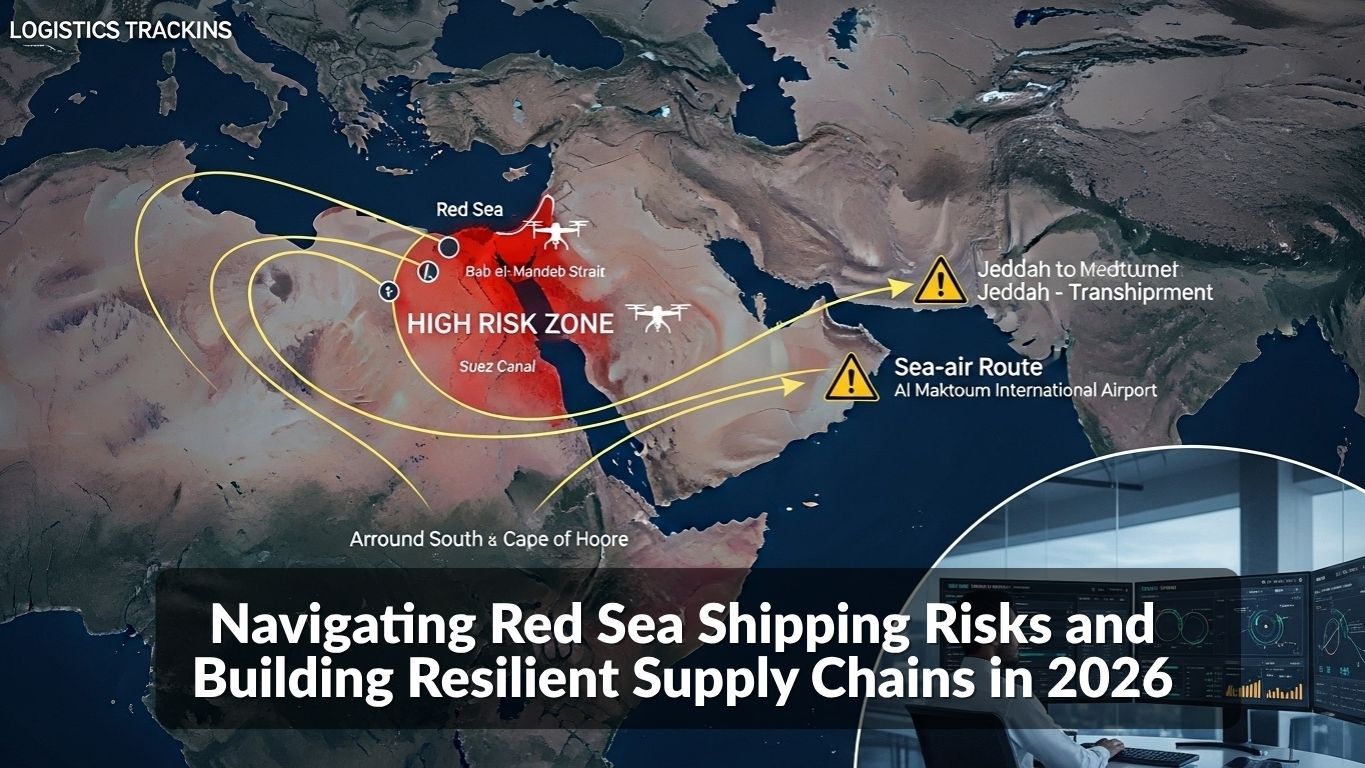
Just when the shipping world thought it could exhale, the Red Sea escalated again.
From November 11, 2025 until late February 2026, the maritime industry experienced a fragile but genuine reduction in Red Sea hostilities. The last confirmed Houthi attack on a commercial vessel, the Minervagracht, occurred on September 29, 2025. In November, the Houthis declared a pause in maritime operations linked to a Gaza ceasefire. Maersk cautiously completed its first Red Sea transit since the crisis began. The ME11 service resumed Suez Canal routing in mid-February 2026. War-risk insurance premiums dropped to their lowest level in two years. It looked, briefly, like the worst might be over.
Then, in the first week of March 2026, US and Israeli strikes on Iran changed everything again. Container carriers including Maersk, Hapag-Lloyd, CMA CGM, and MSC immediately reversed their tentative Suez return decisions, rerouting vessels back around the Cape of Good Hope. Reports emerged of Houthi commanders ordering the Bab el-Mandeb Strait closed to shipping, and Iran taking similar action in the Strait of Hormuz. Brent crude surged to USD 80 to USD 85 per barrel within days. Peter Sand, chief analyst at Xeneta, stated bluntly: “The repercussions of the joint military operation by the US and Israel against Iran and subsequent retaliatory action will see the further weaponization of trade and shatter hopes of a large-scale return of container shipping to the Red Sea in 2026.”
For Dubai importers, exporters, and logistics managers, this is not background noise. Dubai’s geography places it at the precise intersection of the world’s most strategically sensitive waterways. A simultaneous closure of the Bab el-Mandeb and the Strait of Hormuz would isolate Gulf ports and force carriers to reroute or suspend services. These are not hypothetical scenarios. They are the active planning conditions for every supply chain professional operating out of the UAE in 2026.
This guide explains the current state of the Red Sea crisis with precision, examines the alternative routes available to Dubai-based shippers, and provides a practical framework for building the kind of supply chain resilience that converts geopolitical volatility from a threat into a competitive advantage.
1. The Current Situation: What Is Actually Happening in March 2026
Understanding the Red Sea crisis requires separating the signal from the noise. Here is the most current, accurate picture as of publication:
The Timeline That Matters
The Houthis attacked or hijacked ships 99 times between November 2023 and the final incident in September 2025. Quarterly deadweight tonnage transiting the Suez Canal has fallen 51 to 64% below 2023 levels since January 2024. Container shipping has been hit hardest, with fourth-quarter 2025 transits down 86% compared with 2023.
Despite three months of no confirmed Houthi attacks, traffic through the Suez Canal remained approximately 60% below pre-crisis levels as the first week of 2026 closed. The long-anticipated wave of vessels returning to the critical waterway had not materialised. The reason was industrial caution: carriers, burned by two years of disruption and acutely aware that the Houthi pause was conditional, were reluctant to commit fully to Suez routing without sustained evidence of stability.
That caution proved justified. From approximately November 11, 2025 until late February 2026, there were no sustained, confirmed missile or drone attacks against merchant vessels attributable to the Houthis. The statements from Houthi commanders in late February and early March 2026 marked the end of roughly three and a half months of relative calm.
By early March 2026, the picture had deteriorated sharply. Carrier routing decisions that had been inching toward a Suez return were immediately reversed. Hapag-Lloyd stated it had decided to pause future trans-Suez sailings through the Bab el-Mandeb Strait. CMA CGM instructed all its vessels within the Gulf and those heading to the Gulf to proceed to shelter, suspended all services via Suez, and rerouted via the Cape of Good Hope. MSC issued similar instructions to its masters in the region, avoiding both the Bab el-Mandeb and the Strait of Hormuz.
The Strait of Hormuz Dimension
The March 2026 escalation introduced a risk dimension that had not been operationally relevant during the 2024 to 2025 phase of the crisis: the Strait of Hormuz. A sharp rise in global oil prices drove up freight rates, with Brent crude surging to USD 80 to USD 85 per barrel as of early March 2026, up from USD 70 to USD 75 per barrel in the preceding weeks, driven by concerns over disruptions in the Strait of Hormuz, through which approximately 20% of the world’s oil supply passes.
For Dubai specifically, Hormuz closure risk is categorically more disruptive than Red Sea routing problems. While Red Sea disruptions affect the route between the Gulf and Europe and Asia, a Hormuz closure affects Dubai’s access to the open ocean entirely. Jebel Ali Port depends on the Strait of Hormuz for access to both east and west trade routes. The fact that carriers are now actively contingency-planning for this scenario is a signal that every logistics manager in the UAE must take seriously.
The Red Sea and Suez Canal historically formed the shortest maritime link between Asia and Europe, carrying 12 to 15% of global trade and up to one-third of East-West container flows. When shipments avoid this route, carriers are forced to detour around Africa’s Cape of Good Hope, adding nearly 11,000 nautical miles to voyages and as much as 10 to 14 days to transit times. That detour not only inflates fuel consumption but also raises total voyage costs significantly.
Before the crisis: approximately 80 containerships per week used the Suez Canal. By mid-January 2026, that figure had recovered to just 26. In early March 2026, the number reversed direction again. (Source: gCaptain / BIMCO, January 2026)
2. What Two Years of Disruption Has Cost Dubai Importers
The financial impact of the Red Sea crisis on Dubai-based importers and exporters is not theoretical. It is a documented, multi-year cost that has restructured supply chain economics across the region.
The Russell Group estimated that goods worth around USD 1 trillion were disrupted due to Houthi attacks from October 2023 to May 2024 in the Red Sea. For UAE-based shippers, the specific cost impacts have included:
- Freight rate surge: Spot container rates from Shanghai to Europe rose by 256% on average between December 2023 and February 2024. The Dubai-to-Europe lane experienced proportional increases, with base rates on some services rising by multiples of their pre-crisis levels.
- Extended transit times: The Cape of Good Hope diversion adds 10 to 14 days to Asia-Europe voyages. For Dubai-to-Europe routes, effective transit times increased by 8 to 12 days compared to Suez Canal routing. For importers with just-in-time inventory strategies, this added buffer time requirement forced safety stock increases that tied up working capital.
- War risk insurance costs: War risk premiums rose sharply when Houthi attacks were active. During previous campaigns, additional war risk premiums for Red Sea transits added hundreds of thousands of dollars to individual voyages. The cost now appears to be rising again as the March 2026 escalation unfolds.
- Carrier losses passed through to shippers: Maersk reported a USD 153 million loss in its Ocean division for Q4 2025, marking its first quarterly loss in years, as it navigated the difficult transition between Cape diversions and Suez transits. The company issued 2026 guidance ranging from a USD 1.5 billion loss to a USD 1.0 billion profit, reflecting deep uncertainty around the pace of any sustained Red Sea reopening. Carrier financial pressure of this magnitude translates into surcharge implementation and capacity management decisions that directly affect shipper costs.
- Carbon footprint increase: Carbon emissions for container ships spiked by approximately 46% in 2024 due to the longer Cape of Good Hope routes. For businesses with ESG commitments and emissions reporting obligations, this involuntary increase in their logistics carbon footprint required explanation and mitigation strategy.
The aggregate lesson is clear: passively accepting whatever route your carrier chooses, and absorbing whatever surcharge they apply, is the most expensive approach to Red Sea disruption. Active route management, carrier selection, and timing strategy deliver material cost savings for importers who are willing to engage with the problem intelligently.
3. The Four Alternative Route Options for Dubai Shippers in 2026
When the Red Sea and the Bab el-Mandeb Strait are effectively closed to commercial shipping, Dubai-based importers are not without options. The key is understanding each alternative’s specific cost, transit time, and suitability for different cargo profiles.
Route Option 1: Cape of Good Hope
The established and proven alternative, routing vessels south around the southern tip of Africa rather than north through the Red Sea and Suez Canal. This has been the dominant routing for the majority of Asia-Europe container services since January 2024.
The reality for Dubai shippers: Cape of Good Hope routing from Chinese manufacturing ports to Jebel Ali adds approximately 3,000 to 4,000 nautical miles compared to Suez Canal routing for Dubai-bound cargo (since Dubai is in the Gulf, the calculation differs from the Asia-to-Europe distance impact). For Dubai-to-Europe routing specifically, the total distance via Cape of Good Hope is approximately 12,000 to 14,000 nautical miles versus 8,500 to 9,000 via Suez. At typical slow-steaming speeds, the Cape routing adds 10 to 14 days to Dubai-to-Europe transit times.
Best for: Non-time-critical cargo, bulk shipments, heavy project cargo where transit time flexibility exists in the project schedule, and shipments where the security risk of alternative routes outweighs the cost of longer transit.
Route Option 2: Transshipment via Colombo or Salalah
For Asia-origin cargo destined for Dubai, transshipment through Colombo (Sri Lanka) or Salalah (Oman) provides an alternative to direct sailings that might otherwise transit through risk-affected waters. Colombo is positioned south of the Bab el-Mandeb threat zone and serves as a major transshipment hub for Asia-to-Middle East cargo. Salalah, operated by APM Terminals and located at the southern tip of Oman, provides direct onward feeder connectivity to Jebel Ali and other Gulf ports without routing through the contested strait.
Best for: Cargo originating in South and Southeast Asia, time-sensitive shipments that cannot absorb Cape of Good Hope transit time, and LCL (less-than-container load) shipments where the consolidation point can be moved to a southern hub.
Route Option 3: Sea-Air via Dubai
For cargo where the extended sea transit times generated by Cape of Good Hope routing are commercially unacceptable but where pure air freight is cost-prohibitive, the sea-air combination offers a compelling middle ground. Cargo travels by sea from origin to Dubai (avoiding the northern Red Sea risk zone by routing through Salalah or direct Gulf entry), clears customs at Jebel Ali, and then departs by air freight from Dubai International Airport or Al Maktoum International Airport to the final destination in Europe, the Americas, or Africa.
The expansion of Al Maktoum International’s cargo capacity in 2026, combined with Emirates SkyCargo’s fleet doubling programme (from 11 to 21 dedicated freighters by end-2026), makes Dubai the most capable sea-air transshipment hub in the region. For cargo from Chinese manufacturers, a sea voyage from Shanghai or Shenzhen to Dubai followed by air freight to Rotterdam or London can deliver in 12 to 18 days door-to-door, at a cost approximately 40 to 60% below pure air freight but with meaningful transit time advantages over the Cape of Good Hope sea route.
Best for: Electronics, fashion, pharmaceuticals, perishables, and other time-sensitive or high-value goods where transit time is a commercial priority and the cargo-to-value ratio supports a modest freight cost premium over standard sea rates. Our air freight and sea freight teams coordinate sea-air routings through Dubai as a standard service offering.
Route Option 4: Land Freight via Saudi Arabia and the Northern Corridors
For cargo originating in Turkey, Eastern Europe, or the Levant, and destined for the UAE, the overland route through Saudi Arabia via the Hejaz Railway corridor and the Saudi Land Bridge is an alternative that bypasses maritime risk entirely for the origin-to-KSA portion of the journey, with sea transit only required for the final Gulf crossing.
For UAE-to-Europe cargo, a reverse land routing through Saudi Arabia, Jordan, and into Turkey provides an alternative to ocean freight that has gained operational credibility over the past two years of maritime disruption. Transit times are 12 to 16 days by road and rail, costs are competitive for certain cargo profiles, and the route eliminates maritime security risk entirely. Our land freight team operates across the UAE-Saudi Arabia and broader GCC corridor, providing multimodal options for cargo that cannot afford maritime uncertainty.
4. The Port Congestion Risk That Nobody Is Talking About Yet
The dominant narrative around the Red Sea crisis focuses on the risk when the route is closed. But the shipping industry is also facing a paradoxical and equally serious risk from the opposite direction: what happens when it reopens.
If carriers redirect vessels through the Suez Canal, those ships will arrive in European ports at the exact same time as vessels that departed earlier but took the longer Cape of Good Hope route. Arrivals in Europe are predicted to grow by 10 to 39% during the transition period. This could result in two to three weeks of massive volume spikes with severe consequences including port congestion, where European terminals could be overwhelmed, leading to berthing delays and slower container releases. Inland bottlenecks would follow, as the sudden influx of cargo places extreme pressure on trucks, trains, and barges. Equipment imbalances would create a secondary shockwave in Asia, with container shortages appearing approximately eight to nine weeks after the first wave of Suez transits clears European ports.
For Dubai importers whose cargo is destined for European markets, or whose European suppliers are shipping inbound to Dubai, this congestion risk is a planning reality that must be modelled now. The moment a sustained Suez Canal reopening begins, the race to book before the congestion spike becomes critical. Shippers who are first to book on returning Suez services secure the transit time advantage and the pre-congestion rates. Those who follow two to three weeks later find themselves booking into a market where European port congestion is already building.
5. How Smart Route Management Actually Works in 2026
Talking about “real-time route optimization” is easy. Delivering it requires specific operational capabilities that separate genuine supply chain partners from freight brokers who simply book the cheapest available service and report back when something goes wrong.
Here is what intelligent route management for Dubai-based importers and exporters actually consists of in 2026:
Carrier Intelligence: Knowing Who Is Going Where Before You Book
In the current environment, individual carriers are making different routing decisions on a week-by-week basis for the same trade lanes. CMA CGM has announced that some of its Asia-Europe services that went through the Suez Canal in 2025 will go back to transiting via the Cape of Good Hope as a result of a complex and uncertain international context. Maersk’s ME11 service resumed Suez Canal routing in mid-February 2026, then reversed that decision within weeks following the March escalation.
A freight forwarder with genuine market intelligence knows, before a booking is confirmed, exactly which routing each carrier is currently operating on each specific trade lane. This is not information that appears on a carrier’s public website in real time. It requires active relationship management with carrier commercial teams, monitoring of industry intelligence sources including Lloyd’s List, gCaptain, Xeneta, and Drewry, and the analytical capability to translate that information into specific routing recommendations for each client shipment.
At U.N. Cargo and Logistics, our market monitoring team tracks carrier routing decisions across all major services connecting Dubai to Europe, Asia, and the Americas in real time. We know which service strings are currently Suez-routed versus Cape-routed, and we communicate this to clients before booking confirmation so that transit time expectations are accurate and not based on pre-crisis norms.
War Risk Insurance Management
BIMCO warned that war risk premiums are likely to increase sharply if attacks resume. During previous Houthi campaigns, additional war risk premiums for Red Sea transits rose significantly, in some cases adding hundreds of thousands of dollars to individual voyages.
Managing war risk insurance is not simply a matter of adding a surcharge to the freight invoice. It requires understanding which cargo is covered, which routes trigger coverage provisions, how the war risk exclusion clauses in standard marine cargo policies interact with current threat zones, and whether your specific cargo value and route combination requires additional specialist coverage above the standard marine policy. Our team works with specialist marine underwriters to ensure client cargo is properly covered for the current risk environment, not for a pre-2023 risk map that no longer reflects operational reality.
Booking Timing and Capacity Security
Rate and space availability in the current market do not move predictably. The market impact of a Suez return effectively releases roughly 6% of global fleet capacity back into the market. Combined with new vessel deliveries, this oversupply is expected to drive freight rates down significantly. Conversely, a renewed closure or escalation sends rates sharply upward within days as available capacity on alternative routes is absorbed.
This volatility creates a specific strategic opportunity for well-prepared shippers: booking ahead of rate spikes, and delaying bookings during temporary congestion-driven surges, can generate freight cost savings that dwarf the forwarder fee on any given shipment. Our market analysts track rate trajectory data from Xeneta, Freightos, and the Drewry World Container Index and advise clients on whether current market conditions favour immediate booking or short-term delay.
Pre-Alert and Contingency Trigger Management
For cargo that is already in transit on a vessel when a route escalation occurs, the key is having pre-agreed contingency protocols that activate without requiring a client decision cycle that burns days of response time. Our operations team monitors all active shipments against the current threat environment, and for any shipment on a vessel approaching a risk-elevated zone, we proactively contact the client with a situation briefing and recommended action within hours of a threat change, not days.
This is the practical difference between a freight partner and a booking agent. A booking agent tells you what happened. A freight partner tells you what is about to happen and what you should do about it before it does.
6. Building Supply Chain Resilience for Dubai Importers: The 2026 Framework
The Red Sea crisis has been the most powerful supply chain resilience teaching moment in a generation. The businesses that emerged from two-plus years of disruption in the strongest position shared common structural characteristics. Here is the framework that emerged from operational experience:
Principle 1: Diversify Your Carrier Base, Not Just Your Routes
Carrier alliance concentration is a hidden supply chain risk that the Red Sea crisis exposed brutally. Shippers who had committed exclusively to one carrier or one alliance found themselves unable to access alternative routings when their primary carrier reversed its Suez decision. Maintaining relationships with at least two to three carriers across different alliances for your primary trade lanes gives you routing optionality that a single-carrier dependency eliminates.
In 2026, the Gemini Alliance (Maersk and Hapag-Lloyd), the Ocean Alliance (CMA CGM, Evergreen, COSCO, OOCL), the Premier Alliance (ONE, HMM, Yang Ming), and independent operators including MSC are all making independent routing decisions. A shipper with space secured across multiple alliances can systematically shift bookings toward whichever alliance is currently operating the most favourable route for their specific trade lane.
Principle 2: Build Safety Stock Proportional to Routing Volatility
Just-in-time inventory management was designed for a world where transit time was predictable to within two or three days. In a world where a single geopolitical event can add 14 days to a voyage overnight, lean safety stock is a business risk disguised as an efficiency metric. The appropriate safety stock level for any product category sourced via a route exposed to Middle East shipping disruption should now be calculated using the longest plausible transit time under adverse routing conditions, not the standard transit time under normal conditions.
Principle 3: Use Long-Term Contracts with Route Flexibility Clauses
Long-term freight contracts in the current market serve two purposes. First, they provide rate certainty against the GRI-driven volatility that characterises the spot market during geopolitical spikes. Second, and critically for 2026, a well-structured long-term contract includes route flexibility clauses that prevent a carrier from applying surcharges when they change routing without giving the shipper a corresponding schedule adjustment. Without explicit route flexibility provisions, a carrier that switches from Suez to Cape routing can apply additional fuel surcharges on an existing contract, increasing costs without changing service commitments.
Principle 4: Invest in Shipment Visibility Technology
You cannot manage what you cannot see. Real-time vessel tracking, integrated with carrier schedule data and geopolitical risk alerts, enables responsive rather than reactive supply chain management. For Dubai importers managing regular import programmes, visibility tools that show exact vessel position, current routing, weather overlays, port congestion data, and estimated arrival times are not a premium feature. They are the operational baseline for any supply chain that is seriously managing Middle East route risk.
Principle 5: Multimodal Flexibility Is a Competitive Advantage
The businesses most resilient to Red Sea disruption in 2024 and 2025 were those that could pivot between sea freight, air freight, and land freight quickly, without requiring long procurement cycles to establish new carrier relationships or customs procedures. Building established service relationships across all three modalities before a crisis, not during one, is the foundational supply chain resilience investment.
Our integrated service model at U.N. Cargo and Logistics provides exactly this flexibility. When sea freight routing is compromised, our air freight team can be engaged immediately without client relationship setup time. When both sea and air are under pressure, our land freight network provides the overland routing alternative. And our customs clearance team ensures that whichever entry point is used, the documentation is prepared correctly for that specific port and routing, with no clearance delays caused by a documentation set that was prepared for a different entry point.
7. The Strait of Hormuz: The Risk That Changes Everything for Dubai
Every supply chain risk analysis for Dubai must now include a Strait of Hormuz scenario. This is not alarmism. It is the operationally accurate risk landscape as of March 2026.
The Strait of Hormuz is the world’s most critical oil chokepoint, with approximately 20% of global oil supply transiting through it. For Dubai specifically, the strait is the only maritime exit from the Arabian Gulf. A sustained closure would not merely add transit time or costs to Dubai’s trade flows. It would effectively sever Dubai’s sea freight connectivity to the world.
The probability of a sustained, total Hormuz closure remains low. Every party with influence in the region, including Iran, has strong economic incentives to avoid a prolonged closure. But the temporary threats and posturing that occurred in early March 2026 are a reminder that this risk exists and that no Dubai-based logistics strategy is complete without a Hormuz contingency.
The contingency for a Hormuz disruption is air freight, overland routing through Saudi Arabia and into northern trade corridors, and pre-positioned inventory in markets that can be served without Gulf access. For businesses with a high dependency on ocean freight and no established air freight or land freight relationships, a Hormuz disruption would be a supply chain emergency. For businesses with diversified, pre-established multimodal relationships through a partner like U.N. Cargo, it would be a managed operational challenge.
8. What This All Means for Your Next Shipment Decision
Given everything above, here is the practical, actionable intelligence for Dubai importers and exporters making shipping decisions right now:
- Do not assume any routing is stable for more than two to four weeks. The March 2026 escalation reversed months of cautious progress toward Suez normalization within days. Any shipment booking should be made with explicit awareness of the routing at the time of booking and a clear understanding of the surcharge implications if the carrier changes routing between booking and loading.
- Ask your forwarder specifically which route the nominated vessel is currently operating. This is not a question that should require a two-day wait for an answer. A freight partner with genuine market intelligence knows this in real time.
- For time-sensitive shipments to Europe, model the sea-air option through Dubai explicitly. With Cape of Good Hope transit times adding 10 to 14 days versus pre-crisis norms, the cost differential between sea freight and sea-air has narrowed considerably for high-value cargo. The calculation that previously favoured standard sea freight may no longer hold in the current routing environment.
- Build war risk insurance into your cost modelling, not as an afterthought. War risk premiums are rising again following the March escalation. The specific exclusion clauses in your marine cargo policy may affect coverage for cargo routing through risk-elevated zones. Verify this with your insurer before your next booking.
- Review your safety stock levels for any product category imported via sea freight from Asia or Europe. The routing uncertainty of 2026 means transit time windows should be planned against a worst-case scenario, not a pre-crisis baseline.
- Engage a freight partner with genuine multimodal capability now, before the next escalation. Establishing relationships, documentation, and operational procedures across sea, air, and land freight during a calm period takes days. Establishing them during a crisis takes weeks and costs more.
Your Red Sea Resilience Checklist for 2026
- ✅ Current carrier routing confirmed: Know whether every active booking is Suez-routed or Cape-routed and what transit time this implies
- ✅ War risk insurance reviewed: Marine cargo policy reviewed against current threat zone definitions, with exclusion clauses understood and additional coverage arranged if required
- ✅ Sea-air alternative modelled: Cost and transit time of sea-air via Dubai calculated for your key trade lanes as a standing contingency option
- ✅ Land freight routes mapped: Overland routing from Turkey, Jordan, or Saudi Arabia investigated as a maritime bypass option for European-origin cargo
- ✅ Carrier base diversified: Space secured across at least two carrier alliances for primary trade lanes to prevent single-carrier routing dependency
- ✅ Safety stock adjusted: Inventory levels recalculated using worst-case transit times under Cape of Good Hope routing, not pre-crisis Suez Canal norms
- ✅ Freight contract route clauses reviewed: Long-term contracts reviewed for route flexibility provisions preventing unconsented surcharges on routing changes
- ✅ Hormuz contingency planned: Air freight and land freight alternatives identified and operationally available for a Strait of Hormuz disruption scenario
- ✅ Port congestion buffer built: For Europe-destined cargo, arrival scheduling accounts for the 2 to 3 week congestion spike risk that would follow a rapid Suez Canal reopening
- ✅ Freight partner with multimodal capability engaged: Sea, air, and land freight accessible through a single, coordinated partner without setup delay
Conclusion: Resilience Is Not Preparation for One Crisis. It Is Preparation for the Next One.
The Red Sea crisis is not a single event with a beginning, middle, and end. It is a new operational baseline for Middle East shipping: a state of managed uncertainty in which geopolitical developments can materially alter trade route economics within days, and in which the shippers best positioned to absorb those changes are those who invested in resilience before they needed it.
BIMCO Chief Shipping Analyst Niels Rasmussen noted that a normalisation of ship transits now appears more likely than at any point during the last two years, but it remains unknown if, or how fast, this may happen. A return to the Suez Canal would reduce shipping companies’ costs significantly but also hurt ship demand. A full normalisation is estimated to reduce container ship demand by approximately 10%.
That normalisation, whenever it comes, will itself create disruption in the form of port congestion, rate volatility, and equipment imbalances. The supply chains that navigate it best will be those that can read the market in advance, secure capacity before the congestion wave arrives, and pivot between modalities quickly when the situation demands.
U.N. Cargo and Logistics provides Dubai-based importers and exporters with the route intelligence, carrier network breadth, multimodal flexibility, and customs expertise to navigate the 2026 shipping environment, whatever it brings next. From sea freight under Cape of Good Hope routing to air freight through Al Maktoum International, from land freight across the Saudi border to sea-air transshipment through Jebel Ali, our team is positioned to keep your supply chain moving regardless of what happens in the strait.
Get a Current Sea Freight Quote with Route Intelligence → |
Air Freight Alternatives from Dubai → |
GCC Land Freight Options → |
Customs Clearance for Any Route →
References
- gCaptain: Suez Canal Traffic Stalls at 60% Below Normal Despite 100 Days Without Houthi Attacks (January 2026): https://gcaptain.com/suez-canal-traffic-stalls-at-60-below-normal-despite-100-days-without-houthi-attacks/
- gCaptain: Red Sea Corridor Slips Back Into Crisis as Houthi Threats Resurface (March 2026): https://gcaptain.com/red-sea-corridor-slips-back-into-crisis-as-houthi-threats-resurface/
- Container News: The Return of Container Shipping to the Red Sea, What Supply Chain Leaders Must Know in 2026 (March 2026): https://container-news.com/the-return-of-container-shipping-to-the-red-sea-what-supply-chain-leaders-must-know-in-2026/
- S&P Global Market Intelligence: Red Sea Shipping Reopens but Renewed Houthi Threats Keep Route Uncertainty High (February 2026): https://www.spglobal.com/market-intelligence/en/news-insights/research/2026/02/red-sea-shipping-reopens
- Seatrade Maritime: Shipping Lines Reroute from Red Sea Avoiding Houthi Threat (March 2026): https://www.seatrade-maritime.com/containers/shipping-lines-reroute-from-red-sea-avoiding-houthi-threat
- Zencargo: Red Sea Shipping 2026, How Will the Suez Canal Reopening Affect Your Supply Chain (January 2026): https://www.zencargo.com/resources/red-sea-reopening-2026/
- Coface: Houthi Attacks in the Red Sea, Why Maritime Trade Is Still Not Smooth Sailing (February 2026): https://www.coface.com/news-economy-and-insights/houthi-attacks-in-the-red-sea-why-maritime-trade-is-still-not-smooth-sailing
- Scan Global Logistics: Important Notice, Update on the Ongoing Middle East Security Situation (March 2026): https://www.scangl.com/news/important-notice-update-on-the-ongoing-middle-east-security-situation/
- Atlas Institute for International Affairs: The Red Sea Shipping Crisis 2024-2025, Houthi Attacks and Global Trade Disruption (March 2025): https://atlasinstitute.org/the-red-sea-shipping-crisis-2024-2025-houthi-attacks-and-global-trade-disruption/
- Wikipedia: Red Sea Crisis (Updated March 2026): https://en.wikipedia.org/wiki/Red_Sea_crisis
- Xeneta: Peter Sand Chief Analyst Commentary on Red Sea and Strait of Hormuz Escalation (March 2026): https://www.xeneta.com/blog
- BIMCO: Red Sea and Suez Canal Traffic Analysis Q1 2026: https://www.bimco.org/news/market_analysis
- Lloyd’s List: Red Sea Crisis Impact on Global Container Shipping (Ongoing Coverage): https://www.lloydslist.com
- Drewry World Container Index: Weekly Rate Tracking February to March 2026: https://www.drewry.co.uk/supply-chain-advisors/supply-chain-expertise/world-container-index-assessed-by-drewry