

There is a moment in logistics that every importer and exporter has experienced: the moment when the transit time quote for air freight makes you wince, and the transit time quote for sea freight makes you anxious. Too fast is too expensive. Too slow is too risky. You book sea freight, you build in a buffer, and you hope the container arrives before your customer notices the delay.
That moment is being redesigned in Dubai. Not gradually, not theoretically, but structurally and right now, in concrete, steel, and policy.
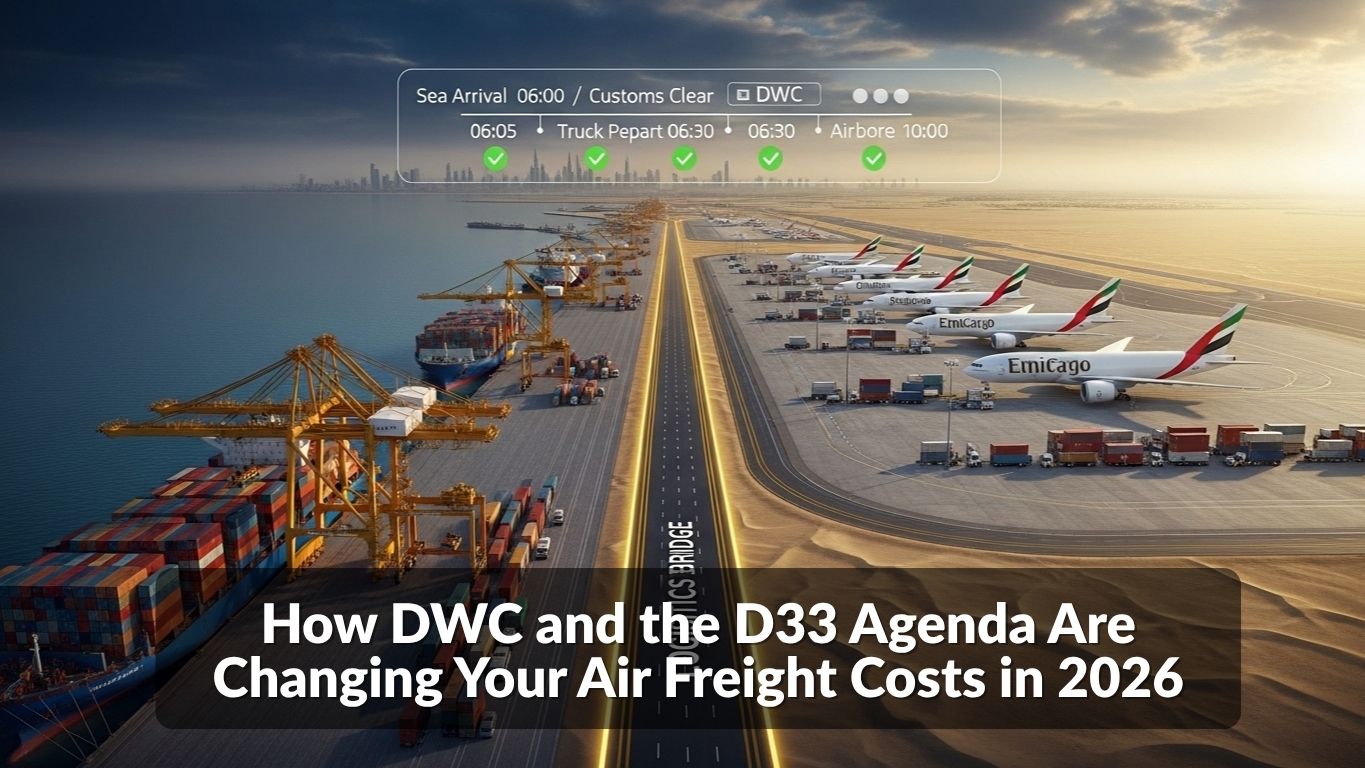
The instrument of that redesign is a 37-kilometre stretch of bonded road connecting Jebel Ali Port to Al Maktoum International Airport in Dubai South. A logistics corridor where a container can arrive by sea, clear customs in five minutes using automated X-ray scanning, be transferred to a bonded truck, driven to an Emirates SkyCargo freighter, and be airborne to Frankfurt, Singapore, or New York within four hours of arriving in the Gulf. Dubai’s sea-to-air model, where cargo arrives at Jebel Ali and is airborne from Al Maktoum International within four to six hours, is described as the gold standard of multimodal logistics.
This is the Logistics Bridge. And in 2026, with the D33 Economic Agenda accelerating investment into the DWC ecosystem, Emirates SkyCargo doubling its freighter fleet, and Dubai Customs integrating its digital systems with sea and air operations in real time, the Logistics Bridge is evolving from a clever piece of infrastructure into the defining competitive advantage of Dubai as a global air freight hub.
For businesses shipping goods to and from Dubai, understanding exactly how DWC and the D33 agenda are changing your air freight options, your cost structure, and your supply chain timing is not background knowledge. It is operational intelligence that affects decisions you are making today.
1. What the D33 Agenda Actually Requires from Dubai’s Logistics Infrastructure
The Dubai Economic Agenda D33 is a ten-year economic blueprint launched in January 2023 with a target of doubling Dubai’s economy to AED 32 trillion in cumulative GDP by 2033. Understanding its specific logistics commitments explains why DWC is receiving the investment levels it is, and why that investment is translating into real, measurable advantages for air freight users.
D33 sets five specific logistics and trade targets that are directly relevant to air freight users:
- Top 3 global logistics hub by 2033: Dubai currently ranks among the world’s top five logistics hubs. D33 targets the top three, competing directly with Singapore, Rotterdam, and Hong Kong.
- Double foreign trade: From AED 14.2 trillion to AED 25.6 trillion, adding 400 new cities to Dubai’s active trade network. Emirates SkyCargo’s Divisional Senior Vice President Badr Abbas stated explicitly that “the Dubai Economic Agenda D33 aims to double foreign trade and add 400 cities to the foreign trade map. Emirates SkyCargo is well positioned to capitalise on this growing multimodal transportation opportunity.”
- Dubai as the world’s largest air cargo hub: Abbas noted that Al Maktoum International Airport expansion is “a long-term vision to the world’s largest cargo hub that will be able to process 12 million tonnes of cargo annually from the current capacity we have.”
- Fully integrated sea-air logistics corridor: The explicit policy goal of making the Jebel Ali to DWC corridor a single, seamless logistics operation rather than two separate port and airport systems with a road connection between them.
- Digital customs integration: Reducing cargo dwell time across the Jebel Ali and DWC ecosystem through technology-driven customs alignment, not just infrastructure investment.
These are not aspirational statements. They are funded mandates, backed by the AED 128 billion approved for DWC expansion in April 2024, by Emirates’ fleet investment programme, and by the active digital integration projects being delivered by Dubai Customs and Emirates SkyCargo simultaneously. As Air Cargo Week noted in February 2026, Dubai is sharpening its focus on one of the most persistent challenges in global logistics: time, specifically the time cargo spends waiting, and this focus is driving a deliberate move away from parallel air and maritime workflows towards a fully synchronised, data-driven cargo ecosystem.
2. The Logistics Bridge: How It Actually Works in 2026
The Logistics Bridge between Jebel Ali Port and DWC is not a marketing term. It is a specific, documented, operationally active cargo movement system with measurable performance metrics. Here is exactly how it works:
Step 1: Sea Arrival and Automated Customs Scanning at Jebel Ali
When a vessel arrives at Jebel Ali and a container is discharged, the customs clearance process for goods destined for onward air freight begins immediately using Dubai Customs’ automated X-ray inspection system. Dubai Customs showcased its advanced inspection system at Jebel Ali Port, highlighting its role in accelerating cargo clearance without compromising regulatory controls. The system screens shipments, vehicles, oversized equipment and yachts using X-ray technology, significantly increasing inspection capacity. Inspection time has been reduced from up to six hours under manual processes to around five minutes using the automated system.
For air freight-bound cargo, a five-minute customs inspection versus a six-hour manual process is not a marginal improvement. It is the difference between a cargo movement that catches the same day’s freighter departure and one that misses it entirely.
Step 2: Bonded Truck Transfer to DWC
Once cleared, the cargo is transferred to an Emirates SkyCargo bonded truck for the 37-kilometre drive to DWC. Emirates SkyCargo established the bonded trucking corridor to seamlessly integrate the airports and offer customers a five-hour air-to-air transfer service. Comprised of over 60 trucks and operating 24/7, the fleet serves as a rolling conveyor between the dedicated freighter operations at DWC and bellyhold operations at DXB. Since May 2014, Emirates SkyCargo trucks have transferred more than 2.16 million tonnes of cargo between the airports in 640,000-plus trips, facilitating trade to over 150 destinations on the airline’s vast global network.
The bonded status of the trucks is critical. Cargo moving from Jebel Ali to DWC in a bonded vehicle does not need to re-clear customs at the airport end. The customs event at Jebel Ali is the single clearance point for the entire sea-to-air movement. This eliminates the double-handling and double-clearance delays that would otherwise add hours to the corridor transit time.
Step 3: Loading and Airborne Departure from DWC
At DWC, Emirates SkyCargo operates dedicated freighter services from 26 international destinations with access to an additional 61 destinations through Emirates’ passenger bellyhold network. The combination provides access to 87 global destinations from a single DWC booking, covering every major trade lane from Europe to Asia to the Americas to Africa.
The total elapsed time from sea arrival at Jebel Ali to airborne departure from DWC, under efficient conditions with pre-cleared documentation, is four to six hours. No other logistics hub on Earth combines deepwater port access, automated customs, bonded road transfer, and major freighter operations at this proximity and speed.
The January 2026 Integration Upgrade
In January 2026, Dubai Customs and Emirates SkyCargo advanced a new phase of their sea-air integration programme. Senior officials from both organisations met to advance coordination between maritime and air freight systems, with a focus on digital connectivity and aligned logistics services. Discussions centred on integrating digital systems that manage maritime and air cargo operations to support the smooth flow of global supply chains through Dubai. Officials said closer system connectivity would enable seamless transfers of goods from shipping containers to aircraft, while allowing more accurate end-to-end tracking of commercial shipments. The proposed integration is designed to reduce delays, lower operational friction and improve predictability across cargo movements.
Greater alignment with Dubai Customs gives Emirates SkyCargo clearer visibility over clearance timelines, particularly in complex transhipment scenarios where air-sea transfers are essential. Predictable clearance enables more confident uplift planning, tighter aircraft loading strategies and improved asset utilisation across both freighters and passenger bellyhold capacity. That certainty reduces operational buffers, and buffers in cargo translate directly into cost.
For shippers, this integration creates a direct, measurable financial benefit: when your freight forwarder can tell Emirates SkyCargo exactly when your cargo will clear Jebel Ali, Emirates SkyCargo can plan the uplift with precision, which means your cargo gets onto the aircraft it was planned for rather than being bumped to the next departure because clearance ran over.
3. DWC vs. DXB: What the Dual-Airport System Means for Your Air Freight Quote
Dubai’s dual-airport cargo system gives shippers a genuine choice that does not exist at any other major Middle East hub: two operationally complementary airports, managed by the same organisation, with a bonded truck corridor connecting them. Understanding the distinct role of each airport is essential to understanding your air freight options and why the right airport choice for your specific cargo may not be the obvious default.
Together, Dubai International Airport (DXB) and Dubai World Central (DWC) have a combined capacity of almost 4 million tonnes and facilities that are fully operational 24 hours a day, 365 days a year. DXB, with a handling capacity of 2.8 million tonnes, accommodates both general and specialised cargo with a turnaround of 90 minutes. DWC has a handling capacity of 800,000 tonnes to 1.2 million tonnes a year with a dedicated bonded road link to Jebel Ali Port, enabling rapid transit of sea-to-air cargo.
When DXB Is the Right Choice
- Pure air-to-air transshipment: When cargo arrives on a passenger flight at DXB and needs to connect to another passenger flight at DXB, the 90-minute turnaround capability and the density of the passenger network make DXB the faster and more connection-rich option.
- Urgent small parcels and express cargo: Express courier operations are concentrated at DXB, with DHL, FedEx, and UPS all operating their UAE hub facilities there.
- Pharmaceutical and temperature-sensitive cargo originating at DXB: The Emirates SkyCargo pharmaceutical facilities and temperature-controlled handling capabilities at DXB’s Cargo Village make it the preferred entry point for cold-chain cargo arriving by passenger aircraft.
When DWC Is the Right Choice
- All sea-air transshipment: The bonded corridor and proximity to Jebel Ali make DWC the only practical choice for cargo moving between sea freight and air freight. Al Maktoum International Airport has a habit of providing competitive rates on bulk movement and specific routes.
- High-volume freighter cargo: DWC is the dedicated freighter hub for Emirates SkyCargo. Large-volume consignments moving on dedicated freighter services depart from DWC as the primary origin, with DXB serving as the secondary hub through the bonded corridor.
- Oversized and heavy cargo: DWC’s lower congestion and unconstrained ground handling area make it the preferred option for out-of-gauge, oversized, or extremely heavy cargo that requires specialist handling equipment. Since 2020, Emirates SkyCargo has seen significant transit traffic from GCC markets such as Saudi Arabia and Bahrain for oversized and heavy cargo, including machinery, engines, automotive and oil field equipment, among others.
- 24/7 freighter operations without passenger traffic congestion: DWC operates as a pure cargo and aviation hub without the passenger terminal complexity that creates apron congestion and ground handling competition at DXB. For cargo that must be loaded on a specific flight at a specific time, the reduced congestion variability at DWC provides greater scheduling reliability.
- GCC regional distribution as a hub: The combination of DWC air freight and Jebel Ali sea freight connectivity, plus the Emirates SkyCargo road feeder service extending to regional airports across the GCC, makes DWC the most powerful regional distribution hub for cargo serving Saudi Arabia, Kuwait, Bahrain, Qatar, and Oman simultaneously.
The Air-to-Air Corridor: Using Both Airports as One System
The five-hour air-to-air transfer service between DWC and DXB, operated by Emirates SkyCargo’s 60-truck bonded fleet, means that for booking purposes the two airports function as a single, 4-million-tonne hub rather than as two competing facilities. Cargo arriving on a freighter at DWC can connect to a passenger bellyhold flight at DXB within five hours. Cargo arriving on a passenger flight at DXB can be transferred to a freighter departure at DWC with the same speed. The bonded trucking corridor offers customers a five-hour air-to-air transfer service, with the fleet operating 24/7 as a rolling conveyor between the dedicated freighter operations at DWC and bellyhold operations at DXB.
For freight forwarders with access to the full booking system for both airports, this corridor creates routing flexibility that single-airport hubs cannot offer. When freighter space on a specific DWC departure is fully booked, bellyhold capacity on a DXB passenger departure may be available for the same destination, with the truck corridor providing the bridge. This optionality is one of the factors that makes Dubai’s dual-airport system genuinely more competitive for cargo routing than a single-airport hub of equivalent total capacity.
4. The Emirates SkyCargo Fleet Doubling: What 21 Freighters Mean for Your Air Freight Rate
Capacity is the single most powerful driver of air freight rates, and Dubai’s air freight capacity picture in 2026 is being transformed by one of the most significant freighter fleet expansions in aviation history.
Emirates SkyCargo Divisional Senior Vice President Badr Abbas stated: “Next financial year, or the next two financial years, we’re expecting delivery of multiple aircraft, and we aim to operate a fleet of 21 dedicated freighters by December 2026. So, 15 more freighters are expected across orders and conversions. This will double our capacity, expand destinations, and cement our leadership in air logistics, which again will help facilitate global trade.”
The capacity implications of moving from 11 to 21 dedicated freighters operating from DWC by the end of 2026 are concrete:
- A Boeing 777F freighter carries approximately 103 tonnes of cargo per flight. Adding 10 net new freighters to the DWC operation adds a theoretical capacity of approximately 1,030 tonnes per daily rotation, or roughly 376,000 tonnes of annual uplift capacity when deployed at typical freighter utilisation rates.
- More freighter capacity on competitive trade lanes creates downward pressure on charter rates and reduces the premium for guaranteed space on freighter services, particularly for large-volume consignments where spot market pricing has historically been volatile.
- The expansion of freighter destinations beyond the current 26 DWC direct destinations adds new non-stop routing options that reduce connection times and the associated cost and risk of transit via a third-country hub.
- Greater freighter capacity supports more competitive rates for the sea-air corridor specifically, because the incremental cost of providing the last-mile air segment to the Logistics Bridge combination is spread across a larger and more efficient operation.
Emirates SkyCargo is also integrating dedicated freighters with the extensive wide-body fleet, comprising Boeing 777s, Boeing 777 freighters, Boeing 747 freighters, A350s, and A380s, providing, in the words of Abbas, “unmatched flexibility to move goods quickly and efficiently across the globe.”
For shippers, the practical effect is that the best air freight rates from Dubai in 2026 are available to those with the relationships, market intelligence, and booking capability to access both the dedicated freighter programme at DWC and the bellyhold capacity of the Emirates passenger network at DXB through an integrated booking approach. This is not available through a simple online booking platform. It requires a freight forwarder with established booking relationships across both operations.
5. The New Dubai South Logistics Infrastructure: What Completed by Q1 2026 Means
The DWC air freight opportunity in 2026 is not limited to the airport itself. The broader Dubai South ecosystem within which DWC is embedded has seen a significant wave of logistics infrastructure completions that are transforming the supply chain options for businesses operating in or around the DWC corridor.
Dubai South officially announced the launch of a 215,278 square foot multi-user logistics facilities project, with completion scheduled for the first quarter of 2026. This development supports the UAE’s National Logistics Strategy 2030 and Dubai’s broader economic vision, specifically the goals of the Dubai Economic Agenda D33 to double the emirate’s economy over the next decade. These new Dubai South logistics facilities are designed to meet the growing needs of companies in e-commerce, freight forwarding, and supply chain sectors. With direct access to Al Maktoum International Airport and Jebel Ali Port, the facility is expected to improve efficiency and competitiveness across regional logistics networks.
The significance of new multi-user logistics space completing in Dubai South in Q1 2026 is direct for air freight users: warehousing near the DWC-Jebel Ali corridor is now operating at full capacity. Warehousing near the sea-to-air corridor linking Jebel Ali Port to Al Maktoum is now 98% full. New purpose-built space is therefore not a speculative addition to the supply chain. It is the answer to a documented occupancy problem that was actively constraining the Logistics Bridge’s throughput capacity.
For businesses requiring airside-adjacent storage in Dubai South, the completion of this facility in early 2026 provides the first new logistics real estate in the immediate DWC catchment area since the prior phase of Dubai South development. Securing space in this facility positions a company’s inventory within minutes of the DWC cargo apron, enabling same-day air freight booking for stock that is already staged at the airport’s logistics zone rather than requiring hours of truck transit from a central warehouse before a flight can be loaded.
6. The Air Freight Cost Factors That DWC Changes for Dubai Shippers
Understanding how DWC specifically affects your air freight costs requires understanding the cost components of air freight that the DWC ecosystem addresses differently from any other option available to Dubai-based shippers.
The Sea-Air Cost Advantage
The most powerful cost impact of DWC’s Logistics Bridge is on the sea-air combination route. By providing a four to six hour sea-to-air transit, Dubai enables a routing that delivers goods from Asian manufacturing origins to European or African markets at a cost typically 40 to 60% lower than pure air freight, with a transit time advantage of 10 to 15 days over pure sea freight routing via Cape of Good Hope or even Suez Canal.
For a shipper moving electronics from Shenzhen to Rotterdam in 2026, the cost and timing comparison looks approximately like this:
| Routing Option | Approx. Transit Time | Approx. Cost vs. Pure Air |
|---|---|---|
| Pure air freight (Shenzhen to Rotterdam direct) | 3 to 5 days | Baseline (100%) |
| Sea-air via Dubai (sea to Jebel Ali + air DWC to Rotterdam) | 12 to 18 days | 40 to 60% lower |
| Pure sea freight (Shenzhen to Rotterdam, Cape of Good Hope) | 35 to 45 days | 70 to 80% lower (but 30+ days slower) |
The sea-air via Dubai option occupies precisely the cost and time space between the two extremes, and DWC’s four to six hour Logistics Bridge is what makes the transit time competitive. A sea-air hub that takes 24 to 48 hours for the sea-to-air transfer loses most of that competitive advantage. DWC’s five-minute customs plus four-hour total transfer is the specific operational capability that makes Dubai sea-air genuinely competitive rather than merely theoretically attractive.
The Congestion Premium Eliminated at DWC
DXB is operating at or near saturation capacity, approaching 99.5 million passengers in 2026. Passenger terminal congestion at DXB has a real but indirect effect on cargo operations: aircraft are under pressure to turn around quickly to maintain schedule integrity, which compresses the time available for cargo loading and unloading. Ground handling priority under pressure sometimes favours passenger service restoration over cargo maximisation.
DWC operates as a pure cargo and aviation hub without this passenger congestion dynamic. The aviation cargo challenges of 2026 have pushed the UAE to accelerate the expansion of DWC. The goal is to create a logistics super-hub that is entirely separated from passenger congestion, allowing for 24/7 dedicated freighter operations. For cargo shippers, the absence of passenger congestion at DWC translates into more reliable loading windows, lower risk of cargo being bumped to make room for passenger load requirements, and better ground handling availability for specialist cargo types that require more time to handle.
The Surcharge Structure at DWC
Al Maktoum International Airport has a habit of providing competitive rates on bulk movement and specific routes. The specific cost advantages at DWC versus DXB for large-volume freighter cargo arise from the airport’s lower slot congestion premium (DXB’s high demand creates indirect cost pressure on slot prices), the purpose-built freighter infrastructure that enables faster turnarounds and lower handling times per tonne, and the competitive pricing dynamics that Emirates SkyCargo maintains at DWC as the anchor operator in a facility designed specifically for their operation.
For shippers with regular large-volume air freight requirements, DWC bookings through an established freight forwarder with direct carrier relationships consistently deliver better rate-per-kg outcomes than ad-hoc DXB spot bookings, particularly on trade lanes where Emirates SkyCargo’s freighter network provides direct service rather than requiring a connecting flight through a third hub.
7. The CEPAs That D33 Is Activating: Why New Trade Corridors Lower Your Freight Cost
The D33 agenda’s target of adding 400 cities to Dubai’s active trade network is not purely an infrastructure project. It is also a trade policy project, executed through the UAE’s Comprehensive Economic Partnership Agreement (CEPA) programme. As of 2026, the UAE has signed CEPAs with India, Indonesia, Cambodia, Georgia, Israel, Turkey, Mauritius, the Philippines, Vietnam, and several additional markets, with further agreements in various stages of negotiation.
CEPAs have a direct, measurable effect on air freight costs through two mechanisms. First, reduced or zero tariff rates for goods from CEPA partner countries reduce the total landed cost of imports and make Dubai a more commercially attractive routing point for goods from CEPA origins. Second, the increased trade volumes that CEPA agreements generate create the demand density that justifies more frequent direct air services between Dubai and the partner markets, which in turn reduces air freight rates through competition and capacity growth.
The practical effect for a Dubai-based importer sourcing from India, where the UAE-India CEPA has been in force since May 2022 and trade volumes have grown substantially, is that both the tariff cost and the freight rate on the India-Dubai lane have moved in a favourable direction simultaneously. D33’s CEPA expansion programme will replicate this dynamic on 400 additional city pairs over the next decade, progressively making more trade lanes cost-effective to serve from Dubai and adding more airlines and cargo services to serve those lanes.
8. Practical Guide: How to Access DWC Air Freight Advantages for Your Business
Understanding the DWC ecosystem is valuable. Accessing its advantages requires working with a freight forwarder who has the carrier relationships, booking capabilities, and operational presence to deliver them in practice.
Identify Whether Sea-Air Is Right for Your Cargo Profile
Sea-air via Dubai delivers its strongest cost advantage for cargo with these characteristics: goods originating in Asia (China, India, Southeast Asia) destined for Europe, Africa, or the Americas; goods with a chargeable weight above 500 kg where the per-kg air freight rate makes a significant difference in total cost; goods that require faster delivery than sea freight provides but where the cost of pure air freight is prohibitive; and goods with a value-to-weight ratio that makes the sea-air transit time commercially acceptable without requiring the absolute speed of pure air.
Confirm Airside Storage in Dubai South
For businesses with regular air freight requirements from Dubai, positioning a stock buffer in the Dubai South logistics zone adjacent to DWC is the fastest way to access DWC departures without building in the truck transit time from a central warehouse. Our storage in Dubai solutions include options within the Dubai South logistics corridor, providing airside-proximate inventory positioning that enables same-day air freight loading for stock held on the ground in the DWC catchment area.
Book DWC Freighter vs. DXB Bellyhold Based on Your Shipment Profile
For shipments above 500 kg on trade lanes served by Emirates SkyCargo freighters from DWC, freighter bookings typically offer better guaranteed space and more predictable loading compared to bellyhold bookings on passenger aircraft at DXB. For smaller, lighter, or more time-critical shipments where the density of the DXB passenger network provides more departure options, DXB bellyhold may deliver faster total transit. Our air freight team evaluates both options for every client shipment and books the combination that delivers the optimal balance of cost, speed, and space certainty for your specific cargo.
Integrate with the Bonded Corridor for Sea-Air Movements
The sea-air combination works as a single, integrated service from origin to destination only when the sea freight booking, the Jebel Ali customs clearance, the bonded truck transfer, and the DWC air freight booking are all coordinated through the same logistics provider. Splitting these elements across different providers introduces the coordination gaps that destroy the four to six hour sea-to-air transfer advantage. Our sea freight and air freight teams work from a single integrated booking system, ensuring that your cargo’s Jebel Ali arrival time is synchronised with its DWC departure booking before either element is confirmed.
Use the DXB-DWC Corridor for Flexibility
When space on your preferred DWC freighter service is tight, the five-hour air-to-air bonded corridor between DWC and DXB gives our team the ability to book your cargo on a DXB bellyhold departure with the same confidence in the total transit time. This routing flexibility is only available when your freight forwarder has active booking relationships at both airports. We maintain these relationships as a standard operational capability, not as a premium service add-on.
9. The 2026 DWC Air Freight Checklist for Dubai Businesses
- ✅ Identify your primary trade lanes: Which origins and destinations account for the majority of your air freight volume? Verify whether Emirates SkyCargo operates direct freighter services from DWC on those lanes and what the rate differential is versus a connecting route
- ✅ Model the sea-air alternative for your top trade lanes: Request a sea-air via Dubai cost and transit time comparison for your highest-volume Asia-origin or Africa-destination trade lanes
- ✅ Assess Dubai South storage proximity: If you are currently warehousing in Al Quoz, JAFZA (main zone), or central Dubai, calculate the time and cost difference of positioning fast-moving air freight stock in the Dubai South logistics corridor adjacent to DWC
- ✅ Confirm your forwarder has DWC and DXB booking access: A forwarder with access only to DXB cannot optimise your cargo across the full dual-airport system. Confirm specifically that your freight partner books Emirates SkyCargo freighter space at DWC directly
- ✅ Pre-clear documentation for sea-air movements: For cargo using the Jebel Ali to DWC Logistics Bridge, pre-arrival customs documentation submitted to Dubai Customs before vessel arrival enables the five-minute automated scan clearance rather than a longer manual process
- ✅ Build the four-hour bridge window into your logistics planning: When scheduling sea-air movements, the four to six hour Jebel Ali to DWC transit window must be reflected in your flight booking lead time. Your freight forwarder should be coordinating the vessel ETA with the DWC departure schedule before your goods even leave the origin port
- ✅ Review CEPA eligibility for your sourcing markets: If you are importing from India, Indonesia, Israel, Turkey, or another current UAE CEPA partner, confirm whether your specific goods qualify for preferential duty rates and whether this affects your total landed cost calculation for goods transiting through Dubai
- ✅ Plan for 21-freighter capacity by December 2026: Emirates SkyCargo’s fleet doubling will add significant capacity and new destination services by end-2026. If you are locking in long-term freight contracts now, structure the agreement to allow access to new DWC freighter services as they come online, rather than committing only to current routes
Conclusion: The Shift Is Already Happening. The Question Is Whether You Are Positioned for It.
The centre of gravity for air cargo in the Middle East is moving south. Not eventually, not theoretically. Right now, in 2026, with warehousing near the DWC corridor at 98% occupancy, with Emirates SkyCargo’s 21-freighter fleet taking shape, with Dubai Customs’ five-minute automated clearance now operational at Jebel Ali, and with the D33 agenda providing the policy and funding framework that ensures this investment continues for the next decade.
Businesses that understand the Logistics Bridge and position their supply chains to use it gain a structural cost and transit time advantage over those that default to DXB out of habit, or that continue treating air freight as a single-dimensional cost item rather than a network positioning decision.
U.N. Cargo and Logistics operates at the intersection of the Jebel Ali and DWC ecosystems, providing integrated air freight and sea freight services that make the Logistics Bridge a practical reality for our clients. From sea-air combination bookings to DWC freighter access to Dubai South storage to customs clearance that clears before the vessel arrives, we deliver what the D33 agenda is building: a logistics operation that moves faster, costs less, and connects Dubai to more of the world than any other hub on Earth.
Get a DWC Air Freight Quote Today → |
Sea Freight to Jebel Ali → |
Dubai South Airside Storage → |
Customs Clearance for Sea-Air → |
GCC Land Freight Connections →
References
- Dubai Airports: Cargo Business Opportunities, DXB and DWC Combined Capacity Overview: https://dubaiairports.ae/corporate/business-opportunities/cargo
- Emirates SkyCargo: 10 Years of Dual Airport Operations, Bonded Corridor and D33 (May 2024): https://www.skycargo.com/media-centre/emirates-skycargo-celebrates-10-years-of-dual-airport-operations/
- Air Cargo Week: Emirates SkyCargo Celebrates 10 Years of Dual Airport Operations (May 2024): https://aircargoweek.com/emirates-skycargo-celebrates-10-years-of-dual-airport-operations/
- Air Cargo Week: Shaping the Future of Global Logistics from Dubai, Emirates SkyCargo SVP Interview (June 2025): https://aircargoweek.com/shaping-the-future-of-global-logistics-from-dubai/
- Air Cargo Week: Dubai’s Integrated Air-to-Sea Strategy (February 2026): https://aircargoweek.com/dubais-integrated-air-to-sea-strategy/
- Travels Dubai: Dubai Customs and Emirates SkyCargo Advance Sea-Air Integration Plans (January 2026): https://www.travelsdubai.com/22-Jan-2026/dubai-customs-emirates-skycargo-move-integrate-sea-air-cargo-systems
- Tarangya Blog: UAE Supply Chain and Aviation Disruption, Logistics Report 2026 (February 2026): https://blogs.tarangya.com/uae-under-pressure-aviation-supply-chain-disruption-in-the-gulf/
- UAE Stories: Dubai South Logistics Facilities Set to Complete by Q1 2026 (July 2025): https://uaestories.com/dubai-south-logistics-facilities-set-to-complete/
- Place Overseas: Al Maktoum Airport Expansion, How It Affects Dubai, Sea-to-Air Corridor and 98% Warehousing Occupancy: https://placeoverseas.com/en/blog/al-maktoum-airport-expansion-how-it-affects-dubai
- Alliance Shipping: Air Freight Charges in Dubai per KG, Rate Calculation and Complete Guide (November 2025): https://theallianceshipping.com/air-freight-charges-in-dubai-per-kg-rate-calculation-complete-guide/
- Wikipedia: Al Maktoum International Airport (Updated February 2026): https://en.wikipedia.org/wiki/Al_Maktoum_International_Airport
- Wikipedia: Emirates SkyCargo (Updated March 2026): https://en.wikipedia.org/wiki/Emirates_SkyCargo
- Driven Properties: Comprehensive Guide to Al Maktoum International Airport DWC Dubai (October 2025): https://www.drivenproperties.com/blog/comprehensive-guide-to-al-maktoum-international-airport-dwc-dubai
- Invest in Dubai: Dubai Economic Agenda D33 Overview: https://www.investindubai.gov.ae/en/why-dubai/d33-agenda
- Freightos: ME-ME Air Freight Index, DXB and DWC Rate Tracking: https://www.freightos.com/enterprise/terminal/fax-middle-east-to-middle-east/