

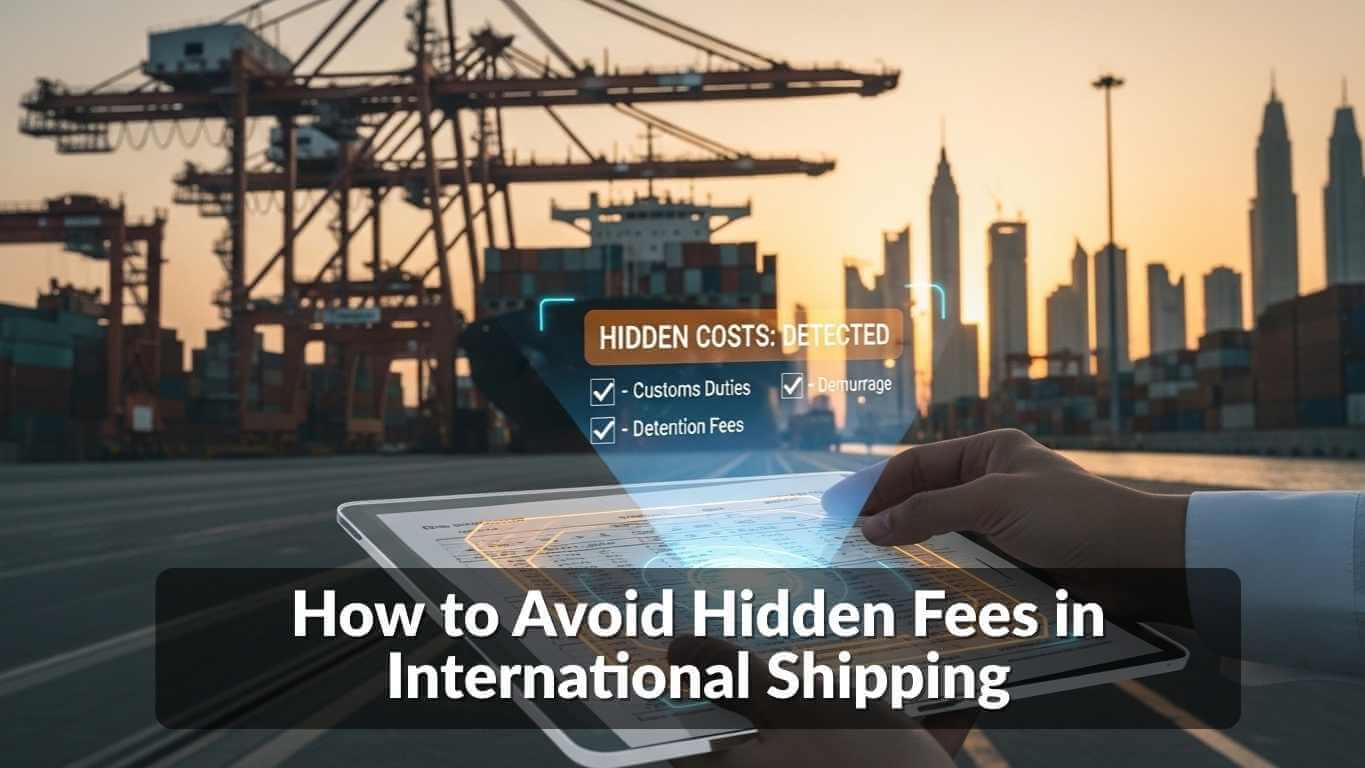
The quote looked reasonable. You approved it, placed the order, and waited for your goods. Then the invoice arrived, and it looked nothing like the quote. Somewhere between the factory and your warehouse, charges appeared that nobody mentioned, for storage at the port, for a rate increase that kicked in after you booked, for a customs hold caused by a document error, for an empty container that sat outside your premises three days longer than planned. By the time the final bill was settled, your landed cost per unit had ballooned, and your margin had evaporated.
If this sounds familiar, you are not alone. Hidden and unexpected fees are the single most common complaint among importers using international shipping for the first time, and they remain a persistent frustration even for experienced buyers who do not have the time to interrogate every line of a freight quote.
The fees are not always dishonest. Most of them are real, legitimate charges that arise from genuinely variable market conditions, customs processes, and carrier commercial policies. But they feel hidden because they were never explained clearly at the start of the process, because the quote you approved did not include them, or because a documentation error set off a chain of delays that multiplied a small problem into a large bill.
This guide explains the five categories of hidden and unexpected costs that cost Dubai importers the most money in 2026, exactly how each one works, and the specific steps you can take to eliminate or substantially reduce each one. At U.N. Cargo & Logistics, transparency is a service standard, not a marketing claim. By the time you finish reading this, you will have the knowledge to hold any freight forwarder or carrier accountable for every line on your invoice.
Why Hidden Shipping Costs Are Getting Worse in 2026
Before the five tips, it helps to understand the market conditions that are making hidden costs a bigger problem for importers in 2026 specifically.
The container shipping market in 2026 is characterised by what analysts at SeaRates describe as a period of extreme rate volatility: base rates that look stable can swing by USD 2,000 to USD 3,000 per container within weeks when a General Rate Increase is filed and holds, or when a geopolitical event disrupts a major route. (Source: SeaRates, November 2025) Carriers are deploying blank sailings and slow steaming to manage capacity in an oversupplied market, which creates unpredictable schedule changes. The Red Sea situation is improving but not resolved, meaning routing decisions are still fluid. And the new EU ETS 100% coverage requirement in 2026 has added a new carbon surcharge line that many importers had never seen on a freight invoice before this year.
The result is a market in which the gap between a headline quote and a final invoice is wider than at almost any point in the past decade. The importers who understand what creates that gap are the ones who can manage it. The ones who do not are the ones paying for it.
Tip 1: Understand Demurrage and Detention Before Your Container Arrives
These two charges are responsible for more financial shock among first-time importers than any other single item in international shipping. They are genuinely confusing, they are rarely explained proactively, and at Jebel Ali they start accruing the moment your free time expires, whether you know it or not.
What Demurrage Actually Is
Demurrage is the fee the shipping line charges when your container remains inside the port terminal beyond the number of free days allocated for you to collect it after it is discharged from the vessel. At Jebel Ali Port, shipping lines typically allow between 5 and 7 free days after vessel discharge before demurrage begins. During those free days, you are expected to complete customs clearance, pay your duties, obtain the delivery order from the carrier’s local agent, and book a truck to collect the container. (Source: Alliance Shipping, September 2025)
If your customs clearance takes 10 days because of a document error, you will pay demurrage for 3 to 5 days beyond the free period. Demurrage charges at Jebel Ali vary by carrier and container type, but as a reference point, charges across major carriers at Jebel Ali have historically ranged from approximately USD 10 to USD 40 per container per day at lower slab rates, with escalating slab structures that increase significantly after 14 or 21 days overdue. (Source: Statista / xChange, 2020 reference data; confirmed by OOCL and CMA CGM published tariffs, 2025)
What Detention Actually Is
Detention is a different charge from demurrage, and the two are frequently confused. While demurrage is about the container sitting inside the port, detention is about the container sitting outside the port. Once you collect a full container and drive it to your warehouse to unpack it, the clock starts running on the detention free period allocated by the carrier for you to return the empty container. If unpacking takes longer than the free period (typically 5 to 7 days after gate-out), detention charges begin accumulating for every day the empty container sits on your premises before you return it. (Source: OOCL Middle East Detention and Demurrage Guidelines, 2025)
It is important to understand that at Jebel Ali and other UAE ports, some carriers combine demurrage and detention into a single merged free period and a single escalating charge structure. Others keep them separate. The specific terms of your container depend entirely on which shipping line is operating your vessel. Our sea freight team at U.N. Cargo reviews the demurrage and detention terms of every carrier booking as a standard step, and we communicate the free period and cost-per-day figures to every client before the vessel departs.
How to Avoid These Charges: The Three Rules
- Rule 1: Start your customs clearance before the vessel arrives. The moment you have confirmed sailing details and a vessel ETA, your customs agent should begin preparing the declaration. At U.N. Cargo, we submit pre-arrival customs declarations through Dubai’s Mirsal 2 system as standard practice. This means the risk assessment and document verification process starts days before discharge, and many shipments are cleared within hours of the container being offloaded. The entire 5 to 7 free day window is preserved for transport coordination, not eaten up by paperwork.
- Rule 2: Have your duty payment funds ready before the vessel arrives. Dubai Customs will not release a container until duties and VAT are paid. If your payment approval process internally takes 48 hours, you are burning through your free days before a truck is even booked. Pre-calculate your expected duty payment and have it ready to pay the moment the customs declaration is approved.
- Rule 3: Pre-book your truck for collection during the free period. Port truck bookings at Jebel Ali require advance scheduling through the terminal’s appointment system. Do not wait until customs clearance is confirmed to start the truck booking process. Start both simultaneously, so the truck is available the moment clearance is granted.
Tip 2: Know What Is Inside Your Freight Quote Before You Accept It
The second most common source of invoice shock is the difference between what a headline freight quote includes and what the final invoice charges. A quote that says USD 3,200 for a 40ft container from Shanghai to Jebel Ali is not necessarily wrong. It is simply incomplete, because the total cost of moving that container door-to-door is almost always higher than the ocean freight rate alone.
Here is a reference breakdown of the charges that are frequently either excluded from a headline freight quote, or included in some quotes but not others, making comparison between providers misleading unless you know to ask:
THC: Terminal Handling Charges
THC is charged at both the origin port and the destination port to cover the cost of moving your container within the terminal. At major Chinese ports, origin THC typically runs USD 80 to USD 150 per container. At Jebel Ali, destination THC is charged separately and must be added to the base ocean rate. Some freight quotes include THC at both ends in the headline rate. Others quote “ocean freight only” and add THC as a separate line. When you receive two quotes for the same route and one is significantly cheaper, the most common explanation is that the cheaper quote does not include destination THC. Always confirm explicitly: is THC included at both ends?
BAF: Bunker Adjustment Factor
The BAF is a fuel cost surcharge updated quarterly by most carriers and applied on top of the base rate. It is a genuine cost and it is non-negotiable, but the amount varies by carrier and trade lane, and some forwarders choose to show it as a separate line while others embed it in an “all-in” rate. On major long-haul routes, BAF can add USD 400 to USD 700 per FEU to the base rate. If a quote shows an unusually low base ocean rate, the first question to ask is whether the BAF is included.
GRI: General Rate Increase
This is the charge that surprises importers most often because it can appear after a quote has been accepted but before the cargo is loaded. Carriers file GRIs on specific trade lanes, typically with 30 days notice, as a mechanism to restore rates to profitable levels when market pricing has declined. GRIs are applied to all cargo not yet loaded at the time the increase takes effect. This means a shipment booked at USD 3,000 per container in week one of the month can be invoiced at USD 3,300 if the vessel does not depart until week three, when a GRI became effective. The industry term for this principle is “VATOS” (Valid As Of Time Of Shipping).
In 2026, with carriers managing overcapacity pressure through active capacity management and blank sailings, GRIs are being filed regularly. SeaRates data shows that main trade routes in 2026 carry ongoing volatility of approximately USD 2,000 to USD 3,000 attributable to GRI and PSS activity. (Source: SeaRates, November 2025)
The protection against GRI surprise is a freight quote with a clearly stated validity period and a forwarder who advises you proactively when a GRI is scheduled before your cargo ships. Ask every forwarder: what is the validity of this quote, and are there any GRIs announced for this lane that would affect cargo sailing after this date?
PSS: Peak Season Surcharge
The PSS is a temporary additional surcharge applied by carriers during predictable periods of high demand: pre-Lunar New Year (November to January), and the pre-holiday retail restocking season (June to October). PSS typically adds USD 150 to USD 300 per container on major lanes and can be higher on specific routes during periods of acute demand. (Source: Forto, March 2025) Like the GRI, it can apply to cargo that was quoted before the PSS was announced but ships after its effective date.
Documentation and Telex Release Fees
Bill of Lading issuance fees (USD 50 to USD 150 per shipment), telex release fees for electronic release of original Bills of Lading, and amendment fees for corrections to issued Bills of Lading are frequently charged separately from the freight rate. A single amendment to a Bill of Lading because a shipper’s name was misspelled can cost USD 50 to USD 100 and, more importantly, delay cargo release while the amendment is processed.
The Question to Ask Every Forwarder
Before you accept any freight quote, ask one question: “Please itemise every charge that could appear on my final invoice that is not included in this quote.” A good forwarder will answer this question completely and willingly. A forwarder who deflects or says “nothing, this is all-in” without actually showing you the surcharge itemisation is one to approach with caution.
At U.N. Cargo & Logistics, every sea freight quote we issue shows the base rate, BAF, THC at both ends, all applicable surcharges, and the quote validity period on the face of the document. No separate conversations required.
Tip 3: Understand UAE Customs Duties Before Your Goods Are Ordered
Customs duties are not a hidden charge in the strict sense. They are set by the UAE government and applied consistently to all commercial imports. But they surprise new importers constantly, because many businesses calculate their landed cost based only on the supplier’s unit price and the freight cost, forgetting that the UAE government takes its share before the goods leave the port.
How UAE Customs Duties Work
The standard customs duty rate in Dubai is 5% of the CIF value of your shipment. CIF means Cost, Insurance, and Freight combined. So if your goods cost USD 50,000, your insurance is USD 175, and your freight is USD 3,200, the customs duty base is USD 53,375, and the duty is USD 2,669.
On top of the customs duty, UAE VAT of 5% is applied to the duty-inclusive CIF value. So on that same shipment: USD 53,375 (CIF) plus USD 2,669 (duty) equals USD 56,044, and 5% VAT on that total is USD 2,802. Your total government charges are USD 5,471 on a USD 50,000 order value, a combined effective rate of approximately 10.9% on the goods value alone. For VAT-registered businesses, the import VAT of USD 2,802 is fully recoverable through the Federal Tax Authority quarterly VAT return, which significantly reduces the net cash flow impact.
Excise Tax: The Category-Specific Shock
Where importers of specific product categories face a genuinely surprising duty bill is the UAE excise tax regime. Certain goods attract excise tax rates that dwarf the standard 5% customs duty:
- Tobacco products and electronic smoking devices: 100% excise tax
- Energy drinks: 100% excise tax
- Carbonated drinks: 50% excise tax
- Sweetened beverages (from January 2026): AED 1.09 per litre for drinks containing 8g or more of sugar per 100ml, and AED 0.79 per litre for drinks containing 5 to 8g of sugar per 100ml
An importer bringing in a container of energy drinks for the first time, unaware of the excise regime, faces a 100% tax on the CIF value before customs duty and VAT are even calculated. On a CIF value of AED 200,000 of energy drinks, the excise tax alone is AED 200,000. This is not a marginal surcharge. It is a business model reality that must be understood before a single unit is ordered.
HS Code Errors: The Most Expensive Paperwork Mistake
The Harmonized System (HS) code you declare for your goods determines the duty rate applied. Using the wrong HS code, whether accidentally or through copying a code from a previous shipment without verification, can result in either overpaying duty or underpaying it. Both outcomes have consequences.
Overpaying is money lost that does not come back easily. Underpaying triggers a customs mis-declaration finding, with penalties ranging from AED 1,000 upward and potential escalation to multiples of the duty value for systematic mis-declaration. In 2026, the UAE is in the middle of a transition from 8-digit to 12-digit HS codes under the GCC Integrated Customs Tariff. Using an outdated 8-digit code can cause a Mirsal 2 declaration to be flagged, delaying clearance and potentially triggering an inspection.
The protection: work with a licensed customs clearance agent who verifies HS codes against the current 12-digit GCC tariff for every product line in every shipment, not just the first time a new product is imported. Our customs team at U.N. Cargo performs this verification as a standard step in every import clearance engagement.
Calculating Your True Landed Cost: The Formula
Building customs duties into your landed cost from the moment you place the order, not after it arrives at Jebel Ali, is the single most effective way to protect your margin on imported goods. Here is the complete landed cost formula every Dubai importer should be using:
Goods value (EXW or FOB) + Origin inland freight to port + Ocean/air freight + Insurance + Origin charges (THC, documentation) + Customs duty (5% of CIF) + UAE VAT (5% of duty-inclusive CIF) + Destination THC + Delivery order fee + Inland delivery to warehouse = Total Landed Cost
For any product subject to excise tax, that calculation needs an additional layer before customs duty is applied. Our team builds this complete landed cost model for every new client importing into Dubai, so there are no surprises when the container arrives.
Tip 4: Never Let Documentation Become the Reason Your Cargo Is Delayed
Documentation errors are the most avoidable and most expensive cause of shipping delays for Dubai importers. They are avoidable because every document requirement is known in advance. They are expensive because the consequences of an error cascade: a correction takes days, during which the container sits at port burning through free days, and demurrage begins accumulating from the moment the free period expires.
Here are the five documentation errors that cause the most delays on shipments arriving at Jebel Ali:
Error 1: Vague or Generic Goods Descriptions on the Commercial Invoice
Dubai Customs requires a specific, accurate description of every item in a shipment on the commercial invoice. Descriptions like “general merchandise,” “consumer goods,” “spare parts,” or “electronics” are insufficient. The description must be specific enough to assign a 12-digit HS code with confidence. A vague description is one of the most reliable triggers for a physical inspection, which can add 2 to 5 days to clearance time on top of any free period already consumed.
Error 2: Value Discrepancies Between Documents
The value declared on the commercial invoice, the packing list, the Bill of Lading, and the insurance certificate must be fully consistent. Any discrepancy, even a minor one caused by a rounding difference or currency conversion, triggers an automatic query from Mirsal 2 and requires a revised declaration or additional supporting documents. Requesting corrected documents from a Chinese or Indian supplier after the vessel has already sailed is both time-consuming and occasionally impossible before the free period expires.
Error 3: Missing or Invalid Certificate of Origin
A Certificate of Origin (COO) is mandatory for all commercial imports into Dubai without exception. A COO that does not match the declared goods, that was issued by an unauthorised body, or that has not been properly attested by the relevant Chamber of Commerce is worse than no COO at all, because it creates an active inconsistency in the declaration that customs must resolve. For goods from countries with UAE CEPA agreements (where preferential duty rates depend on a valid COO), a missing or invalid certificate means the 5% standard duty is applied even if the goods qualify for a lower rate.
Error 4: Consignee Name Mismatch
The consignee name on the Bill of Lading must match the registered importer name in the Dubai Customs system exactly. A minor spelling variation, an abbreviated trading name instead of the full legal entity name, or an outdated company name following a business rebranding can cause the declaration to be rejected and require a Bill of Lading amendment from the carrier. Amendments take days and cost money, and during those days the container is sitting at port.
Error 5: Missing Regulatory Permits for Controlled Products
Electronics require TDRA type approval. Food products require Dubai Municipality or Food Safety Department clearance. Pharmaceuticals require MOHAP import permits. Cosmetics require Ministry of Health registration. These permits must exist before goods arrive at Jebel Ali, not after. There is no fast-track permit process at the port. A container of telecommunications equipment that arrives without the required TDRA approval will sit in the terminal until the approval is obtained, a process that can take days to weeks depending on the product and whether the registration has been started at all.
The Protection: Pre-Arrival Document Review
Every one of these errors is preventable with a pre-arrival document review conducted by your customs clearance agent before the vessel sails, not when it arrives. At U.N. Cargo, our standard process for every import shipment includes requesting and reviewing the commercial invoice, packing list, and draft Bill of Lading from the shipper at least 7 days before vessel departure. We identify errors, request corrections, and confirm that all regulatory permits are in place while there is still time to fix problems without burning free days.
Tip 5: Read Your Freight Quote Validity Date as Seriously as the Rate Itself
This is the tip that sounds the simplest and is ignored most often. Every freight quote has a validity period, typically 7 to 14 days for ocean freight spot rates. That validity period is not a formality or a sales technique. It is a contractual definition of the window within which the quoted rate is guaranteed, and outside of which the carrier’s commercial right to apply a GRI or PSS to your cargo exists.
Here is how this plays out in practice for Dubai importers in 2026:
You receive a sea freight quote with a 10-day validity period. You spend 3 days getting internal approval for the shipment. You confirm with your forwarder on day 4 and send the booking instruction on day 5. Your cargo is collected from the factory on day 8 and arrives at the port of loading on day 12. It is loaded onto a vessel on day 16. A GRI was filed on day 11 with an effective date of the first cargo loaded after day 14. Your cargo, loaded on day 16, attracts the new GRI. Your invoice is USD 350 higher per container than the quote you approved.
This scenario is legal, standard industry practice, and entirely avoidable with one adjustment: book earlier than you think you need to.
Practical Steps to Protect Your Rate
- Streamline your internal booking approval process. International freight quotes have short validity windows for a reason. An internal process that takes 5 working days to approve a freight booking is incompatible with a 7-day quote validity period. Build the freight booking decision into your procurement workflow at the same stage you confirm the purchase order, not after it.
- Confirm your booking in writing before the quote expires. A verbal “yes” is not a booking. The booking is confirmed when you have a written booking confirmation from the forwarder with the agreed rate, sailing date, and container reference. Without this confirmation in writing, the rate is not protected.
- Ask your forwarder about upcoming GRIs at the time of quoting. Carriers are required to give 30 days notice of a GRI in most jurisdictions. A good forwarder knows what is coming and can advise you whether to accelerate your booking to beat an effective date.
- For regular import programmes, consider long-term contracts. In 2026, with carriers eager to lock in volumes during an overcapacity period, long-term contract rates are being offered at levels that compare favourably with spot market pricing. A 6 to 12 month contract with a major carrier eliminates GRI exposure for the contracted volume and provides rate certainty for budget planning. Our sea freight team advises clients on whether long-term contracts make sense for their specific trade lane and volume profile.
The 2026 Hidden Cost Checklist: Your Reference Before Every Shipment
Use this checklist before every international shipment to protect your budget from the five hidden cost categories covered in this guide:
- ✅ Free period confirmed: Ask your forwarder the exact number of demurrage free days and detention free days for the specific carrier booking before you confirm the shipment
- ✅ Duty payment ready: Pre-calculate customs duty (5% of CIF) and VAT (5% of duty-inclusive CIF) and have payment ready before the vessel ETA
- ✅ Truck pre-booked: Terminal slot at Jebel Ali booked in parallel with the customs clearance process, not after
- ✅ Quote itemised: Confirm whether BAF, THC (both ends), documentation fees, and any applicable PSS or GRI are included in or excluded from the headline rate
- ✅ Quote validity checked: Confirmed booking instruction sent to forwarder within the quote validity period, with written booking confirmation received
- ✅ GRI risk assessed: Forwarder consulted on any announced GRIs for the trade lane that could affect cargo loading after the quote validity date
- ✅ 12-digit HS codes verified: Verified against current GCC Integrated Customs Tariff for every product line in the shipment
- ✅ Excise tax checked: Confirmed whether any goods in the shipment fall under the UAE excise tax regime before the order is placed
- ✅ Documents reviewed pre-departure: Commercial invoice, packing list, Certificate of Origin, and draft Bill of Lading reviewed by your customs agent before the vessel sails
- ✅ Regulatory permits confirmed: TDRA, Dubai Municipality, MOHAP, or other relevant approvals confirmed in advance for any controlled product categories in the shipment
- ✅ Consignee name verified: Confirmed that the consignee name on the Bill of Lading matches the registered importer name in Mirsal 2 exactly
- ✅ Total landed cost calculated: Full landed cost inclusive of all above elements calculated before the purchase order is placed, not when the container arrives
What Transparent Shipping Actually Looks Like
There is a version of international shipping where you never receive an invoice that surprises you. Where you know your duty payment before your goods leave origin. Where your forwarder tells you about an upcoming GRI before it hits your cargo, not after. Where your customs clearance is submitted before the vessel arrives so your free days are preserved for transport, not paperwork. Where the only thing on your port invoice is the delivery order fee you expected to pay.
That version of shipping exists. It is not a premium service for large enterprises with dedicated logistics teams. It is what a well-structured freight forwarding engagement looks like when both parties commit to full transparency from the first quote to the final invoice.
At U.N. Cargo & Logistics, we build that transparency into every client relationship from day one. Our sea freight quotations are fully itemised with every surcharge shown. Our customs clearance team verifies HS codes, reviews documents, calculates duties, and submits pre-arrival declarations as standard practice. We advise you on GRI exposure, free period terms, and total landed cost as part of the service, not as an optional upgrade.
Because we think the best relationship between a freight forwarder and their client is one where the client never needs to ask what that charge is on their invoice. They already know. We already told them.
Ready to Ship Without the Surprises?
Get in touch with U.N. Cargo & Logistics for a fully itemised, no-hidden-charges freight quote for your next international shipment into Dubai. Our team will walk you through every cost component, every surcharge, every duty calculation, and every free period term before you commit to a single dirham.
Get a Transparent Sea Freight Quote → |
Customs Clearance That Prevents Delays →
References
- Alliance Shipping: What Are Demurrage and Detention Charges in Shipping? (September 2025): https://theallianceshipping.com/demurrage-and-detention-charges/
- OOCL: Middle East Detention and Demurrage Terminology and Application: https://www.oocl.com/middleeast/eng/localinformation/ddfreetime/middleeast/Pages/middleeastdetentionanddemurrage.aspx
- CMA CGM: Demurrage and Detention Prices and Policy: https://www.cma-cgm.com/ebusiness/tariffs/demurrage-detention
- Momex: What Is Demurrage, How to Calculate It, and How to Avoid It (UAE Focus): https://momex.ae/blog/what-is-demurrage-how-to-calculate-it-and-how-to-avoid-it/
- Statista / xChange: Average Demurrage and Detention Charges in Jebel Ali by Shipping Line: https://www.statista.com/statistics/1127313/average-demurrage-and-detention-charges-in-jebel-ali-by-shipping-line/
- SeaRates: 5 Key Factors of Container Costs in 2026: Pay $2,200 or $9,500? (November 2025): https://www.searates.com/blog/post/5-key-factors-of-container-costs-in-2026-pay-2200-or-9500
- Salalah Cargo: How to Avoid Hidden Fees in Freight Shipping in 2025 (September 2025): https://www.salalahcargo.com/blogs/how-to-avoid-hidden-fees-in-freight-shipping-in-2025/
- 1 Stop Pack n Ship: Hidden Factors That Could Drive Up International Shipping Costs in 2025 (February 2025): https://1stoppacknship.com/hidden-factors-that-could-drive-up-international-shipping-costs-in-2025/
- Foresmart: GRI Shipping: What Is GRI on Freight Quotes? (November 2025): https://www.foresmart.com/what-is-gri-on-freight-quotes/
- Flexport Help Center: What Are the General Rate Increase (GRI) and Peak Season Surcharge (PSS)?: https://www.flexport.com/help/21-gri-pss-freight-fees/
- Forto: General Rate Increase (GRI): Definition, Overview and Tips (March 2025): https://forto.com/en/blog/general-rate-increase/
- Freightos: GRI Shipping: Increases, Surcharges and Fees (January 2025): https://www.freightos.com/freight-resources/gri-shipping-increase/
- Unicargo: Container Rates Today: Shipping Rates Chart and Prices (October 2025): https://www.unicargo.com/container-rates-today-shipping-rates-chart-prices-2025/
- Freightos: Container Shipping Cost and Rates Calculator 2026 (Updated February 2026): https://www.freightos.com/freight-resources/container-shipping-cost-calculator-free-tool/
- C4 Customs: UAE 12-Digit HS Code Guide 2026: https://c4customs.co/blog-uae-12-digit-hs-code-guide-2026/
- Shuraa Tax: Dubai Import Tax 2025, Rates, Exemptions and Procedures: https://www.shuraatax.com/dubai-import-tax/