

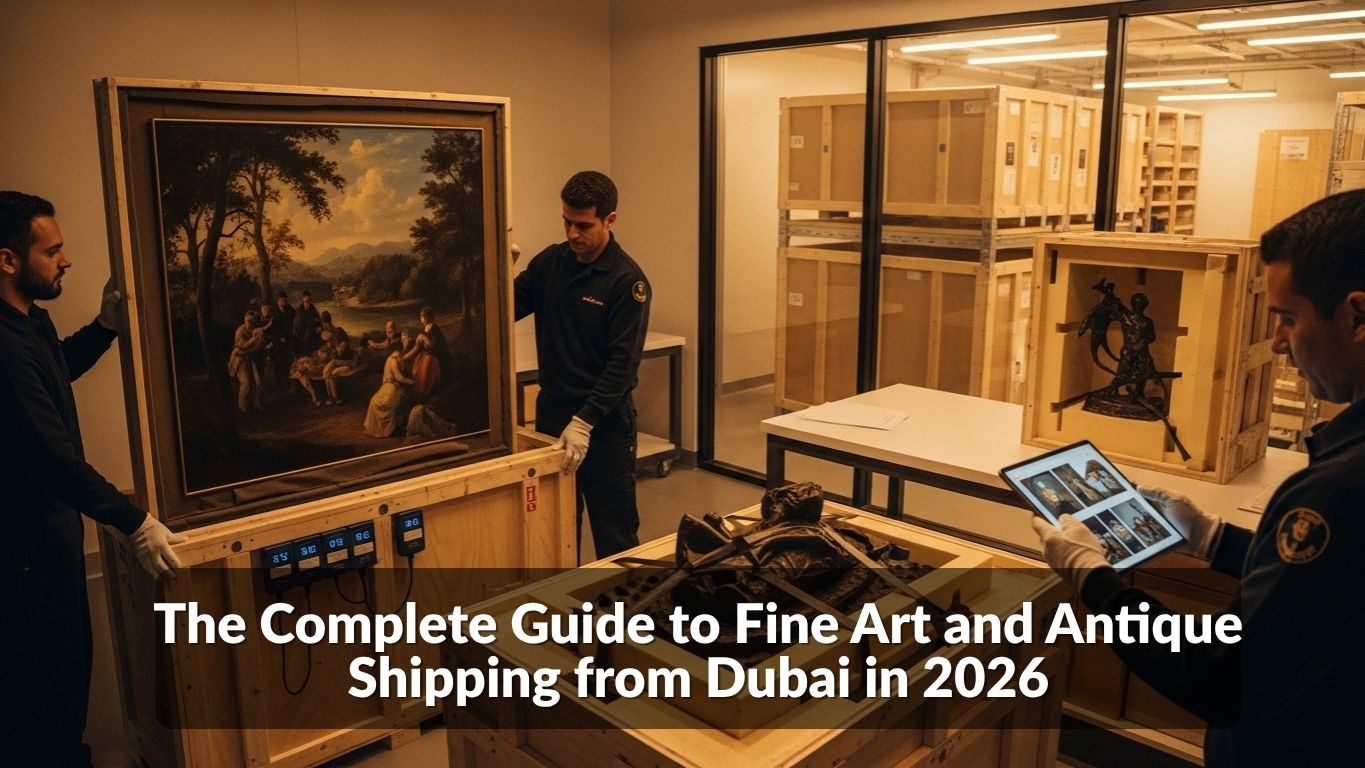
There is a Picasso that needs to travel from a collector’s villa in Emirates Hills to a gallery in London for a three-month exhibition. An antique Omani carved wooden chest, three hundred years old, that must reach a buyer in Paris after a sale at a Dubai auction house. A collection of contemporary Arab canvases, some of them worth more than the container carrying them, that needs to move from a DIFC gallery to Art Basel in Basel. A bronze sculpture commissioned from an Italian artist, acquired at Art Dubai 2026, that must be installed in a corporate headquarters in New York without a single surface mark.
Each of these movements has one thing in common with all the others: the item being moved cannot be replaced. The financial loss from damage is significant. The cultural and personal loss is total.
Dubai in 2026 is one of the most active fine art markets in the world. Sales of modern Middle Eastern art, a favourite of local collectors, trebled in value between 2020 and 2024. The number of millionaires in Dubai has doubled over the last decade and is set to double again by 2035. Sotheby’s held its first live luxury-centred auction in Abu Dhabi in December 2025, which generated USD 133.4 million, described as the largest debut for any new market in the auction house’s history. Art Basel Qatar launched in February 2026, cementing the Gulf as a new axis of influence in the global art trade. The UAE has invested nearly USD 5.3 billion into arts and culture infrastructure, with Louvre Abu Dhabi already operating and Guggenheim Abu Dhabi still under development. Christie’s and Sotheby’s both maintain specialist teams in Dubai. Gagosian, Perrotin, and Pace have established Gulf presences. The number of high-net-worth individuals in the UAE is growing from 160,000 to over 228,000, a 39% increase.
Behind every acquisition, every loan, every exhibition, and every international collection move that this surging market generates is a logistics problem that demands a level of precision, expertise, and care that standard freight forwarding simply cannot provide. Fine art and antique shipping from Dubai is its own specialism, governed by its own standards, materials, regulations, and insurance structures. Getting it wrong, even once, is not recoverable.
At U.N. Cargo and Logistics, we provide white glove fine art and antique shipping services from Dubai to destinations worldwide, managing every element of the journey from the collector’s home or gallery through to installation at the destination. This guide explains exactly what that means, and what every Dubai collector, gallery owner, and auction house client should know before their next high-value shipment moves.
1. Why Dubai’s Fine Art Logistics Market Is Uniquely Demanding
Dubai presents a specific combination of challenges for fine art logistics that does not exist in quite the same form in any other major art market. Understanding these challenges is the starting point for understanding why specialist handling is not optional for high-value pieces moving to or from the UAE.
The Climate Challenge
Dubai’s ambient climate is among the most hostile to fine art in the world. Summer temperatures regularly exceed 45 degrees Celsius, and coastal humidity can reach 90% or above during the hottest months. A painting that has been maintained in a controlled-environment Dubai villa at 20 degrees Celsius and 50% relative humidity will begin to react within minutes of exposure to uncontrolled ambient conditions. Canvas fibres expand. Wood panels warp. Pigment layers crack. Varnish becomes tacky. These are not theoretical risks. They are the documented physical responses of the organic and inorganic materials that comprise fine art when exposed to rapid or extreme environmental change.
According to studies on ocean cargo transit, the typical temperature range inside a standard shipping container can fluctuate between -21 degrees Fahrenheit and 135 degrees Fahrenheit, while relative humidity can vary from 40 to 90 percent. For a piece being shipped from a climate-controlled Dubai gallery into a standard ocean container, that range represents a potentially catastrophic environmental shock. The solution is not simply to hope the container stays cool. It is to engineer the crate, the packing system, and where necessary the container itself, to maintain the correct microclimate throughout the journey.
The Distance Challenge
Dubai’s position in the Gulf means that ocean voyages to the most common fine art destinations in Europe and North America are among the longest in the world for art logistics. A sea freight voyage from Jebel Ali to Southampton or Le Havre takes 20 to 40 days depending on routing and current Red Sea conditions. Every day of that voyage is a day during which temperature, humidity, vibration, and handling risk are accumulating against your artwork’s structural integrity. Deterioration is cumulative. Like damage from light exposure, vibration and shock-related deterioration in objects is cumulative, and no molecular or structural bonds are restored by resting an object between travel and exhibition. This means that a badly packed shipment that arrives apparently intact may have suffered micro-structural damage that becomes visible only when the piece is examined under specialist lighting at the destination.
The Regulatory Challenge
Fine art and antiques moving internationally are subject to a complex web of export and import regulations, cultural heritage protection laws, CITES (Convention on International Trade in Endangered Species) restrictions for works containing ivory, tortoiseshell, coral, or exotic timber, and customs classification requirements that vary by destination country. A piece misclassified at UAE export or at the destination country’s import can be held by customs, subjected to duty assessment, or in extreme cases confiscated under cultural property protection laws. Specialist art logistics expertise in the regulatory dimension is as important as the physical handling capability.
2. The Fine Art Shipping Decision: Sea Freight vs. Air Freight
The first decision in planning any fine art or antique shipment from Dubai is the choice of transport modality. This decision affects cost, transit time, environmental exposure duration, and in some cases the physical handling methodology.
Air Freight for Fine Art
Air freight is the preferred modality for time-sensitive, very high-value, or exceptionally fragile fine art movements. The transit time advantage is decisive: a consignment that would take 25 to 35 days by ocean typically reaches its European destination in 2 to 5 days by air freight. The shorter exposure duration significantly reduces cumulative environmental and vibration risk. For a single canvas by a major contemporary artist valued at AED 500,000 or above, the cost of air freight is typically a small fraction of the piece’s value and a reasonable risk management investment.
The limitations of air freight for fine art are dimensional and weight-related. Most air cargo aircraft have cargo hold opening dimensions that limit the maximum crate size. For very large format works, oversized sculptures, or pieces with extreme dimensional footprints, air freight may be physically impossible regardless of cost. In these cases, sea freight in a properly engineered climate-controlled crate is the only viable option.
Sea Freight for Fine Art
For large-format works, collections of multiple pieces being moved together (where the economies of scale favour ocean freight), antique furniture, architectural elements, and sculptures, sea freight is the appropriate modality. The key is ensuring that the environmental management during the voyage is not left to chance. This means custom crating with internal climate buffering, consideration of climate-controlled container options for the highest-value consignments, careful carrier selection to avoid routes or services with particularly poor climate management histories, and the use of data loggers within crates to provide a documented climate record throughout the voyage.
For fine art, a shared or sole-use climate-controlled container is the highest standard of environmental protection available in ocean freight. These refrigerated or temperature-regulated containers maintain a set temperature range (typically 18 to 22 degrees Celsius) throughout the voyage. At approximately AED 3,000 to AED 5,000 per voyage above the standard container rate, they represent a minor premium relative to the value of the works they protect.
3. Custom Crating: The Engineering at the Heart of Fine Art Protection
The crate is the single most important physical protection decision in any fine art shipment. A correctly engineered crate does not merely prevent breakage. It manages shock, vibration, humidity, temperature fluctuation, and electrostatic risk simultaneously, across a voyage that subjects the crate to crane lifts, truck vibration, vessel movement, port handling, and temperature swings at multiple stages of the journey.
Custom wooden crates provide tailored protection for delicate paintings, sculptures, and antiques during transit. Key benefits include shock absorption, climate control, and a precise fit to prevent movement. In 2025, with art market values surging, proper crating reduces insurance premiums by up to 20%.
The Crating Process Step by Step
Step 1: Expert condition assessment and measurement. Before any crate is designed, our specialist team conducts a full condition assessment of the piece. Every existing crack, abrasion, area of flaking pigment, unstable veneer, or structural weakness is documented photographically and in writing. This assessment serves three purposes: it informs the crating design, it establishes the baseline condition for insurance purposes, and it provides the documentation that protects our client if any condition change is discovered at the destination.
Step 2: Bespoke crate design. A crate is not just a box. It is a bespoke piece of engineering designed for a single purpose: to deliver your most treasured possessions to their destination in the exact condition they left. Our crate design incorporates the piece’s precise dimensions, weight, fragility characteristics, sensitivity to vibration (which varies significantly between a rigid bronze sculpture and an unstretched canvas), and the specific transit conditions of the planned route.
Step 3: ISPM 15-compliant timber selection. All timber used in crates for international shipment must comply with the International Standards for Phytosanitary Measures No. 15, the international standard requiring heat treatment of wood packaging material to prevent the international spread of wood-borne pests. ISPM 15 heat treatment and IPPC markings are mandatory for international fine art shipping. Skipping ISPM 15 treatment leads to customs rejection, with 2025 fines up 30% from prior years. At U.N. Cargo, all timber components are certified ISPM 15 compliant with visible IPPC stamps before incorporation into any export crate.
Step 4: The box-within-a-box construction. According to a technical bulletin from the Canadian Conservation Institute, a box-within-a-box approach for managing shock, vibration, and climate control is best practice. Properly isolating the object helps reduce the likelihood and severity of damage. The outer crate provides structural protection against impact and compression. The inner layer provides environmental and vibration isolation, using a combination of materials chosen for the specific piece:
- High-density Ethafoam: The primary choice for shock absorption, as unlike softer foams it does not compress under weight, providing consistent cushioning for heavy antiques and sculptures.
- Acid-free tissue and felt: For any material that makes direct contact with the artwork surface. Chemically neutral materials prevent abrasion and chemical transfer that can occur over extended transit periods with standard foam or bubble wrap. This is particularly critical for painted surfaces, gilded frames, lacquerwork, and polished metals.
- Anti-static bubble wrap: For mixed-media contemporary works containing electronic components, photographic elements, or metal surfaces sensitive to static discharge.
- Vapour barrier film: A sealed moisture barrier between the inner and outer crate layers that prevents ambient humidity from penetrating to the artwork, regardless of the external conditions.
- Silica gel desiccant packs: Calibrated to the specific internal crate volume to maintain the target relative humidity range of 40 to 55% throughout the voyage.
Step 5: Data logger placement. One or more calibrated temperature and humidity data loggers are secured within the inner crate before sealing. Climate data loggers are required in some destination jurisdictions and are increasingly standard practice for high-value art shipments. The logger records conditions at regular intervals throughout the voyage. At the destination, the logger data is downloaded to produce a complete climate record of the transit. If any condition excursion occurred during the voyage, the data is available to support an insurance claim and to assist the conservation team at the destination in assessing any potential impact.
Step 6: Crate labelling and orientation arrows. Every crate is clearly labelled “Fine Art Fragile,” carries “This Way Up” orientation arrows on all four vertical faces, and displays the piece’s accession or reference number. Stacking limitations are marked on the crate exterior. Where pieces must not be stacked upon, this is marked with maximum stack height indicators.
Small painting or work on paper (up to 60 x 80 cm): USD 200 to USD 450
Medium canvas (60 x 80 cm to 120 x 150 cm): USD 350 to USD 700
Large format painting (above 120 x 150 cm): USD 600 to USD 1,500
Bronze or stone sculpture (up to 50 kg): USD 400 to USD 900
Antique furniture piece (cabinet, table, chest): USD 500 to USD 2,000 depending on dimensions
Very large format or installation elements: USD 1,500 to USD 5,000+
Note: Professional crating reduces marine insurance premiums by 10 to 25% and is a mandatory requirement for all-risk policy coverage on high-value art. The net cost of professional crating, after insurance premium reduction, is often lower than the cost of insufficient packing.
(Source: FreightAmigo, December 2025 / Union Fine Art Services, May 2025)
4. Climate-Controlled Storage in Dubai: The Bridge Between Acquisition and Shipment
For collectors who acquire works at Art Dubai, at Christie’s or Sotheby’s UAE auctions, or from DIFC galleries, there is frequently a period between acquisition and international shipment during which the artwork must be stored securely in Dubai. Standard warehouse storage is not appropriate for fine art, regardless of how well the piece is crated. Fine art requires dedicated climate-controlled storage that maintains the correct temperature and humidity range continuously, with security protocols appropriate to the value of the contents.
Our storage in Dubai facilities include dedicated climate-controlled areas maintained at 18 to 22 degrees Celsius and 45 to 55% relative humidity, with continuous monitoring and alarm systems. Access is controlled and logged. All stored pieces are covered under our storage insurance from the moment of receipt. For large collections or pieces requiring specific orientation (works that cannot be stored flat, sculptures requiring custom supports), our team designs the storage configuration before the pieces are received, ensuring that the storage period itself adds no risk to the artwork’s condition.
5. The Marine Insurance Framework for Fine Art: What “All-Risk” Actually Means
Marine cargo insurance for fine art is not the same as standard cargo insurance. The distinctions matter enormously, and understanding them before a shipment is the difference between genuine financial protection and a policy that will not pay when you need it to.
The Problem with Standard Cargo Insurance for Fine Art
Standard marine cargo insurance, the type typically included in a general freight forwarding agreement, covers loss or damage caused by specific named perils: fire, theft, vessel sinking, and similar catastrophic events. It typically excludes inherent vice (the natural tendency of certain materials to deteriorate under transit stress), scratching, denting, and breakage caused by inadequate packing, and gradual deterioration from temperature or humidity exposure. For a painting that arrives at its destination with a network of fine cracks caused by humidity fluctuation during a poorly managed sea voyage, a standard cargo policy will almost certainly deny the claim on the grounds that the damage was caused by inadequate environmental control rather than a named peril.
All-Risk Fine Art Transit Insurance
The correct insurance for fine art in transit is an all-risk, agreed-value fine art transit policy. Here is what that means in practice:
- All-risk coverage: Rather than listing the perils covered, an all-risk policy covers any and all causes of loss or damage except those specifically excluded. For fine art, this means coverage for the types of subtle damage, surface scratching, vibration-induced cracking, and humidity damage, that are excluded from standard cargo policies.
- Agreed value basis: The sum insured is the agreed value of the work, established by a current appraisal or auction result, rather than the depreciated market value or original purchase price. For a work that has appreciated in value since purchase (common for high-quality contemporary and modern art in a market that has grown as rapidly as Dubai’s), the agreed value basis ensures that the full current value is recoverable, not the original purchase price.
- Door-to-door coverage: The policy attaches from the moment the piece leaves its current location and remains in force until it is installed at the destination and has been inspected and signed off in good condition. This includes the crating process, road transport to the port or airport, the ocean or air voyage, destination port handling, customs clearance, and final delivery and installation.
- Professional packing as a coverage condition: Fine-art transit insurance is often available at 1 to 2% of the artwork value, though galleries may agree to procure this for consigned works. Most specialist fine art insurers require, as a condition of full all-risk coverage, that the work was professionally packed and crated by a qualified art handler. Self-packed works, or works packed in general freight packaging materials, will typically receive reduced coverage or face claim rejection on packing adequacy grounds.
What a Fine Art Insurance Certificate Must Contain
- The artwork’s full title, artist, medium, date of creation, and dimensions
- The current agreed value in a specified currency, supported by a recent appraisal certificate or auction estimate
- The complete transit route, from origin address to destination address, including all transit points
- Confirmation of all-risk coverage basis
- Confirmation of door-to-door coverage period
- The specific exclusions applicable to the policy
- The claims notification procedure and contact details
Our team coordinates fine art transit insurance for every high-value piece we handle, working with specialist marine underwriters experienced in the Dubai and wider Gulf art market to ensure that coverage terms are genuinely appropriate for the work and the transit, not merely adequate on paper.
6. UAE Customs for Fine Art and Antiques: What Every Dubai Collector Must Know
The regulatory framework for exporting fine art and antiques from the UAE and importing them into destination countries is complex and carries risks that even experienced international collectors occasionally underestimate.
UAE Export Requirements
The UAE does not impose export duties on fine art. However, any piece classified as a cultural heritage item under UAE Federal Law No. 11 of 2017 on Antiquities, Museums, and Antiques may require a permit from the UAE Ministry of Culture and Youth before export. Items manufactured before 1900 in any medium are generally classified as antiques and may fall under this provision depending on their origin and cultural significance. Our customs clearance team assesses every export consignment for potential cultural heritage restrictions at the documentation review stage, before any piece is crated or booked for shipment.
CITES Compliance: The Endangered Species Dimension
Many antiques and some fine art pieces incorporate materials derived from species protected under CITES: ivory, tortoiseshell, coral, exotic hardwoods (rosewood, ebony), shagreen (shark or ray skin), whale ivory, and similar materials. These materials require specific CITES export and import permits regardless of the age of the piece, and some materials (post-1989 elephant ivory in particular) face near-absolute trade prohibitions in many jurisdictions. A 19th-century Chinese cabinet with ivory inlay destined for the UK must navigate UK ivory trade regulations as well as CITES provisions. A pre-Columbian artefact with coral elements faces restrictions in most destination markets. Our team conducts CITES material assessment for any piece that may contain restricted materials before shipment is planned.
Import Duties at the Destination
Fine art import duty rates vary significantly between major art market destinations:
| Destination | Fine Art Duty Rate | Notes |
|---|---|---|
| European Union | 0% for original artworks | VAT applies at the destination country rate (5.5% in France under the reduced cultural goods rate, 5% in UK if imported as a Temporary Admission for exhibition) |
| United Kingdom | 0% for original works of art | 5% import VAT for permanent import; Temporary Admission available for exhibition loans |
| United States | 0% for original artworks | No import duty, no VAT. State sales tax may apply on purchase, not import |
| Australia | 0% import duty | 10% GST applies on CIF value at import for permanent import; Temporary Admission Permit available |
| Switzerland / Geneva Freeport | 0% if stored in freeport | Freeport storage defers all duty and VAT; widely used for high-value collection storage |
Temporary Admission provisions, available in most jurisdictions, allow works to enter a country for exhibition or appraisal purposes without payment of import duty or VAT, provided they are re-exported within the permitted period. For galleries lending works to international exhibitions, or for collectors who want to exhibit works in multiple markets, Temporary Admission is the correct customs structure. Using a permanent import declaration when Temporary Admission was appropriate can result in unnecessary duty and VAT payments that are difficult to recover.
7. The White Glove Standard: What Specialist Handling Means in Practice
“White glove” is a term used liberally in the fine art logistics industry. Here is what it should actually mean when applied to fine art and antique shipping from Dubai, and the specific standards our team applies:
Collection from the Collector’s Premises
Our art handling team arrives at your Dubai villa, apartment, or gallery in a soft-floor panel van with onboard climate control. The vehicle interior is maintained at 20 to 22 degrees Celsius throughout the collection. Our handlers wear cotton gloves (not latex, which can leave chemical residue on certain surfaces) for all direct contact with artworks. The collection process begins with a condition review: every visible surface is examined and compared against the existing condition report, any new developments are photographed and documented before the piece is moved.
Art is moved using flat, padded carrying boards for paintings and works on paper, which distribute the load evenly and prevent the torquing stresses that occur when a canvas is lifted from a single corner or edge. Sculptures are moved using padded trolleys or lifting straps attached to the sculpture’s base structure, never to the artwork itself.
Packing and Crating at Our Facility
Crating is performed in our dedicated fine art packing studio, not in a general freight handling area. The studio is climate controlled, clean, and designed to accommodate works of all dimensions. Our packaging services team for fine art holds specialist art handling qualifications and works to the standards established by the Professional Picture Framers Association and the American Institute for Conservation (AIC) for packing materials and methods.
Transportation to Port or Airport
All road transport of fine art is conducted in air-ride suspension vehicles. Air-ride suspension eliminates the low-frequency vibration that conventional leaf-spring suspension transmits to cargo, which is the primary cause of vibration-related fine art damage during road transport. Our vehicles are GPS-tracked in real time throughout each journey, and our operations team monitors all art transport movements actively.
Installation at Destination
True white glove service does not end at the destination port. It ends when the work is installed in its final location in the condition it was collected in, with a signed condition report confirming the installation state. Through our international agent network, we coordinate uncrating and installation at the destination, whether that is a gallery in London, a collector’s home in Paris, a museum storage facility in New York, or a corporate headquarters in Singapore.
8. Special Categories: Unique Challenges for Specific Art Forms
Different categories of fine art and antiques present distinct handling, packing, and transport challenges. Here is a specialist guide to the most common categories in Dubai’s international art logistics market:
Oil Paintings on Canvas
Canvas is inherently flexible and responds to humidity and temperature changes by expanding and contracting. This movement stresses the paint layer, which is more rigid than the canvas, causing cracking and flaking over time. Key requirements: paintings should not be stored or transported rolled under any circumstances. The crate must prevent any flexing of the canvas during transit. Stretcher bars should be checked for integrity before crating, as loose wedge corners allow the canvas to sag, creating paint surface distortion during extended voyages.
Works on Paper, Photographs, and Prints
Paper is acutely sensitive to humidity: it absorbs moisture and swells, and desiccates and becomes brittle when humidity is too low. Photographs, particularly chromogenic and inkjet prints, are sensitive to both UV exposure and humidity. All works on paper must be transported in acid-free enclosures, separated by interleaving tissue to prevent surface adhesion, and the crate’s internal humidity must be rigorously managed throughout the voyage.
Bronze and Metal Sculptures
Bronze is relatively robust structurally but sensitive to condensation, which accelerates the development of patina and in extreme cases can cause bronze disease, an irreversible corrosion process. Crating for bronze must include complete vapour barrier protection and desiccant management. Metal sculptures with dark, fine patina surfaces are susceptible to fingerprint marking if handled without gloves. All contact points between the sculpture and its crate supports must be buffered with acid-free materials.
Antique Furniture
Wooden furniture presents perhaps the most complex climate management challenge in fine art logistics. Historical furniture combines multiple wood species, each with different expansion coefficients, with inlay materials (ivory, bone, tortoiseshell, contrasting timber species), gilded or lacquered surfaces, upholstered panels, and metal hardware. Each element responds differently to temperature and humidity change, creating internal stresses that can cause joints to open, veneers to lift, and inlay to separate over the extended period of an ocean voyage. Antique furniture being shipped internationally requires individual wrapping in acid-free tissue, padding of all projecting elements, custom-fitted internal crate supports that immobilise the piece without creating pressure points, and strict humidity management throughout the transit.
Islamic Art and Manuscripts
Dubai’s position at the centre of the Islamic art market creates specific expertise requirements. Manuscripts and illuminated texts are among the most fragile objects in transit: gold leaf illumination is sensitive to pressure and vibration, aged vellum or paper is extremely humidity-sensitive, and binding structures in historical manuscripts are often partially failed and will deteriorate further without specialist support during transit. Ceramic and metalwork pieces from Islamic collections require shock isolation and, for lustre ceramics, protection from vibration-induced surface abrasion against packing materials.
9. The Art Fair Logistics Calendar: Planning Around Art Dubai, Art Basel, and Major Auction Events
For galleries, dealers, and collectors managing works that will appear at major international art events, logistics timing is as strategically important as the works themselves. A painting that misses the Art Basel opening due to a customs delay, or an antique that arrives at a Sotheby’s sale damaged by an inadequately managed transit, represents not just a logistics failure but a reputational and financial event.
The major art logistics demand peaks that Dubai-based shippers must plan around include:
- Art Dubai (March, Madinat Jumeirah): Art Dubai 2026 marks the fair’s 20th edition, with 120 galleries from more than 60 cities. Works arriving for the fair from international galleries require expert customs clearance and installation coordination on a tight installation schedule. Works departing after the fair close require immediate packing, crating, and export documentation to avoid storage costs and meet the galleries’ onward commitments.
- Art Basel Qatar (February 2026): The inaugural edition of Art Basel Qatar created significant cross-Gulf fine art logistics demand, with works moving between Dubai and Doha for galleries exhibiting at both Gulf fairs in the same season.
- Christie’s and Sotheby’s Dubai Auction Cycles: Both houses conduct major sales in Dubai twice yearly. Post-auction logistics, managing the movement of sold works to buyers in multiple international destinations simultaneously, is a complex coordination exercise that benefits from a logistics partner embedded in the UAE art market ecosystem.
- Art Basel Basel (June): The world’s leading art fair generates significant demand for fine art shipping from Dubai in the April to May pre-fair period, as UAE-based galleries prepare their booth shipments and collectors arrange loans to gallery participants.
- Frieze London (October): A major demand peak for Dubai to London fine art logistics as UAE-based galleries participate in one of the most commercially important fairs in the European calendar.
Early booking of crating, air freight, and customs documentation slots around these major events is essential. Fine art crating facilities in Dubai operate at full capacity in the weeks before each major regional art fair, and air freight space on premium services from Dubai to Basel and London fills quickly in the pre-fair period. Our team maintains advance booking relationships with carriers and our crating studio schedules are managed around the art fair calendar to ensure availability for our clients at peak periods.
Your Fine Art Shipping Checklist from Dubai 2026
- ✅ Confirm the artwork’s current appraisal value before arranging insurance. An out-of-date appraisal that undervalues an appreciated piece will result in under-insurance that cannot be corrected after a damage event
- ✅ Arrange a pre-shipment condition report prepared by your logistics team, with photographs from all angles and close-ups of any existing condition issues, before the crating process begins
- ✅ Specify all-risk, agreed-value, door-to-door fine art transit insurance, not standard marine cargo insurance
- ✅ Confirm ISPM 15 compliance for all timber crating materials and verify that IPPC stamps are visible on the completed crate before export
- ✅ Place calibrated data loggers inside the sealed crate for all ocean freight consignments
- ✅ Assess CITES compliance for any piece containing ivory, tortoiseshell, coral, exotic hardwood, or other potentially restricted materials before booking the shipment
- ✅ Confirm whether UAE Ministry of Culture export approval is required for any piece manufactured before 1900
- ✅ Verify the correct customs structure at the destination: permanent import, Temporary Admission for exhibition, or other specific regime
- ✅ Book crating and air freight slots at least 3 to 4 weeks before major art fair deadlines, not the week before shipping is required
- ✅ Confirm that the destination agent has specialist art handling capability, not just general freight delivery capability
- ✅ Arrange climate-controlled storage in Dubai if there is a gap between acquisition or collection and the shipment date
- ✅ Request a complete post-delivery condition report from the installation team at the destination, signed and dated, as the formal close of the insurance cover period
Trust Is Built One Shipment at a Time
A fine art logistics relationship is built on a record of zero damage incidents, transparent communication when challenges arise, and the accumulated expertise that comes from handling hundreds of high-value, irreplaceable objects with the care they deserve. It is not established by a competitive freight rate.
For Dubai’s growing community of collectors, galleries, auction houses, and corporate art advisors, the choice of fine art logistics partner is a decision that should be made with as much care as the acquisition decisions it supports.
U.N. Cargo and Logistics brings specialist fine art handling expertise, dedicated climate-controlled crating, all-risk insurance coordination, expert UAE customs management, and international agent relationships to every high-value collection movement we manage. From a single canvas leaving a DIFC gallery to an entire collection relocating with an international collector, we deliver what matters: your art, intact, exactly as you entrusted it to us.
Fine Art and White Glove Moving from Dubai → |
Specialist Fine Art Crating and Packaging → |
Climate-Controlled Storage in Dubai → |
Air Freight for High-Value Art → |
Sea Freight with Climate-Controlled Containers → |
Art and Antique Customs Clearance →
References
- Apollo Magazine: The UAE’s Art Market Is on the Up (June 2025): https://apollo-magazine.com/uae-art-market-government-dubai-basel/
- Artnet News: To Understand the Gulf’s Growing Art Market, Leave Old Assumptions Behind (February 2026): https://news.artnet.com/market/gulf-art-market-2740860
- ARTnews: Art Dubai Prepares to Open 18th Edition Amid Major Local Growth in HNWIs (April 2025): https://www.artnews.com/art-news/market/art-dubai-prepares-to-open-18th-edition-2025-hnwi-growth-1234738332/
- Artsy: Art Dubai 2025 Spotlights the UAE’s Growing Cultural Pull (June 2025): https://www.artsy.net/article/artsy-editorial-art-dubai-2025-spotlights-uaes-growing-cultural-pull
- Zurani: Middle Eastern Art Market Growth and Investment Potential (July 2025): https://www.zurani.com/middle-eastern-art-market-growth/
- Maddox Gallery: Emerging Markets in the Art World, Developments in the Middle East and Asia: https://maddoxgallery.com/news/433-emerging-markets-in-the-art-world-developments-in/
- FreightAmigo: The Crucial Role of Custom Wooden Crates in Fine Art Shipping (December 2025): https://www.freightamigo.com/en/blog/logistics/the-crucial-role-of-custom-wooden-crates-in-fine-art-shipping/
- FreightAmigo: Packaging Fine Art in Wooden Crates, Best Practices for Safety (December 2025): https://www.freightamigo.com/en/blog/logistics/packaging-fine-art-in-wooden-crates-best-practices-for-safety/
- FreightAmigo: Essential Insurance Considerations When Shipping Fine Art: https://www.freightamigo.com/blog/essential-insurance-considerations-when-shipping-fine-art/
- FreightAmigo: Fine Art Shipping, The Vital Role of Art Insurance (November 2025): https://www.freightamigo.com/en/blog/logistics/fine-art-shipping-the-vital-role-of-art-insurance/
- American Alliance of Museums: Risk and Responsibility, Sustainable Collection Care and Fine Art Insurance (September 2025): https://www.aam-us.org/2025/09/21/risk-and-responsibility-sustainable-collection-care/
- Asiatic International Relocation: Custom Crating for Moving, The Ultimate 2026 Guide to Protecting High-Value Assets (March 2026): https://www.asiaticrelo.com/custom-crating-for-moving-the-ultimate-2026-guide-to-protecting-high-value-assets/
- Russells Moving and Storage: Art Crating, Climate Control for Valuables (March 2026): https://russellsmovingandstorage.com/2026/03/07/climate-controlled-art-crating/
- Union Fine Art Services: Ultimate Guide to Art Shipping Costs and Insurance in 2025 (May 2025): https://unionfas.com/ultimate-guide-to-art-shipping-costs-insurance-in-2025/
- Anthony Wakefield and Co: Insurance for Shipping Artwork (August 2025): https://www.anthonywakefield.com/2025/05/21/insurance-for-shipping-artwork/