

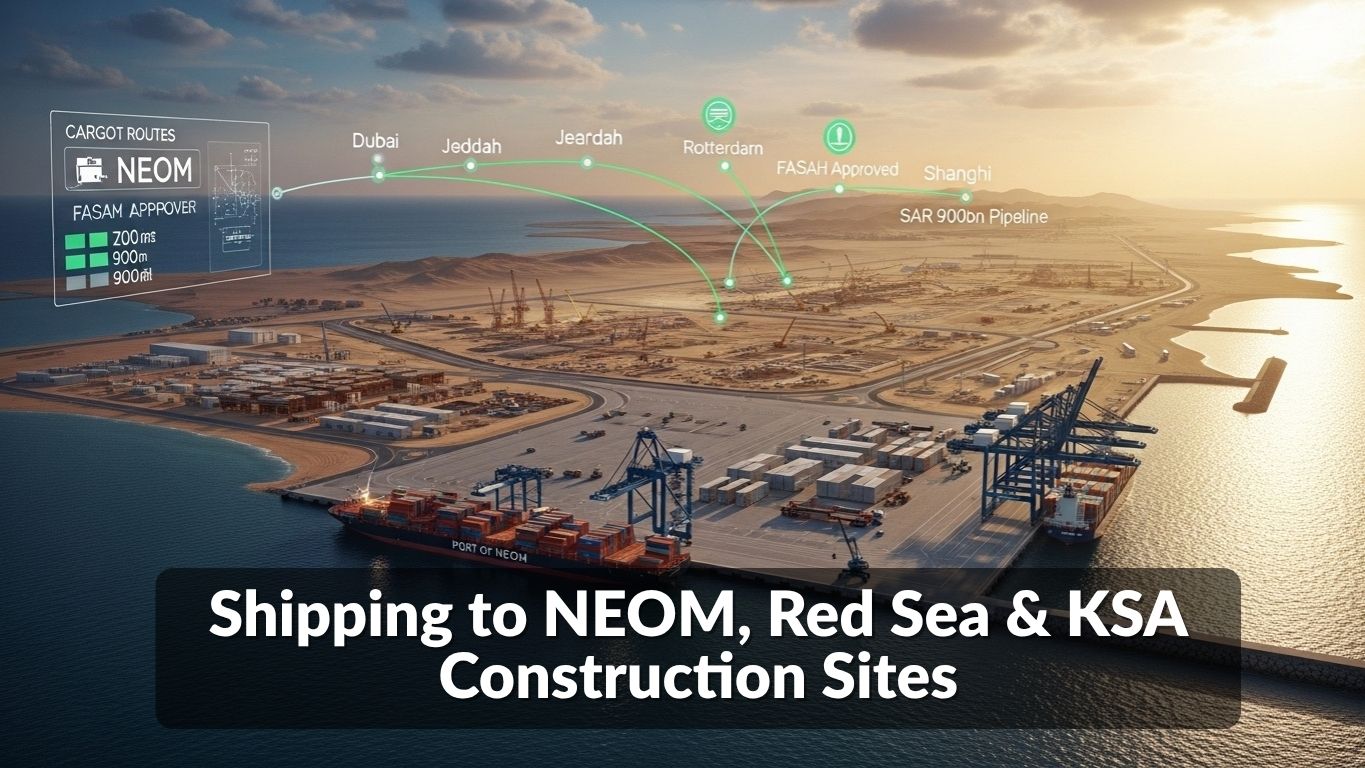
Saudi Arabia is in the middle of the most ambitious construction programme in human history. The numbers are almost beyond comprehension. A giga-projects portfolio exceeding USD 900 billion in planned investment by the Public Investment Fund. A construction market valued at USD 101.4 billion in 2025, forecast to reach USD 138.4 billion by 2034. Contract awards across Vision 2030 projects that reached USD 196 billion in 2024 alone, up 20% on the prior year. A USD 1.5 trillion unawarded construction pipeline that makes the Kingdom of Saudi Arabia the single largest construction market in the world. (Source: IMARC Group / JLL / MEED, 2025)
Every tonne of steel, every prefabricated module, every turbine blade, every construction crane, every kilometre of pipe, and every pallet of specialized industrial equipment that goes into these projects has to arrive in Saudi Arabia through a port, through a land border, or through an air cargo terminal. It has to clear customs under the authority of ZATCA, the Zakat, Tax and Customs Authority. It has to comply with SABER certification requirements, SASO technical standards, and FASAH pre-arrival declaration obligations. And for cargo bound for the most remote project sites in the Tabuk region, it has to travel hundreds of kilometres across desert terrain with overland permits and heavy haulage coordination that requires relationships on the ground.
For EPC contractors, procurement teams, equipment manufacturers, and logistics managers working on any element of Saudi Arabia’s giga-project programme in 2026, this guide provides the operational intelligence you need to move specialized cargo into KSA efficiently, compliantly, and on schedule.
At U.N. Cargo and Logistics, based in Dubai with a dedicated project cargo team covering the entire GCC, we manage heavy-lift, breakbulk, out-of-gauge, and specialist freight movements into Saudi Arabia as a core competency. This handbook reflects what we know from operational experience on the ground.
1. The Honest 2026 State of the Saudi Giga-Projects: What Is Actually Being Built
Before planning any logistics programme for Saudi Arabia, it is essential to understand which projects are actively progressing in 2026, which have been recalibrated, and where the genuine near-term construction activity is concentrated. The giga-project landscape has shifted significantly since the original Vision 2030 announcements, and logistics planning based on outdated project scopes will produce incorrect resource assumptions.
NEOM: A Recalibrated But Active Programme
NEOM is not the USD 500 billion, 170-kilometre linear city that was announced in 2017. Construction on The Line was suspended in September 2025 following fiscal recalibration and a PIF write-down of USD 8 billion across its giga-project portfolio. An internal audit reported by the Wall Street Journal projected costs of USD 8.8 trillion and a completion timeline stretching to 2080 if the original vision were pursued. (Source: House of Saud / WSJ, February 2026)
However, dismissing NEOM as a logistics target is a serious error. What is happening at NEOM in 2026 is a strategic concentration of spending on the components most likely to generate near-term economic returns:
- Oxagon: Construction contracts totalling USD 9.3 billion have been awarded specifically for Oxagon, making it the single largest recipient of NEOM contract spending. The DataVolt AI Factory, a USD 5 billion hyperscale data centre campus announced in February 2025, is the largest active investment within Oxagon, with first-phase operations targeted for 2028.
- NEOM Green Hydrogen Company (NGHC): The green hydrogen plant at Oxagon is 80% complete, making it one of the most active and near-completion construction programmes within the entire NEOM zone. The USD 6.1 billion plant, a joint venture between ACWA Power, Air Products, and NEOM, will deploy four gigawatts of solar and wind energy to produce approximately 600 tonnes of green hydrogen per day.
- Port of NEOM / Duba Port: This is where the most significant logistics infrastructure in the region is being commissioned right now, and it deserves a dedicated section in this handbook.
- Sindalah Island: The luxury yacht island is progressing, with construction activity ongoing through 2025 and into 2026 as the first elements of the marina and hospitality infrastructure are completed.
The Red Sea Project and Amaala
Developed by Red Sea Global, these two regenerative tourism projects cover 28,000 square kilometres of coastline and islands in the Tabuk and Al-Wajh regions. The Red Sea Project has moved firmly from planning into execution, with contract awards accelerating in 2024, surpassing USD 30 billion as delivery gathered pace. Airport infrastructure, resort buildings, marine structures, and renewable energy systems are all in active construction phases, generating continuous demand for construction materials, specialized equipment, and logistics coordination across the remote northwestern Saudi coastline.
Qiddiya
Located 40 kilometres west of Riyadh, Qiddiya is Saudi Arabia’s entertainment, sports, and arts capital. As of September 2025, around 23 contracts are in the execution stage with a total value of USD 10 billion. In addition, nearly USD 21 billion worth of projects are in the pre-execution stages. Six Flags Qiddiya, confirmed as the largest Six Flags park outside North America, and Aquarabia Water Theme Park both opened in early 2026, but the broader construction programme spanning the Performance Arts Centre, residential zones, and transport infrastructure continues at pace. Each of these facilities required extraordinary quantities of specialist imported equipment: roller coaster components, water treatment systems, theatrical rigging, and prefabricated structural steel.
Diriyah Gate
A USD 63.2 billion project in Riyadh developing the historic Diriyah area into a cultural and tourism destination. A USD 1.5 billion contract to build the Arena Block, including the Diriyah Arena and three mixed-use office buildings, was awarded in 2025. Construction is accelerating, and the project’s proximity to Riyadh means logistics into King Khalid International Airport and the Riyadh Dry Port are the primary entry points for imported equipment.
The Recalibrated 2026 Budget Reality
Logistics planners must understand the fiscal context. Saudi Arabia’s giga projects programme remains one of the largest development initiatives globally, exceeding USD 900 billion in planned investment. While contract awards slowed in 2025 compared to 2024, this reflects fiscal recalibration, not cancellation. The 2026 Saudi state budget reflects a disciplined approach, with priority shifting towards projects capable of delivering near-term economic impact, with tourism, logistics, aviation, AI, pilgrimage infrastructure, and non-oil industrial growth at the forefront of spending. For logistics providers, this means the most active cargo flows in 2026 are concentrated in tourism infrastructure, renewable energy, data infrastructure, and port development rather than in the most ambitious smart-city elements of the original giga-project vision.
2. Port of NEOM: The New Gateway Into Northwestern Saudi Arabia
For any cargo bound for NEOM, the Red Sea Project, Amaala, or any project site in the Tabuk and Al-Wajh regions, the Port of NEOM is the single most important logistics infrastructure development of 2026. Understanding its current capabilities and how to route cargo through it is essential operational knowledge.
Formerly known as Duba Port, the facility was transferred to NEOM in 2022 and has undergone a SAR 12 billion (approximately USD 3.2 billion) infrastructure investment programme that is transforming it from a modest regional port into a purpose-built gateway for one of the world’s largest construction sites.
What Is Operational Right Now
Port of NEOM already handles general and project cargo, containerised shipments, bulk consignments, warehousing, and RoRo (roll-on/roll-off) ferry operations. The port received 1,000 vessels last year, mostly serving the ongoing construction operations at NEOM. MSC and CMA CGM, two of the world’s largest shipping lines, are already calling regularly at Port of NEOM, and Folk Maritime, a Saudi-owned carrier, operates a dedicated feeder service connecting NEOM to international trade routes via Jeddah.
For project cargo specifically, the port has received shipments for the NEOM Green Hydrogen Company’s hydrogen production facility, including wind turbine blades and similar equipment for the renewable energy industry, demonstrating its capability to handle specialist out-of-gauge cargo. Liebherr is delivering 10 mobile harbour cranes to the port.
Terminal 1: The 2026 Game-Changer
Development of Port of NEOM continues at pace ahead of the 2026 opening of Terminal 1, a next-generation container terminal, with recent infrastructure milestones including the completion of a 900-metre quay wall and the deepening of the port channel to 18.5 metres, enabling the world’s largest vessels transiting the Suez Canal to call at Port of NEOM.
The automation technology being deployed is remarkable even by global standards. In May 2025, the port took delivery of three STS cranes and four electric RTGs from ZPMC, all remote-controlled and automated, a first for Saudi Arabia. The full equipment delivery comprises 10 STS cranes and 30 eRTGs, with six STS cranes and 16 eRTGs scheduled for delivery in 2025, with the remainder arriving in early 2026.
When Terminal 1 is fully operational, it will have a throughput capacity of 1.5 million TEUs per year and will be capable of handling the world’s largest container vessels. Terminal 1 will also feature horizontal transport automation as part of the broader goal to achieve full automation. Once operational, these technologies will significantly expand the port’s logistics capacity, driving regional industrial growth, opening access to global markets, and enhancing supply chain resilience.
Strategic Position and Connectivity
Advanced automation and digital systems are being built in to reduce turnaround times and boost efficiency, enabling the Port of NEOM to compete with major regional hubs such as Dubai’s Jebel Ali. The Oxagon CEO has stated that the port could cut transit times to Iraq by up to 12 days compared to current routing through Jebel Ali or Salalah. A trial shipment from Egypt to Iraq via Port of NEOM cut transit time from Egypt by over 50%.
For logistics planners, the implications are direct. Port of NEOM is the closest deep-water port to every giga-project site in the Tabuk region. It eliminates the need to truck construction cargo from Jeddah Islamic Port (approximately 800 kilometres) or King Abdulaziz Port Dammam (over 1,500 kilometres). For high-volume, time-sensitive construction supply chains, routing through Port of NEOM rather than Jeddah can save days from the total delivery timeline.
3. The KSA Customs Clearance Framework in 2026: ZATCA, FASAH, SABER, and SASO
Saudi Arabia’s customs clearance system in 2026 is almost entirely digital, governed by multiple interconnected platforms that every importer must understand before their first shipment arrives at a Saudi port, airport, or border crossing. This is not optional complexity that can be delegated to a supplier or carrier. It is a regulatory environment that requires active management from your customs broker team from the moment a purchase order is issued.
ZATCA: The Primary Authority
The Zakat, Tax and Customs Authority (ZATCA) is the Saudi equivalent of a combined revenue authority and customs administration. ZATCA controls customs declarations, tariff classification, valuation, duties, VAT, inspections, and audits. It is the final authority on shipment clearance. All commercial importers must be registered with ZATCA, and only Saudi-registered businesses with valid commercial registration and importer authorisation can legally clear goods. Foreign companies must appoint licensed Saudi partners. This is a fundamental requirement that EPC contractors and foreign equipment suppliers frequently underestimate: you cannot clear your own cargo at a Saudi port without a Saudi commercial registration. You need a licensed Saudi importer or customs broker acting on your behalf.
FASAH: The Digital Clearance Platform
FASAH (meaning “clearance” in Arabic) is the digital platform through which all Saudi customs declarations are submitted and tracked. Importers are required to complete FASAH clearing procedures by presenting the necessary documents and completing the customs declaration form at least 48 hours prior to the arrival of the shipment at the port of entry. The 48-hour pre-arrival declaration obligation is a hard deadline with no exceptions. Cargo arriving without a pre-registered FASAH declaration is flagged for mandatory inspection and held until the declaration is completed, beginning the demurrage clock immediately.
FASAH provides real-time shipment tracking from the moment a declaration is submitted, allowing importers and their agents to monitor clearance status, receive inspection notifications, and manage port release timing. Businesses that understand these tools gain a competitive edge by reducing turnaround time and shipping costs.
SABER: The Product Conformity Certification System
SABER is the Saudi platform for managing product conformity certification under SASO technical regulations. For many product categories imported into Saudi Arabia, including construction materials, electrical equipment, electronics, toys, automotive parts, and personal protective equipment, a SABER certificate is mandatory before the goods can clear customs.
SABER requires two types of certificate for regulated products: a Product Certificate of Conformity (PCoC), which is product-specific and tied to a specific manufacturer and model, and a Shipment Certificate of Conformity (SCoC), which is shipment-specific and required for each individual consignment of a certified product. Critically, undertaking letters or post-arrival submissions are no longer accepted. The SCoC must be in place before the shipment departs from origin, not when it arrives in Saudi Arabia.
In a significant regulatory update effective January 2026, Saudi Arabia updated a number of Customs Tariff Codes used in the SABER platform. These changes align SABER with the latest Customs Tariff Code list published by ZATCA and apply to products falling under a wide range of SASO Technical Regulations. For companies that have established SABER certifications under pre-2026 tariff codes, a review of affected product certificates is mandatory to avoid clearance rejections on shipments departing from January 2026 onwards.
Additionally, the “Letter of Undertaking” option has been removed, requiring full certification for all applicable products, with new categories added to mandatory certification including renewable energy equipment. This is directly relevant to the solar panels, wind turbines, electrolysers, and power conversion equipment flowing into NEOM’s green hydrogen and renewable energy projects.
VAT: The 15% Factor
Saudi Arabia’s VAT rate is 15%, applied to the CIF value plus customs duty, on all commercial imports into the domestic market. This is significantly higher than the UAE’s 5% VAT and is a critical element of the total landed cost calculation for any goods entering Saudi Arabia. VAT is suspended on goods under customs control until their formal release into the market, which is relevant for goods moving into or between Saudi Special Economic Zones (SEZs) where duty suspension applies. VAT-registered businesses in Saudi Arabia can recover import VAT through their FATOORAH (e-invoicing) system quarterly filings.
Industrial Exemptions for Project Cargo
For EPC contractors and project owners importing machinery, equipment, and materials for industrial or infrastructure projects, Saudi Arabia provides a formal industrial exemption mechanism managed through ZATCA. The industrial exemption applies to importing machinery, equipment, and materials, with the service allowing detailed tracking of exemption decisions and remaining quantities. Securing these exemptions before cargo ships is a specialist task requiring detailed coordination between the project owner, the importer of record, ZATCA, and the licensed customs broker. The exemption application must reference the specific project, the scope of equipment, and the intended use. Our customs clearance team manages industrial exemption applications as a standard component of our KSA project cargo service.
4. The Document Architecture for KSA Project Cargo in 2026
Documentation errors are the primary cause of clearance delays for Saudi Arabia-bound project cargo. The Saudi customs system has limited tolerance for incomplete or inconsistent paperwork, and with ZATCA’s AI-powered document verification system now reducing physical inspection rates to approximately 15% of total cargo while catching electronic documentation errors more rapidly, the quality of your paperwork directly determines your clearance speed.
Mandatory Base Documents (All Commercial Imports)
- Commercial Invoice: Must be in Arabic or include an Arabic translation. All product descriptions must be specific and classifiable to a ZATCA tariff code. Values must be declared accurately at true transaction price. ZATCA conducts comparison against market benchmarks, and undervaluation triggers immediate holds and potential mis-declaration penalties of up to SAR 10,000 per occurrence.
- Bill of Lading or Airway Bill: The transport document issued by the carrier, required for port release. The consignee and notify party details must precisely match the registered Saudi importer.
- Packing List: Full item-by-item breakdown of the shipment contents by package, matching the commercial invoice exactly in quantities and descriptions.
- Certificate of Origin: Required for all commercial shipments. GCC-origin goods benefit from duty exemption under the GCC Common Customs Law when accompanied by a valid COO issued by the relevant Chamber of Commerce.
- FASAH Pre-Arrival Declaration: Submitted electronically through the FASAH platform at least 48 hours before arrival. Without this, the shipment is automatically flagged for inspection at entry.
Project Cargo-Specific Documents
- Industrial Exemption Certificate: For project equipment qualifying under ZATCA’s exemption regime. Must be pre-approved and referenced in the customs declaration before goods arrive.
- SABER Certificates (PCoC and SCoC): Required for all regulated product categories. The SCoC must be obtained before the shipment departs from origin.
- Temporary Admission Bond: For construction equipment (cranes, excavators, SPMTs) that enters Saudi Arabia temporarily for use on a project and will be re-exported after completion. A customs guarantee bond is required for the value of applicable duties, released upon verified re-export.
- Weight and Dimension Certificates: Independently certified engineering survey confirming cargo weight, dimensions, and centre of gravity for heavy-lift and out-of-gauge shipments. Required by Saudi ports for crane lift calculations and by the Ministry of Transport for oversize road transport permits.
- IMDG Declarations: For any cargo classified as hazardous under the International Maritime Dangerous Goods Code, specific declarations, segregation documentation, and carrier notification is required. Saudi ports enforce IMDG requirements strictly.
- SFDA Approval: For food products, pharmaceuticals, cosmetics, and medical devices, the Saudi Food and Drug Authority pre-registration and import approval is mandatory. Non-registered products are automatically blocked.
Arabic Labelling Requirements
All retail goods and many regulated products imported into Saudi Arabia must carry Arabic-language labelling showing product name, country of origin, ingredients or specifications, and manufacturer details. For construction and industrial equipment, technical data plates and safety labelling must comply with SASO standards. Non-compliant labelling causes SASO holds that can delay clearance by days while relabelling is arranged in bonded storage.
5. Saudi Entry Ports: Choosing the Right Gateway for Your Project Site
Saudi Arabia has multiple port and airport entry points, and the choice of entry gateway has direct consequences for transit time, clearance speed, and inland transport cost to your project site. Here is the operational guide to the key entry options for Vision 2030 project cargo:
Port of NEOM / Duba (NEOM and Northwest KSA Projects)
The natural gateway for all cargo bound for NEOM, the Red Sea Project, Amaala, and any project site in the Tabuk region. Currently handling over 1,000 vessel calls per year and actively receiving project cargo for NEOM’s hydrogen facility, data centre construction, and Oxagon’s industrial build-out. Terminal 1 opening in 2026 dramatically increases container and breakbulk capacity. For heavyweight project cargo requiring mobile harbour crane handling, the port has 10 Liebherr mobile harbour cranes, and deep-water berths capable of accommodating heavy-lift vessels. Road distance from Port of NEOM to the main NEOM construction zone is approximately 100 kilometres by the coastal highway.
Jeddah Islamic Port (JED)
The Kingdom’s largest commercial port and the primary entry point for the majority of general and containerised cargo into western Saudi Arabia. Jeddah is the established gateway for cargo destined for Mecca, Medina, Jeddah itself, and project sites within 400 kilometres of the city. It has a well-developed project cargo terminal with heavy-lift capability and established customs clearance infrastructure. For NEOM-bound cargo, Jeddah requires an additional 700 to 800 kilometres of inland road transport to the Tabuk region, making Port of NEOM the more efficient option for projects in the northwest.
King Abdulaziz Port Dammam (DMM)
The primary entry point for eastern Saudi Arabia, serving ARAMCO facilities, petrochemical plants in Jubail and Ras Tanura, and industrial projects across the Eastern Province. Dammam is not the natural gateway for Vision 2030 giga-projects concentrated in the west and northwest, but it is essential for any equipment moving into the oil and gas sector or industrial zones of the Eastern Province. Inland connectivity to Riyadh is strong via the Saudi Land Bridge rail network.
King Khalid International Airport (RUH) and King Abdulaziz International Airport (JED)
For critical-path components, control systems, precision instruments, and emergency spare parts where ocean transit times are unacceptable, air freight into Riyadh or Jeddah airports provides the fastest delivery option. NEOM Bay Airport, located within the NEOM zone itself, handles commercial passenger flights but its freight handling capability is limited for large-scale project cargo movements. Cargo for NEOM is more reliably routed through Tabuk Airport or through Port of NEOM.
Riyadh Dry Port (ICDs)
For project cargo bound for Riyadh-area projects including Qiddiya, Diriyah Gate, King Salman Park, and New Murabba, the Riyadh Dry Port and inland container depots provide customs clearance capability without requiring goods to travel through a coastal port first. Goods arrive by rail (Saudi Land Bridge) from Dammam, or by road from Jeddah, and clear customs at the inland facility before delivery to the project site.
6. Inland Transport into Remote Project Sites: The Last Kilometre Challenge
For project cargo logistics managers, clearing the Saudi border is only half the problem. Getting cargo from the entry port to a project site in the Tabuk desert, the Red Sea coastal development zone, or a remote Amaala island is a logistics challenge that requires ground-level expertise, established hauler relationships, and permits that take weeks to obtain.
Oversize and Abnormal Load Permits
Any cargo exceeding the standard road transport limits in Saudi Arabia requires an Abnormal Load Permit from the Ministry of Transport (MOT). The limits that trigger this requirement are approximately 2.5 metres in width, 4.5 metres in height, and 40 tonnes in gross vehicle weight. For large modules, pressure vessels, transformers, or construction crane components, the permit application must include vehicle configuration, route survey, escort requirements, and timing restrictions (many abnormal loads in Saudi Arabia can only move at night between sunset and sunrise to minimize interference with traffic).
Permit lead times in Saudi Arabia typically range from 10 to 21 working days for straightforward applications, and longer for complex multi-axle SPMT movements that require road surface assessments and utility company coordination. Building permit lead times into project logistics schedules from the first planning stage, not after cargo has already arrived at port, is essential to maintaining critical path compliance.
SPMT Operations in KSA
Self-Propelled Modular Transporters (SPMTs) are frequently required for the movement of extremely heavy or large cargo from port quayside to transport vehicle, or from transport vehicle to installation point. Saudi Arabia’s SPMT operators are concentrated in the industrial zones around Jubail, Jeddah, and Dammam, and for NEOM-area projects, equipment must either be mobilized from these locations (a significant cost and time factor) or positioned in advance within the Tabuk region as part of the project’s logistics infrastructure. Our large project shipping team coordinates SPMT sourcing and mobilization for KSA project movements as part of our integrated service.
The Road Network Challenge in Northwest KSA
The Red Sea coastal road connecting Jeddah to Tabuk and the NEOM region is a designated highway with good road surface quality, but the branching roads into the interior project sites vary significantly in quality and bearing capacity. For heavy loads, a formal route survey assessing bridge load ratings, gradient, and road surface is a prerequisite for permit approval. For the most remote Red Sea Project and Amaala island sites, marine access by barge or landing craft may be the only practical option for heavy cargo that cannot be airlifted.
7. Dubai as the Staging Hub for Saudi Giga-Project Logistics
For international contractors and equipment suppliers managing cargo flows into Saudi Arabia, Dubai and Jebel Ali Port serve a critical function as the regional consolidation and staging hub. The geographical, commercial, and regulatory advantages of using Dubai as the gateway for KSA project cargo are substantial:
- Proximity and transit time: Jebel Ali to King Abdulaziz Port Dammam by road is approximately 900 kilometres, a 10 to 12 hour truck journey. Jebel Ali to Port of NEOM by sea is approximately 300 nautical miles, a feeder vessel journey of 2 to 3 days. Both are short enough to allow responsive supply chain management without the lead times of deep-sea ocean freight directly to Saudi Arabia.
- Bonded consolidation in JAFZA: Equipment arriving from multiple global origins can be consolidated in Jebel Ali Free Zone bonded facilities, with UAE customs duties deferred (not payable because goods are re-exported to KSA), allowing a single, optimized consolidated shipment to depart for Saudi Arabia rather than managing multi-origin direct deliveries to a Saudi port.
- Module fabrication: UAE fabrication yards in JAFZA and ICAD Abu Dhabi supply pre-assembled and pre-tested modules to Saudi projects, shipping as complete units to minimize on-site assembly time and cost.
- Air freight connectivity: Dubai International Airport and Al Maktoum International Airport provide daily air freight connections to Jeddah, Riyadh, Tabuk, and Dammam, enabling critical-path components from Asian or European manufacturers to reach Saudi project sites within 48 to 72 hours of departure.
- Land freight via the Saudi-UAE border: The Abu Samra border crossing (Qatar-Saudi Arabia) and the Al Ghuwaifat crossing (UAE-Saudi Arabia) are the primary land freight routes into KSA from the UAE. Our land freight network covers both crossings with established transit documentation, border agency relationships, and transport units cleared for Saudi territory operation.
U.N. Cargo and Logistics operates as the Dubai-based logistics backbone for multiple Saudi giga-project supply chains, providing the consolidation, customs management, multi-modal coordination, and ground-level execution that connects global supply chains to the Kingdom’s construction sites.
8. The Critical Differences Between UAE and KSA Customs: What Experienced UAE Importers Must Relearn
Companies with established UAE import programmes frequently assume that their Dubai customs expertise transfers directly to Saudi Arabia. This assumption creates avoidable problems. Here are the critical differences that experienced UAE logistics teams must understand before managing their first KSA shipment:
| Element | UAE (Dubai) | Saudi Arabia (KSA) |
|---|---|---|
| VAT Rate | 5% on CIF + duty | 15% on CIF + duty |
| Customs Platform | Mirsal 2 (Dubai Trade) | FASAH (Saudi Customs) |
| Conformity Certification | ESMA / TDRA (for specific categories) | SABER / SASO (broader mandatory coverage) |
| Pre-Arrival Declaration | Recommended, not always mandatory | Mandatory: 48 hours before arrival |
| Foreign Importer Rights | Foreign companies can import directly (free zone) | Must appoint Saudi-registered partner |
| Industrial Exemptions | Available but less structured | Formal ZATCA exemption regime, pre-approval required |
| Arabic Labelling | Required for retail goods | Required for broader product categories |
| Standard Duty Rate | 5% CIF | 5% CIF (same, but higher VAT changes total significantly) |
The combined effect of the 15% VAT rate versus the UAE’s 5% means that on an identical CIF value shipment, the total government tax and duty burden in Saudi Arabia is approximately three times that of an equivalent Dubai import. For a CIF value of USD 500,000, the UAE importer pays approximately USD 52,500 in total government charges. The Saudi importer pays approximately USD 115,000. This difference must be built into project cost estimates from day one.
9. Practical Logistics Planning for KSA Giga-Project Cargo in 2026
With the regulatory and infrastructure context established, here is the operational framework for planning a cargo programme into a Saudi giga-project site in 2026:
Phase 1: Pre-Award and Planning
- Identify the correct entry port for the project site (Port of NEOM for Tabuk region, Jeddah for western KSA, Dammam for eastern KSA)
- Determine whether a Saudi importer of record is in place or must be established
- Identify SABER certificate requirements for every product category in the equipment list, and begin PCoC applications for uncertified products
- Assess industrial exemption eligibility for the equipment manifest and begin ZATCA application if applicable
- Model total landed cost inclusive of 15% VAT, customs duties, inland transport, and abnormal load permit costs
- Identify port crane capacity and berth availability at the destination port relative to the heaviest single-lift items in the equipment manifest
Phase 2: Procurement and Shipping Coordination
- Coordinate certificates of origin from all supplier countries to confirm duty treatment
- Obtain SCoC from SABER for every regulated product shipment before goods depart origin
- Submit FASAH pre-arrival declarations at least 48 hours before each vessel’s arrival
- Secure abnormal load transport permits for all oversize inland movements, allowing minimum 21 working days lead time
- Book port berths for heavy-lift vessel arrivals well in advance, particularly at Port of NEOM where Terminal 1 capacity is ramping up but berth availability must be pre-confirmed
Phase 3: Port Operations and Inland Delivery
- Coordinate independent cargo surveys at origin port for all heavy-lift items
- Manage ZATCA inspection process (15% of cargo is selected for physical inspection under the current risk-based system)
- Arrange SPMT or heavy haulage transport with escort vehicles and traffic authority coordination for oversize loads
- Manage laydown yard receipt, inventory verification, and preservation at the project site
10. Your Saudi Giga-Project Logistics Checklist for 2026
- ✅ Saudi importer of record confirmed: Saudi-registered entity with ZATCA commercial registration and valid import authorisation in place before first shipment
- ✅ Entry port selected: Port routing confirmed based on project site location, not carrier preference or historical habit
- ✅ FASAH registration active: All relevant personnel registered on the FASAH platform with pre-arrival declaration capability
- ✅ SABER PCoC obtained: Product Certificates of Conformity obtained for all regulated product categories in the equipment manifest, under 2026-updated tariff codes
- ✅ SABER SCoC process established: Shipment-specific certificates being obtained for each individual consignment before goods depart origin
- ✅ Industrial exemption applied for: ZATCA application submitted and approved for qualifying project equipment before first shipment
- ✅ Temporary admission bonds arranged: For construction equipment to be re-exported after project completion
- ✅ Arabic labelling verified: All regulated products carry compliant Arabic labelling before departure from origin
- ✅ Abnormal load permits in progress: Ministry of Transport applications filed with 21-working-day minimum lead time for all oversize inland moves
- ✅ VAT cash flow modelled: 15% import VAT incorporated into project budget and cash flow plan, with VAT recovery mechanism established
- ✅ Weight certificates obtained: Independent survey certification confirming cargo weight and dimensions for all heavy-lift items
- ✅ Port berth pre-booked: Heavy-lift vessel berth booking confirmed at destination port with adequate lead time relative to vessel ETA
How U.N. Cargo and Logistics Supports Saudi Giga-Project Supply Chains
U.N. Cargo and Logistics brings the GCC operational depth and project logistics expertise required to manage cargo flows into Saudi Arabia’s most demanding construction programmes. From Dubai-based consolidation and staging through Port of NEOM arrivals, ZATCA clearance, and final delivery to project laydown yards, our team manages the complete logistics chain as a single, accountable service.
Our specific capabilities for Saudi giga-project clients include pre-award logistics cost modelling, SABER certification guidance, ZATCA industrial exemption applications, heavy-lift vessel coordination, SPMT sourcing, abnormal load permit management, and real-time cargo visibility across all active shipment streams.
Whether your project cargo is bound for Oxagon, The Red Sea Project, Qiddiya, Diriyah, or any other active Vision 2030 construction site, we have the regulatory knowledge, carrier relationships, and ground-level execution capability to deliver on schedule.
Explore Our KSA Project Cargo Services → |
KSA Customs Clearance Support → |
Sea Freight to Saudi Arabia → |
Air Freight to KSA → |
UAE-Saudi Land Freight →
References
- House of Saud: NEOM in 2026, What Is Actually Being Built (February 2026): https://houseofsaud.com/neom-2026-the-line-saudi-arabia-status-update/
- Port of NEOM Official Website: Port Services and Terminal 1 Development: https://www.neom.com/en-us/our-business/port-of-neom
- NEOM Newsroom: Port of NEOM Strengthens Role in Global Supply Chain Connectivity (June 2025): https://www.neom.com/en-us/newsroom/port-of-neom-strengthens-role-in-global-supply-chain-connectivity
- WorldCargo News: NEOM, Saudi Arabia’s Leap into Terminal Automation (August 2025): https://www.worldcargonews.com/ict-automation/2025/08/neom-saudi-arabias-leap-into-terminal-automation/
- Newsweek: Update: Major Port Grows at World’s Biggest Construction Site (December 2025): https://www.newsweek.com/update-neom-oxagon-port-worlds-biggest-construction-site-saudi-arabia-11172629
- Newsweek: Timelapse Shows New Mega Port at World’s Biggest Construction Site (July 2025): https://www.newsweek.com/timelapse-shows-new-mega-port-world-biggest-construction-site-2106164
- AGBI: Oxagon CEO, Port of NEOM Is the Best Option for Iraqi Shipping (November 2025): https://www.agbi.com/analysis/logistics/2025/11/oxagon-ceo-port-of-neom-is-the-best-option-for-iraqi-shipping/
- Breakbulk: Port of NEOM, A Benchmark for the Maritime Industry: https://breakbulk.com/articles/port-of-neom-a-benchmark-for-the-industry
- Project Cargo Weekly: Port of NEOM Interview (June 2024): https://www.projectcargo-weekly.com/2024/05/29/port-of-neom/
- ZATCA Official: Import Instructions and FASAH Pre-Arrival Requirements: https://zatca.gov.sa/en/RulesRegulations/Taxes/Pages/customs_bussiness/import_pages/Import-Instructions.aspx
- ZATCA Official: Industrial Exemption Inquiry Service: https://zatca.gov.sa/en/eServices/Pages/eServices_285.aspx
- PwC Middle East: ZATCA Announces the Rules of Customs Procedures (2024): https://www.pwc.com/m1/en/services/tax/me-tax-legal-news/2024/the-zakat-tax-customs-authority-announces-the-rules-of-customs-procedures.html
- Pincvision: Saudi Arabia Updates Customs Tariff Codes in SABER as of 2026 (December 2025): https://www.pincvision.com/news/saudi-arabia-updates-customs-tariff-codes-in-saber-as-of-2026
- Radhi Awad: Importing to Saudi Arabia, A Complete Legal Framework Overview 2025 (July 2025): https://radhiawad.com.sa/english/importing-to-saudi-arabia-a-complete-legal-framework-2025/
- Radhi Awad: Customs Clearance in Saudi Arabia, Beginner’s Handbook 2025 Updates (June 2025): https://radhiawad.com.sa/english/customs-clearance-in-saudi-arabia-beginners-handbook-2025-updates/
- Fast n Accurate: How to Import Goods to Saudi Arabia in 2025, A Complete Checklist (October 2025): https://fastnaccurate.com/how-to-import-goods-to-saudi-arabia-in-2025-a-complete-checklist/
- Palm Horizon KSA: Import and Export Regulations in Saudi Arabia (December 2025): https://palmhorizonksa.com/import-and-export-regulations-in-saudi-arabia/
- MEED: Saudi Arabia Giga Projects Report Q1 2026 (February 2026): https://buy.meed.com/product/saudi-arabia-giga-projects/
- AGBI: Saudi Arabia Giga-Projects Tracker (November 2025): https://www.agbi.com/saudi-giga-projects/
- IMARC Group: Saudi Arabia Construction Market Size and Forecast 2026-2034: https://www.imarcgroup.com/saudi-arabia-construction-market
- Public Investment Fund: Giga-Projects Overview: https://www.pif.gov.sa/en/our-investments/giga-projects/
- Gulf News: How Saudi Arabia Is Building the Future Today (December 2025): https://gulfnews.com/world/gulf/saudi/how-saudi-arabia-is-building-the-future-today-why-the-world-cant-afford-to-ignore-or-miss-the-kingdom-1.500381491