

Your customer just ordered a phone case on your Shopify store at 2pm on a Tuesday. They are sitting in a Dubai Marina apartment and they want it today. Not tomorrow. Not in three to five working days. Today. And if you cannot deliver it today, the version of you that can is one tap away on their phone.
This is the commercial reality facing every e-commerce seller operating in Dubai in 2026. Amazon introduced Amazon Now in the UAE during 2025, offering ultra-fast delivery of everyday essentials within approximately 15 minutes, supported by a network of neighbourhood micro-fulfillment centers. Noon, in partnership with ADNOC, converted 50 fuel stations into micro-fulfillment hubs achieving 15-minute coverage across vast catchment areas. Careem announced Careem Quik, a 15-minute delivery service for groceries and electronics. Deliveroo and Talabat are compressing their delivery radiuses to 1 kilometre in dense corridors such as Dubai Marina. (Source: MarkNtel Advisors / Mordor Intelligence, March 2026)
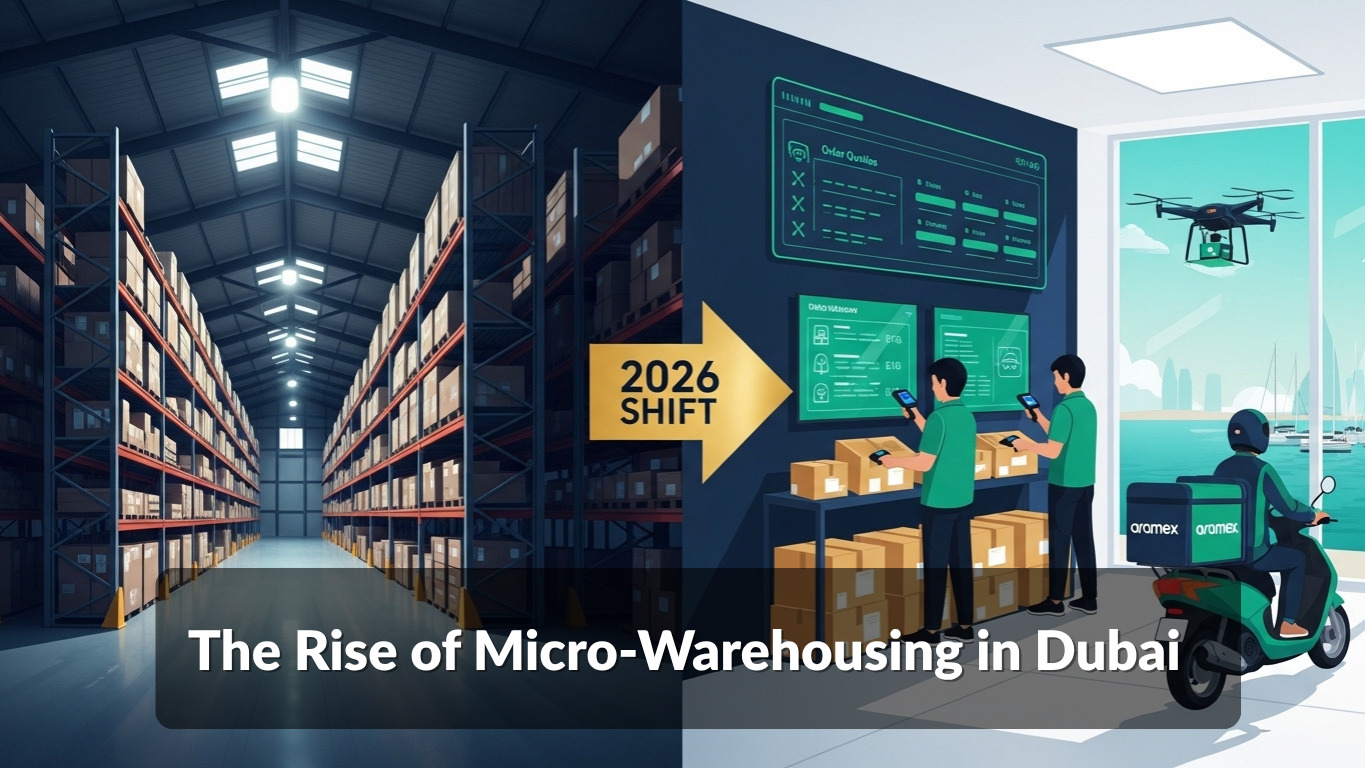
The infrastructure arms race behind sub-30-minute delivery is powered by one thing: micro-fulfillment. The strategic shift from large, centralised warehouses in Jebel Ali and Al Quoz to smaller, technology-enabled storage nodes positioned within 2 to 3 kilometres of high-demand residential clusters. Smaller footprint. Closer to the customer. Faster to pick, pack, and dispatch. Lower last-mile cost per delivery.
For independent Shopify sellers, Amazon marketplace vendors, and growing UAE e-commerce brands, this shift represents the single most important operational decision of 2026: where you store your stock determines how fast you can deliver, and how fast you can deliver increasingly determines whether your customer buys from you or from the platform that can get there in fifteen minutes.
At U.N. Cargo and Logistics, we are evolving our storage solutions to reflect this reality. This guide explains the micro-fulfillment model, the data behind Dubai’s e-commerce delivery revolution, and how smaller sellers can access the same distributed storage infrastructure that the biggest players have been building for years.
1. The Numbers That Are Driving the Micro-Fulfillment Revolution in Dubai
Before examining the operational mechanics of micro-warehousing, it helps to understand the scale and velocity of the market forces creating demand for it. These are not gradual trends. They are structural market shifts happening at exceptional speed.
The UAE e-commerce market is forecast to reach USD 13.8 billion by 2029, growing at a trajectory that makes it the dominant digital commerce market in the MENA region. The UAE e-commerce logistics market was valued at USD 1.67 billion in 2025. (Source: Invest in Dubai / Fortune Business Insights, January 2026)
The Middle East last-mile delivery market was valued at USD 15.64 billion in 2025 and is projected to grow to USD 41.01 billion by 2035, expanding at a CAGR of 10.12%. The UAE leads the region with a 38.5% market share of last-mile delivery in 2025. (Source: Precedence Research, December 2025)
The UAE micro-fulfillment market specifically was valued at USD 74.2 million in 2023 and is forecast to reach USD 460.9 million by 2030, reflecting an astonishing 29.8% CAGR. This makes micro-fulfillment the single fastest-growing segment within the UAE’s entire warehousing and logistics sector. (Source: Ken Research / eSelfStorage UAE, September 2025)
JAFZA reported warehouse occupancy rates surpassing 90% in 2024, with e-commerce and third-party logistics operators driving demand for smaller, modular warehouse units rather than large-format spaces. The consequence of 90%+ occupancy at the main industrial hub is clear: traditional large-format warehousing is no longer the easiest or most cost-effective option for growing e-commerce sellers. (Source: eSelfStorage UAE, September 2025)
Last-mile delivery costs account for up to 53% of total shipping expenses in the UAE market. Micro-warehousing initiatives in Dubai are specifically designed to reduce this disproportionate cost by shortening the final delivery distance. A seller whose stock sits in Jebel Ali delivering to Dubai Marina covers 35 to 45 kilometres per order. A seller whose stock sits in a Marina micro-fulfillment node delivers the same order in under 3 kilometres. The fuel cost, the driver time, the delivery failure rate, and the customer satisfaction score are all transformed by that single location decision. (Source: MarkNtel Advisors, 2026)
2. What Micro-Fulfillment Actually Is (and Is Not)
The term “micro-fulfillment” is used loosely in the Dubai logistics market, and it is worth establishing a precise definition before examining how to use it effectively as an e-commerce seller.
A micro-fulfillment center (MFC) is a small-format, strategically located storage and order-processing facility positioned close to end consumers, typically within 1 to 5 kilometres of a high-density residential or commercial area. It differs from a traditional warehouse in several fundamental ways:
| Feature | Traditional Central Warehouse | Micro-Fulfillment Center |
|---|---|---|
| Location | Industrial zones (Jebel Ali, Al Quoz, JAFZA) | Urban residential areas (Marina, Downtown, JBR, JLT) |
| Footprint | 5,000 to 50,000+ sq metres | 200 to 2,000 sq metres |
| SKU Depth | Thousands to tens of thousands of SKUs | 200 to 2,000 high-velocity SKUs |
| Delivery Radius | City-wide or regional | 1 to 5 kilometres |
| Pick-and-Pack Speed | 30 to 90 minutes (transport distance adds more) | 5 to 15 minutes from order to dispatch |
| Delivery Time | Next-day or same-day (2 to 4 hours minimum) | Sub-30 minutes to 2 hours |
| Lease Cost per sq metre | AED 35 to AED 75 per sq metre per year | AED 90 to AED 120+ per sq metre per year |
| Per-Order Delivery Cost | AED 20 to AED 45 per order (long-distance) | AED 8 to AED 18 per order (short-distance) |
The higher cost per square metre of urban MFC space is the objection most e-commerce sellers raise immediately. It is a legitimate concern, and the answer lies in the math of delivery economics: the reduction in per-order delivery cost more than offsets the premium on storage rent, once order volume reaches the break-even density threshold of approximately 150 to 180 daily orders per node. Below that threshold, traditional warehousing with optimised last-mile routing remains more cost-effective. Above it, micro-fulfillment increasingly wins on both cost and customer satisfaction metrics.
For sellers below the break-even threshold, the answer is not to avoid micro-fulfillment entirely. It is to access shared micro-fulfillment infrastructure rather than operating a dedicated node. This is precisely the model that U.N. Cargo and Logistics offers through our evolving storage in Dubai solutions.
3. The Dubai Micro-Fulfillment Geography: Where It Matters Most
Not all of Dubai is equal when it comes to micro-fulfillment economics. The value of positioning inventory close to the customer depends entirely on where the highest-density, highest-frequency online shoppers are concentrated. Here is the geographic map of micro-fulfillment opportunity in Dubai in 2026:
Dubai Marina and Jumeirah Beach Residence (JBR)
The single highest-value micro-fulfillment zone in Dubai. Dubai Marina has one of the highest population densities in the emirate, with a resident population of approximately 55,000 to 65,000 people concentrated in high-rise towers within a 3 to 4 square kilometre area. The demographic profile is young, high-income, dual-earning, and extremely online. Deliveroo, Talabat, and Noon have all identified Dubai Marina as a priority dark store location, compressing delivery radiuses to 1 kilometre in this corridor. Prime micro-fulfillment real estate in Dubai Marina commands AED 120 per square metre per month in rent at the highest end, reflecting the intensity of competition for well-located urban storage. (Source: Mordor Intelligence, January 2026)
Downtown Dubai and Business Bay
The second major micro-fulfillment priority zone, serving a mix of resident, hotel, and corporate office demand. Downtown Dubai generates high volumes of lunch-hour e-commerce orders and convenience purchases from the daytime working population in addition to its resident base. The DIFC and Business Bay office clusters represent a distinct demand profile: high-value, time-sensitive purchases ordered for same-day delivery to office or hotel.
Jumeirah Lakes Towers (JLT) and DMCC
A major cluster of residential towers and offices with a young professional demographic that mirrors the Marina profile in terms of online shopping behaviour. JLT is slightly less competitive on micro-fulfillment real estate costs than Marina but captures similar demographic demand.
Mirdif, Arabian Ranches, and Dubai Hills
The villa communities of Dubai generate a different but equally valuable micro-fulfillment demand profile. Families in these communities generate high average order values (large grocery baskets, children’s products, household goods) with less frequency than Marina residents, but with high delivery address density within each community. A single micro-fulfillment node serving Arabian Ranches or Dubai Hills can cover thousands of households within a 2 to 3 kilometre radius with consistent delivery times.
Al Barsha and Tecom
The Al Barsha corridor connecting Sheikh Zayed Road to Mall of the Emirates serves a large, diverse resident population at a lower real estate cost than Marina or Downtown. For sellers whose products are priced for the middle-income consumer segment rather than the luxury buyer, Al Barsha and Tecom offer strong demand density at more accessible unit costs.
4. The Shopify Seller’s Problem: Why Your Current Fulfillment Model Is Costing You Sales
If you are a Shopify or WooCommerce seller storing stock in a traditional Jebel Ali or Al Quoz warehouse, here is an honest assessment of the structural disadvantages your current model creates in Dubai’s 2026 e-commerce market:
The Delivery Speed Gap
A Shopify seller with stock in JAFZA delivering to Dubai Marina is 35 to 45 kilometres from the customer. Even with route optimisation, a same-day delivery from JAFZA cannot reach a Marina customer in less than 90 minutes to 2 hours under realistic traffic conditions on Sheikh Zayed Road. During peak hours, that becomes 3 to 4 hours. Meanwhile, a competitor selling the same product via Amazon Now or a Noon-operated dark store delivers in 15 to 30 minutes. The customer did not choose the competitor because of price. They chose them because the speed difference was simply too large to ignore.
The Delivery Failure Rate
Every kilometre of additional last-mile distance increases the statistical likelihood of a delivery failure: a driver who cannot find the address, a customer who is no longer home, a traffic delay that pushes delivery past the expected window. Failed deliveries in the UAE cost an average of AED 15 to AED 25 per attempt in redelivery costs, and they generate the customer service conversations and negative reviews that disproportionately damage smaller Shopify brands. A micro-fulfillment model with a 2 to 3 kilometre delivery radius and a 15 to 30 minute window dramatically reduces the variables that cause failures.
The Cart Abandonment Connection
Research consistently shows that estimated delivery time is a primary driver of cart abandonment in markets where fast delivery is available. In the UAE, where over 75% of all purchases are completed on smartphones and consumers are conditioned by Amazon Prime and Noon Express to expect sub-24-hour delivery, a checkout page that shows “3 to 5 working days” loses a meaningful share of potential conversions to alternatives that show “delivered today.” (Source: Brightery, January 2026) This is a revenue impact that never shows up in your logistics cost analysis but is real and measurable.
The Working Capital Concentration Risk
A single large warehouse holding all your inventory in one location creates concentration risk beyond just delivery speed. A fire, a flood, a lease termination, or a JAFZA occupancy issue can immediately halt all sales. Distributed micro-fulfillment across two to three urban nodes means no single point of failure can zero your entire inventory position.
5. The Three Models for Accessing Micro-Fulfillment as an Independent Dubai Seller
Not every e-commerce seller can or should build their own network of urban dark stores. The investment, operational complexity, and fixed cost commitment of dedicated micro-fulfillment facilities is appropriate only for sellers with very high order volumes and established brand infrastructure. For the growing middle tier of Dubai’s e-commerce market, three models offer practical micro-fulfillment access:
Model 1: Shared Urban Storage with a 3PL Provider
The most accessible model for independent sellers. A third-party logistics provider (3PL) maintains shared micro-fulfillment space in multiple Dubai urban zones, and individual sellers stock their fastest-moving SKUs within the shared facility. Orders are picked, packed, and dispatched by the 3PL’s team, with each seller paying only for the space their inventory occupies plus a per-order handling fee.
This model eliminates the fixed cost of dedicated space while providing the delivery speed advantage of urban proximity. The key requirement is that you identify your high-velocity SKUs accurately, the 20% of products that account for 80% of your order volume, and position only those SKUs in the urban micro-fulfillment node. Slow-moving stock continues to be held in lower-cost central storage. This hybrid model captures the speed benefit for your most frequently ordered products while keeping your average storage cost under control.
Our storage in Dubai solutions at U.N. Cargo and Logistics are evolving toward exactly this model, providing Shopify and Amazon sellers with flexible, shorter-term urban storage options integrated with our broader import, customs clearance, and distribution network.
Model 2: Platform-Operated Fulfillment Programs
For sellers operating primarily on Amazon UAE or Noon, the platforms’ own fulfillment programs (Fulfilment by Amazon and Noon Fulfillment) provide access to micro-fulfillment infrastructure without requiring any direct real estate relationship. Amazon UAE’s 2025 Abu Dhabi fulfillment center, handling up to 8 million units across 30+ categories, and the Noon-ADNOC fuel station micro-hub network both represent platform-owned infrastructure that enrolled sellers can leverage for faster delivery without any operational investment beyond the platform fulfillment fees.
The trade-off is platform dependency: your brand experience, customer data access, and margin structure are all governed by the platform’s terms. For sellers building an independent brand on Shopify alongside a marketplace presence, a hybrid approach that uses platform fulfillment for marketplace orders and an independent 3PL for direct-to-consumer orders provides the best of both models.
Model 3: Dark Store Partnerships with Last-Mile Delivery Platforms
For sellers in specific product categories, particularly FMCG, beauty, and personal care, negotiating stocking agreements with existing dark store operators (Talabat tMart, Careem Now, Deliveroo editions) provides instant access to their micro-fulfillment network without any warehousing investment at all. The seller supplies product to the dark store, and the platform handles storage, picking, packing, and delivery within its own network.
This model is most appropriate for products with very high sale frequency and relatively low SKU complexity. A beauty brand with five to ten top-selling products is a good fit for dark store partnership. A fashion seller with hundreds of SKU variants in multiple sizes and colours is not.
6. What to Store Where: The SKU Velocity Framework
The most common mistake e-commerce sellers make when transitioning to a distributed storage model is trying to move too much inventory into urban micro-fulfillment nodes. Urban storage space is expensive. Storing slow-moving SKUs in AED 120-per-sqm Marina space while they wait weeks between orders is a guaranteed way to make the economics of micro-fulfillment not work. The discipline of SKU velocity analysis is the foundation of a profitable distributed storage model.
Here is the framework:
Tier 1 SKUs: Urban Micro-Fulfillment
Products that account for the top 20% of order volume and that are ordered repeatedly by the same customers or by predictable demand patterns. These SKUs justify urban micro-fulfillment storage because they generate daily or near-daily order velocity from the same geographic clusters. Examples: your bestselling product variant, seasonal top performers during active season, bundled starter kits, and consumables with high repeat purchase rates.
Hold 7 to 14 days of demand coverage for Tier 1 SKUs in your urban node. Replenish from your central storage facility as the stock level drops to a pre-defined reorder point. The replenishment run from central to urban storage should happen at least twice a week for high-velocity SKUs to avoid urban stockouts.
Tier 2 SKUs: Central Warehousing with Rapid Replenishment
Products that sell regularly but not daily from any single geographic cluster. These SKUs are held at your central warehousing location (Jebel Ali, Al Quoz, or JAFZA) and shipped same-day or next-day to customers. The delivery promise for these products is 4 to 24 hours rather than sub-30 minutes, which remains competitive for the majority of non-urgency product categories.
Tier 3 SKUs: Long-Term Storage
Slow-moving SKUs, seasonal inventory out of season, and product ranges awaiting activation. These are held in the most cost-effective storage format available: large-format industrial warehousing in Jebel Ali or a self-storage unit for smaller quantities. No premium urban storage cost is incurred for products that do not generate the order velocity to justify it.
This three-tier SKU velocity framework is the operational core of a profitable micro-fulfillment model. Our team at U.N. Cargo builds this analysis with every e-commerce client before recommending a storage configuration, ensuring that urban storage spend is generating a measurable return in delivery speed and customer satisfaction rather than simply adding a cost layer to a slow-moving inventory position.
7. The Technology Stack That Makes Micro-Fulfillment Work
Distributed inventory across multiple storage nodes creates a new operational challenge: visibility. When your stock is in one place, knowing what you have is simple. When it is across three urban nodes and a central warehouse, real-time inventory visibility is not optional. It is the operational foundation of the entire model.
Here is the minimum viable technology stack for a Dubai e-commerce seller operating a distributed storage model in 2026:
Inventory Management System (IMS) with Multi-Location Support
Your Shopify or WooCommerce store must be connected to an inventory management system that tracks stock levels across all storage locations in real time and updates your online store’s available quantities accordingly. Selling a product on your website that is out of stock at the micro-fulfillment node closest to the customer’s address, and then fulfilling it from a central location, defeats the purpose of the distributed model entirely. Platforms including Linnworks, Cin7, and Skubana provide multi-location IMS capabilities that integrate directly with Shopify.
Order Routing Logic
When a customer in Dubai Marina places an order, your system must automatically identify the nearest micro-fulfillment node that has the required SKU in stock and route the pick-and-pack instruction to that location. This routing logic, simple in concept but requiring careful configuration, is what converts a distributed storage network into a genuine micro-fulfillment capability rather than just a collection of warehouses.
Last-Mile Delivery Integration
Your urban micro-fulfillment node must have an established, real-time connection to your last-mile delivery partner. In Dubai, the major last-mile platforms including Aramex Last Mile, Fetchr, Quiqup, and Lalamove provide API integrations that allow instant booking of a delivery rider at the moment an order is dispatched from the fulfillment node. The moment your picker scans the last item into a sealed bag, a rider should already be en route to the node. This tight integration between pick-and-pack and dispatch is what closes the gap between “order received” and “out for delivery” to under ten minutes.
Demand Forecasting
The data intelligence that prevents stockouts at urban nodes while preventing over-investment in urban storage. AI-based demand forecasting tools, including those available natively in Shopify Plus or through integrations like Inventory Planner, analyse historical order data, seasonality, promotional calendars, and geographic demand patterns to recommend optimal stock levels for each SKU at each location. The platforms are increasingly deploying predictive inventory algorithms that pre-position high-velocity SKUs within 2 to 3 kilometres of dense residential clusters, trimming delivery windows to 10 minutes. (Source: Mordor Intelligence, January 2026)
8. The Cost Model: Does Micro-Fulfillment Actually Save Money?
This is the question every seller asks, and the honest answer is: it depends on your order volume, your product value, and your current last-mile delivery costs. Here is a worked example that reflects realistic Dubai market conditions in 2026:
Model A: Traditional Central Warehousing (JAFZA)
Storage cost: AED 50 per sq metre per month x 100 sq metres = AED 5,000 per month
Last-mile delivery cost per order (35km average): AED 30
Daily delivery cost (100 orders): AED 3,000
Monthly delivery cost: AED 90,000
Delivery failure rate (estimated at 8% for long-distance): 8 failed deliveries per day x AED 20 redelivery = AED 1,600 per day / AED 48,000 per month
Total monthly logistics cost: AED 143,000
Model B: Urban Micro-Fulfillment (Dubai Marina node, shared 3PL)
Urban storage cost: AED 110 per sq metre per month x 30 sq metres (Tier 1 SKUs only) = AED 3,300
Central storage for Tier 2 and 3: AED 50 x 70 sq metres = AED 3,500
Total storage: AED 6,800
Last-mile delivery cost per order (3km average): AED 12
Daily delivery cost (100 orders): AED 1,200
Monthly delivery cost: AED 36,000
3PL pick-and-pack fee: AED 5 per order x 3,000 orders = AED 15,000
Delivery failure rate (estimated at 2% for short-distance): 2 failures per day x AED 20 = AED 40 per day / AED 1,200 per month
Total monthly logistics cost: AED 59,000
Estimated monthly saving with micro-fulfillment: AED 84,000
Note: This example is illustrative and based on indicative market rates. Individual results depend on product weight, actual order volume, carrier rates negotiated, and specific storage location costs. U.N. Cargo provides a customised cost model for every e-commerce client before recommending a storage configuration.
The math changes significantly at lower order volumes. At 20 daily orders, the per-order economics of dedicated urban micro-fulfillment are less favourable. At 50 daily orders from a specific geographic cluster, shared 3PL micro-fulfillment is broadly neutral. Above 100 daily orders from a concentrated delivery zone, the savings compound rapidly. This is why the break-even density threshold of approximately 150 to 180 daily orders per node is cited consistently across market research as the commercial trigger point for dedicated micro-fulfillment investment. (Source: Mordor Intelligence, January 2026)
9. Importing Your Inventory: The Link Between International Freight and Micro-Fulfillment
For e-commerce sellers sourcing products from China, Europe, or other international origins, the micro-fulfillment model creates a specific import logistics question: how do you efficiently move inventory from its international origin through customs and into multiple urban storage nodes without creating a costly and complex distribution bottleneck?
The answer is a hub-and-spoke import model that U.N. Cargo and Logistics manages as an integrated service:
- International freight to Jebel Ali: Your goods arrive by sea freight or air freight into Dubai as a single consolidated shipment, maximising your buying power with carriers and minimising per-unit freight cost.
- Customs clearance at Jebel Ali: Our customs clearance team processes your import declaration, duty payment, and document verification as a standard integrated step. Because we manage both the freight and the clearance, there is no handover gap between the carrier and the customs broker that delays clearance and burns free days.
- Central receiving and quality check: Goods are received at our central storage facility, inspected against the purchase order, photographed for condition documentation, and entered into the inventory management system.
- Urban distribution runs: Two to three times per week, our team runs replenishment from central storage to each active urban micro-fulfillment node, based on the reorder point triggers generated by the inventory management system. This scheduled distribution run keeps urban nodes stocked without requiring daily management from the seller.
- Returns processing: Returned items from urban delivery failures or customer returns flow back to central storage for inspection, re-packaging where applicable, and return to inventory or disposal as required.
The entire chain from factory in Shenzhen to same-day delivery in Dubai Marina is managed through a single logistics partner. No coordination gaps. No system mismatches. No stock sitting in Jebel Ali waiting for someone to move it to where the customer actually is.
10. Your Micro-Fulfillment Launch Checklist for Dubai 2026
- ✅ Run a SKU velocity analysis: Identify your top 20% of SKUs by order volume and map them to your top three delivery postcodes or community clusters. These are your Tier 1 micro-fulfillment candidates
- ✅ Calculate your current last-mile cost per order: Get the actual per-delivery cost from your current courier and multiply by your monthly order volume. This is your baseline
- ✅ Model the micro-fulfillment break-even: Use the framework above to calculate whether your current or projected order volume crosses the break-even threshold for shared 3PL micro-fulfillment
- ✅ Identify your primary delivery zone: Which 3 to 5 Dubai communities generate the highest concentration of your orders? The answer determines which urban node location delivers the most value
- ✅ Audit your inventory management system: Confirm that your current IMS supports multi-location stock tracking. If it does not, this is the first infrastructure investment to make before establishing distributed storage
- ✅ Evaluate shared vs. dedicated node options: Below 100 daily orders, shared 3PL urban storage almost always beats dedicated space on cost. Above 150 daily orders from a single zone, dedicated micro-fulfillment begins to offer cost and service advantages
- ✅ Integrate last-mile delivery API: Ensure your order management system can trigger an instant delivery booking from your urban node the moment a pick-and-pack is completed
- ✅ Set urban node reorder points: Define the stock level at which each Tier 1 SKU triggers an automated replenishment instruction from central storage. Never manage this manually
- ✅ Review your import and customs setup: Confirm that your international freight and customs clearance is structured to deliver goods efficiently to a central hub for urban distribution, not directly to multiple urban locations which creates clearance complexity
- ✅ Talk to U.N. Cargo: Our team builds the import-to-last-mile logistics plan as a single, integrated model for Dubai e-commerce sellers. The conversation starts with your current order volume, your SKU profile, and your delivery data
The Sellers Who Win in Dubai’s 2026 E-Commerce Market Store Closer
The distance between your inventory and your customer is the distance between winning and losing in Dubai’s 2026 e-commerce market. It is not the only factor, but when Amazon Now delivers in 15 minutes and you deliver in 3 to 5 days, no amount of product quality, brand story, or price competitiveness closes that gap in the customer’s decision moment.
Micro-fulfillment is not a technology play available only to large enterprises with warehouse robotics budgets. It is a storage strategy that independent Shopify sellers, Amazon vendors, and growing UAE e-commerce brands can access today through shared 3PL models, platform fulfillment programs, and integrated import-to-last-mile logistics partnerships.
U.N. Cargo and Logistics is building the infrastructure to support this transition for our e-commerce clients. From international freight and customs clearance through central receiving and urban distribution, we manage the chain that turns a product in a Chinese factory into a same-day delivery in Dubai Marina.
Explore Our E-Commerce Storage Solutions in Dubai → |
Sea Freight from China and Europe → |
Air Freight for Fast Restocking → |
Customs Clearance for E-Commerce Imports → |
E-Commerce Packaging Services →
References
- Precedence Research: Middle East Last-Mile Delivery Transportation Market Size to Hit USD 41.01 Billion by 2035 (December 2025): https://www.precedenceresearch.com/middle-east-last-mile-delivery-transportation-market
- Brightery: Dubai E-Commerce 2026, Seizing Your Share of the USD 13.8 Billion Market (January 2026): https://www.brightery.com/en/post/ecommerce-in-dubai
- MarkNtel Advisors / PRNewswire: UAE Quick Commerce Market to Grow at a CAGR of 3.72% During 2026-2032 (March 2026): https://www.prnewswire.com/news-releases/uae-quick-commerce-market-to-grow-at-a-cagr-of-3-72-during-20262032–driven-by-rising-demand-for-ultra-fast-delivery-and-digital-retail-expansion–markntel-advisors-302710855.html
- MarkNtel Advisors: UAE Quick Commerce Market Growth Trends and Opportunities 2032: https://www.marknteladvisors.com/research-library/quick-commerce-market-uae.html
- Mordor Intelligence: UAE Quick Commerce Market Size and Trend Analysis 2031 (January 2026): https://www.mordorintelligence.com/industry-reports/q-commerce-industry-in-uae
- Nexdigm: UAE Last-Mile Delivery Market, Size, Share and Revenue (2026): https://www.nexdigm.com/market-research/report-store/uae-last-mile-delivery-market/
- PS Market Research: GCC Last-Mile Delivery Market Size, Share and Trends Analysis 2032: https://www.psmarketresearch.com/market-analysis/gcc-last-mile-delivery-market-report
- Ken Research: UAE Micro Market 2019 to 2030 (January 2026): https://www.kenresearch.com/united-arab-emirates-micro-market
- eSelfStorage UAE: E-Commerce Growth and Micro-Warehousing in UAE, Storage Impact (September 2025): https://eselfstorageuae.com/ecommerce-growth-micro-warehousing-uae-storage-unit-sizes/
- Fortune Business Insights: E-Commerce Logistics Market Size, Share and Global Report 2034: https://www.fortunebusinessinsights.com/e-commerce-logistics-market-107945
- Invest in Dubai: E-Commerce Report in the MENA Region 2024 (Dubai E-Commerce Forecast): https://www.investindubai.gov.ae